How to get more gym members: leads needed and cost per member
GuideBy Elara team · Updated · 9 min read
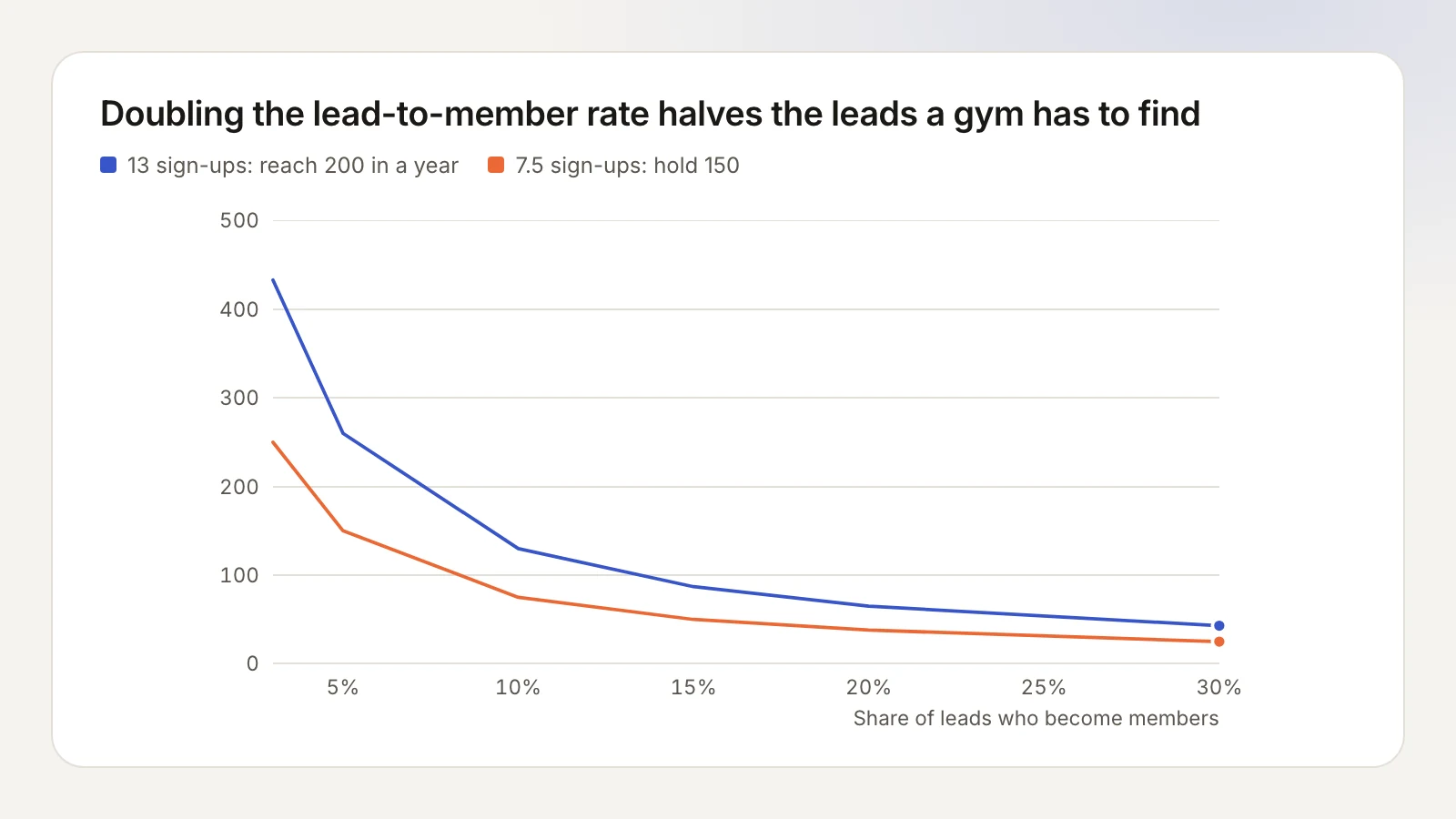
Work out how many sign-ups you need, divide by your lead-to-member rate to get the leads that takes, then fill that number from the channels that cost least per joined member. In the hypothetical gym below, 13 sign-ups a month takes 260 leads at a 5% lead-to-member rate and 65 at 20%. At LocaliQ's average Facebook cost per lead for health and fitness, that is $542 or $136 a member, against the $171 a sign-up that a budget of 9% of member revenue allows.1 So fix follow-up before buying leads, work referrals and former members next, and let paid ads fill what is left.
This is for owners of class gyms and fitness studios in the US and Canada.
Work out how many leads you need
Take a hypothetical gym with 150 members, 5% monthly churn and a target of 200 members in 12 months. The arithmetic in how many new members a gym needs gives 7.5 sign-ups a month to hold 150 and 13 a month to reach 200. Former members who rejoin count toward both numbers.
A lead is anyone who gives you a name and a way to reach them. Leads needed = sign-ups ÷ lead-to-member rate:
Doubling the lead-to-member rate halves the leads a gym has to find
Leads needed a month for the example gym, by the share of leads who become members.
- 13 sign-ups: reach 200 in a year
- 7.5 sign-ups: hold 150
Leads needed a month
Example gym: 150 members and 5% monthly churn. Leads rounded to the nearest whole lead.
Show the numbers
| Share of leads who become members | 13 sign-ups: reach 200 in a year | 7.5 sign-ups: hold 150 |
|---|---|---|
| 3% | 433 | 250 |
| 5% | 260 | 150 |
| 10% | 130 | 75 |
| 15% | 87 | 50 |
| 20% | 65 | 38 |
| 30% | 43 | 25 |
Use a rate that counts what yours counts
Published rates run from 3% to 73%. The widest gaps come from where each one starts counting, and rates that start at the same lead still differ by vendor, lead type and method, much of it unstated. Compare your number only with one that starts where yours does, and treat even that as a rough guide.
| Published rate | What it counts | Basis |
|---|---|---|
| 3 to 6 in 100 | Paid digital leads who become members | Keepme, a fitness software vendor: 5% to 11% book, about 75% attend, about 75% sign. No sample given |
| About 10%, or 16% to 20% | Paid leads who become members, across the industry and at boutique gyms with a tight sales process | PushPress, a gym software vendor. No source given |
| 7% to 8% by text, about 4% by email | Leads who become members, by how they were contacted | ASF and Club OS customer data, 2022. No sample given |
| 41% | Referrals sent who sign up | Glofox: 92,000 sign-ups from 224,000 referrals in 2025. Does not say whether a sign-up means a paying member |
| 73% | Real free trials that become paying members | Gymdesk: 175,000 trials in its 2026 report on martial arts and combat sports gyms |
The rate rises the closer to a purchase the count begins. To measure your own, count the leads each channel brought in a month and how many became members within 60 days. In Gymdesk's trials, nine in ten of those who converted had done so by day 60.
See where the leads go
The rate is the product of the stages inside it. This hypothetical funnel uses PushPress's typical stage rates: 50% of contacted leads book, 50% of those show and 60% of those join.2 It assumes the gym replies to 70% of leads, which is generous: when Keepme sent real inquiries to 45 fitness brands, 57% got no reply.3
Of 100 leads, the example gym signs 10.5 and loses 65 before anyone books
Replies to 70%, 50% of those book, 50% of those show, 60% of those join.
- Takes away
- Total
Leads out of 100
Hypothetical funnel. Booking, show and join rates are PushPress's typical table values; the 70% reply rate is assumed.
Show the numbers
| Stage | Change | Running total |
|---|---|---|
| Leads | 100.0 | |
| Never get a reply | −30.0 | 70.0 |
| Reply but do not book | −35.0 | 35.0 |
| Book but do not show | −17.5 | 17.5 |
| Show but do not join | −7.0 | 10.5 |
| Join | 10.5 |
Because the stages multiply, raising any stage by a given share raises joins by that share, so start with the stages that cost least to change. Replying to every lead, and getting through to each one, takes the rate from 10.5% to 15%. Lifting the show rate to 75%, which PushPress puts within reach of a well-run process, takes it to 15.75%. Doing both gives 22.5% on paper, but that is above the 16% to 20% PushPress reports for boutique gyms with a tight sales process, so plan on 20% at best. For the same 13 sign-ups, a 20% gym needs 65 leads a month instead of 124, and spends $1,762 on Facebook leads instead of $3,356.
Speed is the easiest of these to check. Keepme measured average replies of 4 hours by email, 17.5 hours on Facebook and 37 hours on Instagram.3 In a Zenoti survey of 1,393 current and former members, 63% had decided to join before booking a tour or trial,4 so a slow reply can lose someone who only needed a time to come in. Gymdesk's gyms converted 85.4% of trials with software follow-up and 70.8% with owner follow-up by hand, which Gymdesk calls a correlation, not a guaranteed result.5
Set what a sign-up can cost
Most owners have no number to test a channel against: 74.8% of owners in Gymdesk's 2024 survey did not know what a new member cost them.6 Set one from what operators spend:
- Planet Fitness requires 9% of dues across local marketing and its national fund: 7% and 2% through 2025, and 6% and 3% for 2026.7
- PushPress puts ad spend at 3% to 5% of gross monthly revenue.2
Budget on what members actually pay, not the posted price. Say the example gym's 150 members bring in $165 a month on average, about the middle of the $149 to $180 a member that franchisors' disclosures show in our gym pricing guide. That is well below the $209 median posted for unlimited by the class gyms we read. It is also revenue per member, including packs, retail and intro offers, so dues alone run lower and the budgets here lean high. Member revenue is $24,750 a month. A 9% budget is $2,228, or $171 for each of 13 sign-ups; 5% is $1,238, or $95. Change the $165 and the Facebook break-even in the chart below moves too: 17.5% at $149, 14.5% at $180 and 12.5% at the posted $209.
Those are budgets, not limits. At 5% churn a member stays 20 months on average and brings in $3,300 before costs, so $542 for a member is paid back in about three and a half months. A higher cost can still be worth paying when the gym has the cash to carry it. The budget sets how fast you can buy members; what a member pays you sets the most you should pay for one.
Cost per joined member = cost per lead ÷ lead-to-member rate. For the two paid channels with published health and fitness figures:
At average ad costs, a 9% budget buys Facebook leads only above a 15.8% rate
Ad cost per joined member at LocaliQ's health and fitness averages. Search stays above $171 until 39%.
- Search ads, $67.36 a lead
- Facebook ads, $27.11 a lead
Ad cost per joined member
LocaliQ 2026 Health & Fitness averages. Budget lines: 13 sign-ups on $24,750 of monthly revenue, $165 a member. Ad cost only, before offers or staff time.
Show the numbers
| Share of leads who become members | Search ads, $67.36 a lead | Facebook ads, $27.11 a lead |
|---|---|---|
| 3% | $2,245 | $904 |
| 5% | $1,347 | $542 |
| 10% | $674 | $271 |
| 15% | $449 | $181 |
| 20% | $337 | $136 |
| 30% | $225 | $90 |
These averages come from LocaliQ's own customers,8 across a category wider than gyms, and a lead there can be any form, call or chat, not a qualified prospect. Treat them as a starting estimate until you have three months of your own. A person searching for a class near them may also convert better than one who filled in a Facebook form, which is why each channel needs its own rate.
Rank your channels by cost per joined member
We found no cost per joined member by channel published with a stated method, so this table says what to divide for each one. The nearest published count of where members come from is Gymdesk's 2024 owner survey, with no sample size given: 71.3% named referrals, 69.6% online search, 50.8% social media and 25.4% paid ads.6
| Channel | Cost per joined member | What limits it |
|---|---|---|
| Leads you already have | Staff time to reply and remind | Staff hours at the times leads arrive |
| Former members | Email, plus any return offer | The list: this gym loses 7.5 members a month, about 90 a year |
| Referrals | The reward, paid only when someone joins. Glofox suggests $20 to $40 a side, so $40 to $80 | How many members will refer: 3 joins a month takes about 7 referrals at Glofox's 41%, or one member in 20 |
| Local search and reviews | Your hours, priced at what you pay staff | How many people nearby search for what you teach |
| Partnerships and events | Everything the event costs ÷ members who join from it | Your time, and whether a nearby business will host you |
| Facebook and Instagram ads | Cost per lead ÷ your rate from ads | Audience size within reach of your gym |
| Search ads | Cost per lead ÷ your rate from search | Searches in your area |
Referrals earn their place near the top: in Zenoti's survey, 67% of members said they joined through a recommendation.9 Add what an intro offer costs to any channel that uses one. Intro offer pricing works that out and shows why intro buyers belong in classes with empty places. Win-back of members who stopped coming is covered in gym member retention.
Fill the number from the cheapest channel up
Here is one hypothetical month for the example gym, with every count assumed. Follow-up is fixed, so paid leads convert at 20%, the top of PushPress's range, and cost about $136 a member.
| Source | Sign-ups | Cost per member | Monthly cost |
|---|---|---|---|
| Former members | 2 | $0 | $0 |
| Local search, reviews and walk-ins | 3 | $0 in cash | $0 |
| Referrals | 3 | $60 | $180 |
| Facebook ads | 5 | $135.55 | $678 |
| Total | 13 | $65.98 | $858 |
That is 3.5% of member revenue. At 16%, the bottom of that range, Facebook costs $169 a member, right at the $171 line, and the month costs $1,027, or 4.2%. Buying all 13 from Facebook with the funnel unfixed costs $3,356, or 13.6%. The split will differ for every gym; the method is what carries over. Fill from the top of your ranking, then buy only the remainder.
Three checks before you raise spending:
- The next lead costs more than the average. A small area runs out of cheap leads, so increase ad spend in steps and recalculate cost per joined member each time.
- New members need places. If classes at the times they want are full, more leads add waitlists, not members. The timetable caps the count, as the member ceiling explains.
- Churn may be cheaper. A one-point churn cut does about the same work as two more sign-ups a month for this gym. At the $258 a member that Facebook costs with the funnel unfixed, that is $516 a month you could spend on keeping members instead.
Track leads and joins in Elara
Add each enquiry to Elara as a Lead and give it a tag for its channel and month, such as facebook-2026-11. A lead needs an email address to be added, so someone who leaves only a phone number stays on your own list until you have one. The booking widgets have no enquiry form and Elara has no lead list import, so staff add ad leads one at a time. A lead becomes a customer when it first buys a membership or credit pack, at the point of sale or online, or when staff add one to its profile.
The customer list has no date filter, so a tag with no month in it gives an all-time count. Filter by a dated tag to see that month's leads, add the Customers type to see who joined, and divide the month's spend by those joins. Type shows a join only for records added as a Lead: bring-a-friend guests and online sign-ups start as customers with no purchase, so a friend you tag as a referral reads as a join until you check for a membership or pack.
The Referral Report on the Customers tab of Reports groups website widget traffic by the site a visitor came from, with bookings, checkouts and signups for each. It shows only under all locations, so a manager limited to one location will not see it. It counts widget activity, not memberships, and a visitor who browsed your own site first shows your site as the source. The Marketing tab credits bookings and revenue to email campaigns only.
For referrals, members can bring a friend to a class from checkout, and each friend takes a place and has a customer record. Elara does not track or pay referral rewards, so staff give them by hand, for example as comp credits. For former members, a win-back automation emails customers who have stopped coming and accept marketing email. Elara sends email only and has no automatic reminder before a booked session, so the reminders that lift show rate, and any text or phone follow-up, happen outside it.
The marketing page shows how audiences and campaigns work. Elara is sold by quote: ask for a quote and tell us how you track leads today.