How many new members a gym or studio needs: the ceiling churn sets
GuideBy Elara team · Updated · 5 min read
To hold its member count, a studio has to sign as many new members each month as churn takes away: members times the monthly churn rate. Holding 150 members at 5% churn takes 7.5 sign-ups a month just to stand still. Turned around, a studio that signs the same number every month levels off at that number divided by its churn rate, wherever it starts: ten sign-ups a month at 5% churn stop at 200 members. The approach to that ceiling is slow: at 5% a month, the count closes nine-tenths of the gap in about 45 months. So work out sign-ups from the member count you want and the churn you have, and treat a lower churn rate as a higher ceiling, not a quick gain.
Holding the base takes churn times members
Churn here is the share of the members at the start of a month who are gone by its end. A studio at 150 members loses 150 × churn each month, and has to sign that many to stay level:
- at 3%, 4.5 a month;
- at 5%, 7.5 a month;
- at 8%, 12 a month.
Two US club operators have published their rates. Life Time reported annual attrition of 35.2% for 2014, a year's terminations divided by its average monthly membership, which is about 2.9% a month.1 Town Sports International reported a monthly average attrition rate of 4.1% for 2019 and 2018.2 Both run large clubs. Class studio brands lose more: their franchise disclosure documents put average monthly attrition at 5.9% for Pure Barre3 and 8.8% for Rumble.4 The gym member retention guide sets six such brands side by side, with how each defines the rate.
The ceiling is sign-ups divided by churn
Each month the studio loses a share of its members and adds its new ones. Losses grow with the member count; sign-ups do not. The count stops rising when the two match, at sign-ups ÷ churn. A studio that grows past that point loses more members than it signs and shrinks back.
Halving churn doubles the members 10 sign-ups a month can hold
The member count a studio levels off at when it signs 10 new members a month.
Members it levels off at
Life Time: 35.2% a year in 2014, about 2.9% a month. Pure Barre 2025 and Rumble 2024: brand averages, Item 19 of their 2026 and 2025 disclosure documents.
Show the numbers
| Share of members leaving a month | 10 new members a month |
|---|---|
| 2% | 500.0 |
| 3% | 333.3 |
| 4% | 250.0 |
| 5% | 200.0 |
| 6% | 166.7 |
| 7% | 142.9 |
| 8% | 125.0 |
| 9% | 111.1 |
| 10% | 100.0 |
Scale it to your own sign-ups: 20 a month gives twice each figure. The rule also works backward. A studio that wants 300 members at 6% churn needs 18 new members every month to hold them once it gets there.
Two sign-ups or a point of churn: both arrive slowly
The gap between today's count and the ceiling shrinks by the churn rate each month. At 5% a month the gap loses a twentieth of itself every month, and the count gets nine-tenths of the way after 45 months. At 3% that takes 76 months; at 8%, 28. Lower churn means a higher ceiling reached more slowly.
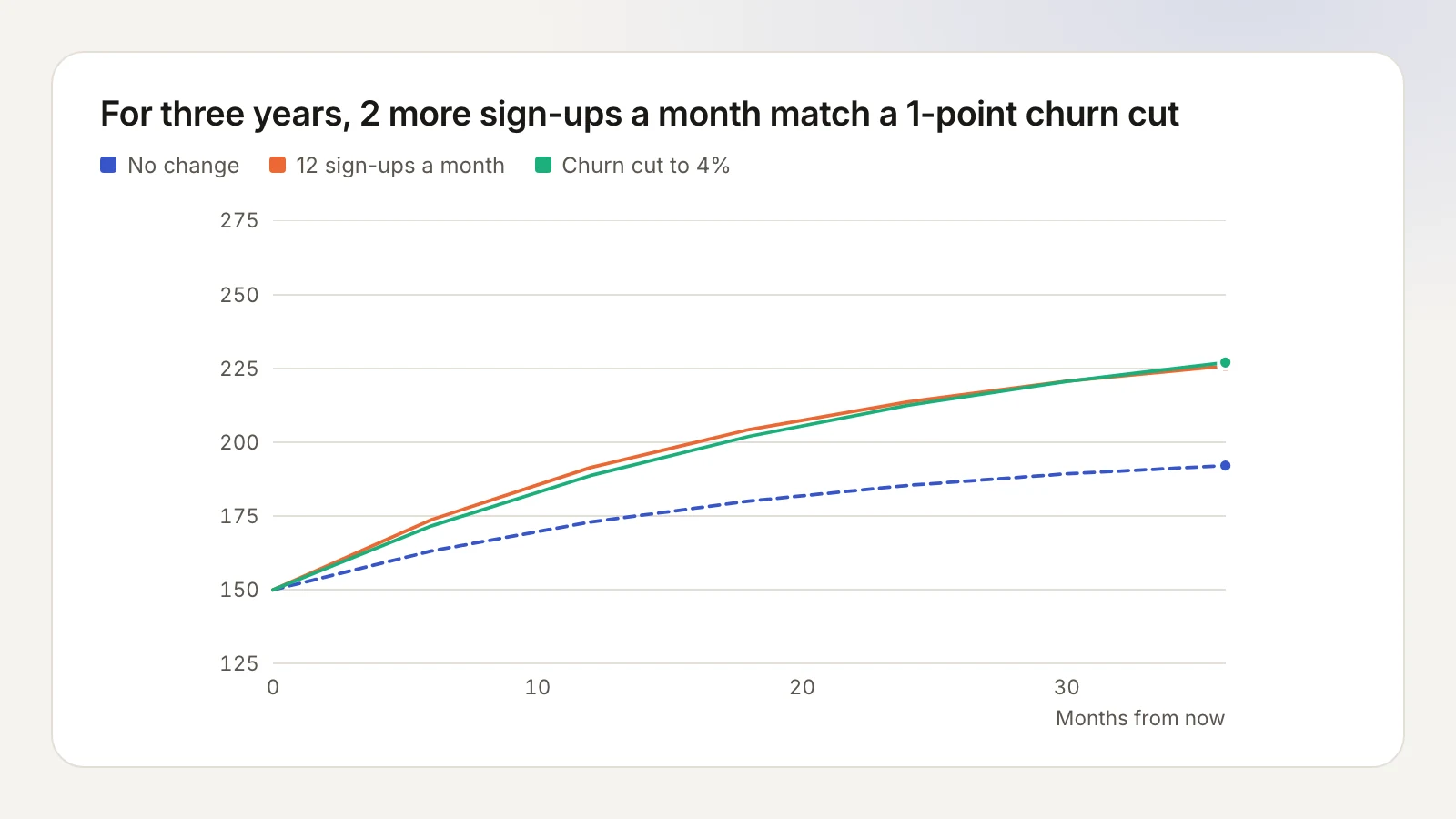
This hypothetical studio has 150 members, signs 10 a month and loses 5%. Its ceiling is 200. Compare two changes: signing two more members a month, or bringing churn down to 4%.
For three years, 2 more sign-ups a month match a 1-point churn cut
Example studio with 150 members today, signing 10 a month and losing 5% a month.
- No change
- 12 sign-ups a month
- Churn cut to 4%
Members
Each month the studio loses 5% (or 4%) of the members it started the month with, then adds its sign-ups.
Show the numbers
| Months from now | No change | 12 sign-ups a month | Churn cut to 4% |
|---|---|---|---|
| 0 | 150.0 | 150.0 | 150.0 |
| 6 | 163.2 | 173.8 | 171.7 |
| 12 | 173.0 | 191.4 | 188.7 |
| 18 | 180.1 | 204.3 | 202.0 |
| 24 | 185.4 | 213.7 | 212.5 |
| 30 | 189.3 | 220.7 | 220.6 |
| 36 | 192.1 | 225.8 | 227.0 |
After a year, the extra sign-ups leave the studio with 191 members and the churn cut with 189. After three years, 226 and 227. The two only separate in the long run: the churn cut levels off at 250, the extra sign-ups at 240. The match is no coincidence. A point of churn keeps one member in a hundred each month, so it is worth 1.5 sign-ups a month at 150 members and 2 at 200, the count both lines pass in their second year, and more as the base grows. Price a retention effort worth a point of churn against what two extra sign-ups a month would cost you.
Sign-ups needed to reach a target by a date
To reach a target T in H months from N members today at churn c, the studio needs
sign-ups a month = c × (T − N × (1 − c)^H) ÷ (1 − (1 − c)^H)
From 150 to 200 members in 12 months at 5% churn: (1 − 0.05)^12 = 0.540, so 0.05 × (200 − 150 × 0.540) ÷ (1 − 0.540) = 12.9, about 13 a month. That is well above the 10 a month that holds 200 once the studio is there, because at 10 it would never quite arrive. At 3% churn the same target takes 9.4 a month; at 8%, 18.3.
What the arithmetic leaves out
The model gives every member the same chance of leaving each month. If newer members leave faster than long-standing ones, the rate you measure today depends on how many new members you have: a base of mostly long-standing members measures a low rate and overstates the ceiling, and a young base full of recent sign-ups measures a high rate and understates it. So measure the churn of members in their first three months separately: the gym member retention guide shows how to build that from monthly exports of the Memberships list. Other things the formula does not hold:
- Returning members count as sign-ups. A former member who rejoins adds to the count as surely as a new one.
- Pauses are neither. A paused member is not paying, so keep pauses out of both churn and the count.
- The timetable caps the count. A ceiling of 300 means little if the classes hold the visits of 220.
- Sign-ups move with the seasons. Use a 12-month average, not January's.
Read churn and sign-ups from Elara
Elara's Memberships report gives the three inputs, and the gym member retention guide explains what each one counts. Current members shows today only, so record it on the first of each month as that month's starting count. When the month closes, record its Churned, since a past range's figure can change later, and its New Members.5 New Members leaves out former members who rejoined, and no report counts them. To add them, export the Memberships list, which includes ended memberships with their start and end dates, and count the customers who started a membership that month after a gap since their last one ended.
A month's churn is that month's Churned divided by the Current members you recorded on the first. Two things bend it. A pack holder who uses up their last pack drops out of Current members without counting as Churned, so the rate runs low wherever packs are common. People who joined and left within the month count as Churned but were not in the starting count, which pushes it up.
The reports page shows what else Elara's reports separate. Elara is sold by quote: ask for a quote and tell us how many members you have and how you sell plans and packs.