Gym member retention: what keeps members in a class gym
GuideBy Elara team · Updated · 7 min read

Work on attendance, not cancellations. Studies of gym members point to three places a gym loses people it could keep: new members who never come often enough to make a habit, members who stop coming months before they cancel, and renewals whose payment fails. So get new members into class often in their first weeks, contact members when their visits stop rather than when they cancel, and follow up a failed renewal the day it fails. Judge each of these by what happens after it ends: in a 61,293-member experiment, most programs that raised visits while they ran left no measurable change a month later. For scale, class studios that publish their figures lose about 6% to 9% of members a month on average.
This is for owners of class-based gyms and fitness studios in the US and Canada. How many sign-ups a month a given churn rate costs you is worked through in how many new members a month you need.
Know what a normal month looks like
Six class studio brands that Xponential Fitness owns or has owned publish a monthly attrition rate in their franchise disclosure documents, each defined as "the number of cancelled Studio memberships during a particular calendar month divided by the number of Studio members at the end of the prior respective calendar month".1 Each studio's twelve months are averaged, weighted by members, and the brand figure is a simple average of its studios:
Studios in the same brand differ far more than brands do
Each brand's average, with its lowest and highest studio. Brand averages run from 5.9% to 8.8%.
- Lowest studio
- Brand average
- Highest studio
Share of members canceling a month
Item 19 of each brand's disclosure document: 2025 for Pure Barre, Club Pilates, BFT and YogaSix, 2024 for CycleBar and Rumble. 36 to 1,005 studios a brand.
Show the numbers
| Brand | Lowest studio | Brand average | Highest studio |
|---|---|---|---|
| Pure Barre | 1.8% | 5.9% | 10.4% |
| Club Pilates | 3.4% | 6.4% | 13.7% |
| BFT | 2.9% | 6.6% | 11.6% |
| YogaSix | 3.6% | 6.6% | 11.1% |
| CycleBar | 3.7% | 7.7% | 14.7% |
| Rumble | 5.2% | 8.8% | 12.6% |
The other documents are Club Pilates,2 BFT,3 YogaSix,4 CycleBar5 and Rumble.6 The definition does not say how a paused membership counts, so compare your own rate with these only roughly.
The gap inside a brand is the useful part. Studios under one brand, with the same classes and systems, still differ several-fold, so your own rate says more than the brand's average.
Plan on attendance falling before membership does
The often-repeated figure that half of new members quit within six months is about exercise programs, not gym memberships. A 2011 review notes that "numerous reports cite the statistic that 50% of people who start an exercise program will dropout within 6 months" and traces it to a 1988 book.7
Studies that followed new gym members measured different things. At one Rio de Janeiro fitness center, records of 5,240 members showed 63% abandoning before the third month and under 4% staying more than 12 months without a break.8 In Oslo, 250 new members who had not exercised regularly, on a 12-month contract they could not cancel or on pay as you go, were followed for a year, and 184 answered every check. Only 13.4% said they had canceled by 12 months (many could not), but the share training at the club at least twice a week fell to 51.8% at 3 months and 37.4% at 12, and 16.9% kept it up at every check.9
So the warning sign comes from visits, and it comes early.
Get new members coming often in their first weeks
In monthly records of 14,522 members of three Spanish sports centers, coming in more than 8 times a month was, at one center, the factor most associated with staying: it cut the odds of dropping out to about a quarter (odds ratio 0.247).10 A study of 111 new gym members, surveyed over 12 weeks, found that at least four sessions a week for six weeks was the minimum for the habit to form.11
Both studies are observational. Members who come often may be the ones who would have stayed anyway, so neither shows that pushing a new member to book more will keep them. They do say which new members to watch: the ones whose bookings thin out in the first month.
In Elara, an automation can email a customer after their first attended session (the trigger is Customer attended first session). It is a marketing email, so it is off until you turn it on and reaches only customers who accept marketing email. A campaign can go to customers by visit frequency, such as fewer than 4 visits in the last 30 days.12
Contact members when visits stop, not when they cancel
In three New England clubs, members on monthly contracts went 2.31 full months on average between their last visit and canceling, paying $187 in that time, and at least four months for 20% of them.13 A cancellation usually arrives long after the member has decided.
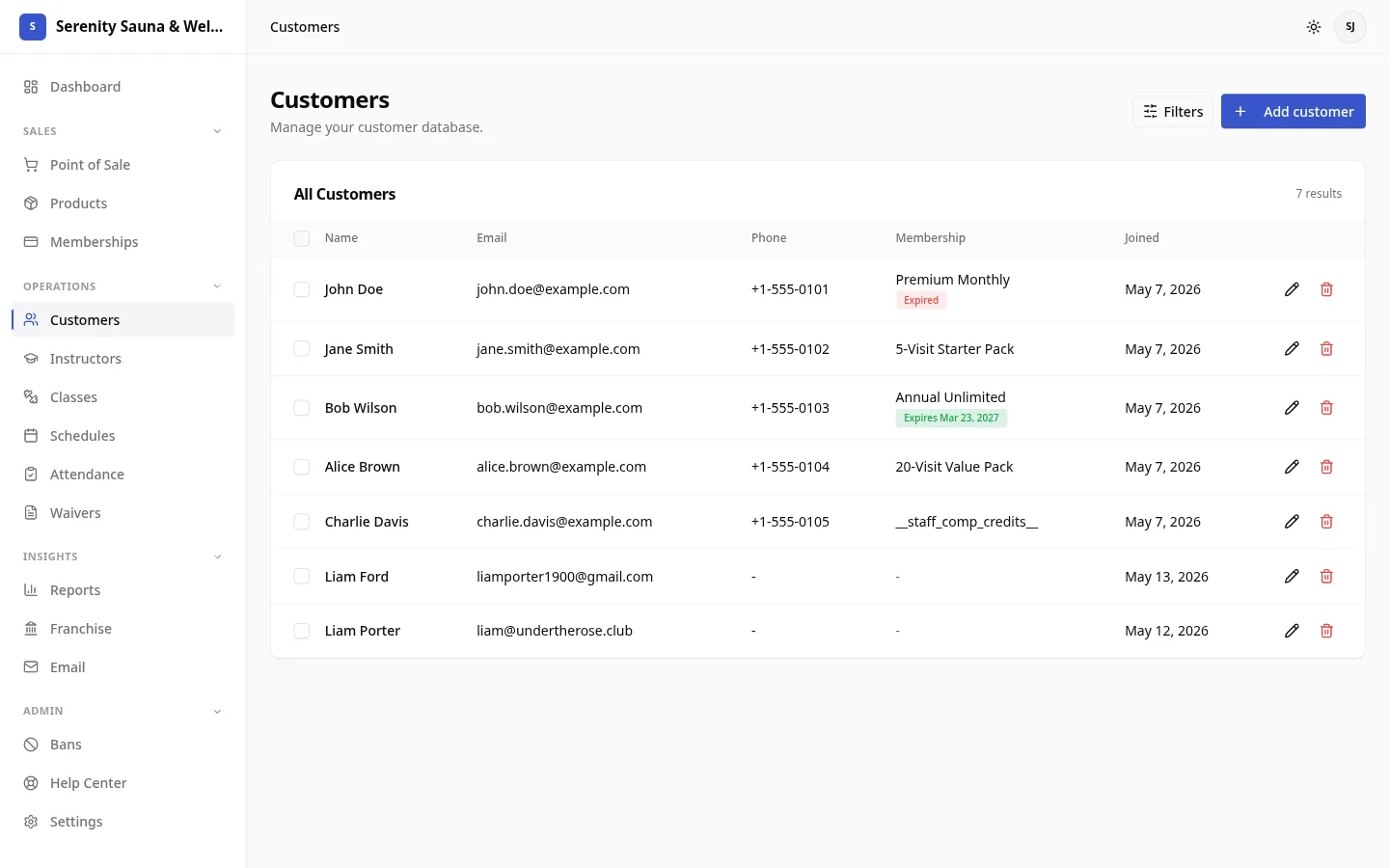
Elara's At Risk (lapsing members) list shows customers who attended before, whose last visit was 30 to 60 days ago by default and who have nothing booked, with their membership status and lifetime value.14 A win-back automation emails a customer once when they cross a number of days without a visit, skips anyone with a booking ahead, and resets when they come back. When to send it and what to offer is covered in when to send a win-back email.
Follow up a failed renewal the day it fails
At the same Spanish center, more returned payments more than doubled the chance of dropping out. A failed card is not yet a decision to leave, so it is worth a same-day message.
In Elara, the Failed Payments table lists each renewal Stripe or Square could not collect, one row per failed attempt, and keeps the row after a later retry succeeds. Elara emails the member its Payment plan failed notice, which is on by default, but tells staff only if you add an automation on that trigger sent to staff,15 so without one, check the table each day. Any retry is the payment provider's: Elara runs no retry schedule of its own. Until a renewal succeeds, the plan covers sessions only through its paid-through date, and most free bookings made past that date are canceled.16 A member on a Stripe plan can change the card and pay the overdue renewal from their account, so the follow-up can be a message telling them where; one billed through Square cannot change the card online and has to contact you.17
Offer a pause, then follow each one to its end
No study we found measures whether offering a pause keeps members who would otherwise cancel. A pause can save a member who is traveling or injured, or delay a cancellation by a few months. The only way to tell which is happening at your gym is to record how each pause ends: resumed, or canceled.
In Elara, staff can pause a membership with or without a resume date, and resuming extends it by the paused days. A membership no payment provider bills can be paused from a date you choose, and one billed through Stripe from today or any later day up to its renewal date; one billed through Square pauses at its next billing date. A plan set to cancel at the end of its period cannot be paused, by staff or by the member, and neither can one whose latest renewal payment failed and has not been collected. Members can pause their own Stripe or Square plan only if you turn on Allow members to pause their membership in booking settings, with an optional maximum length.
Judge a campaign by the weeks after it ends
In a study of 61,293 members of 24 Hour Fitness, 54 four-week digital programs were each tested against a control. 45% raised weekly visits by 9% to 27% while they ran, but only 8% left a measurable increase in the four weeks after, against 2.5% expected by chance.18
So a challenge month or a reminder campaign that fills classes has not yet shown it keeps anyone. Compare the members who received it with a group that did not, over the month after it ends.
Measure retention in Elara
The Memberships report counts people, not memberships:
- Current members counts people with an active, unpaused membership today. It shows today only, so note it on the first of each month.
- New Members counts people whose first membership was bought in the range, pack buyers included.
- Churned counts people whose last membership with credits or time left ended in the range. A pack used up is not churn; one that expires or is canceled with credits left is. A pause is not churn.
Balances are read as they are today, so record each month's figures when the month closes. To see how one month's sign-ups have held up, set the Memberships tab's range to that month and read Current Status of Membership Acquisitions: it shows where the memberships sold that month stand today, counting memberships, packs included, rather than people. It cannot show how a month stood on an earlier date, so to compare months, read each one at the same age, such as 90 days after it ends, and write the figures down. For a member-by-member view, the Memberships list's CSV export includes ended memberships, with each one's status and start and end dates. What a given churn rate does to your member count is in how many new members a gym needs.
The reports page shows how Elara separates new, current, churned and lapsing members, and the marketing page covers the automations above. Elara is sold by quote: ask for a quote and tell us how you sell plans, packs and pauses today.