How much do gym owners make? Income by member count
GuideBy Elara team · Published · 8 min read
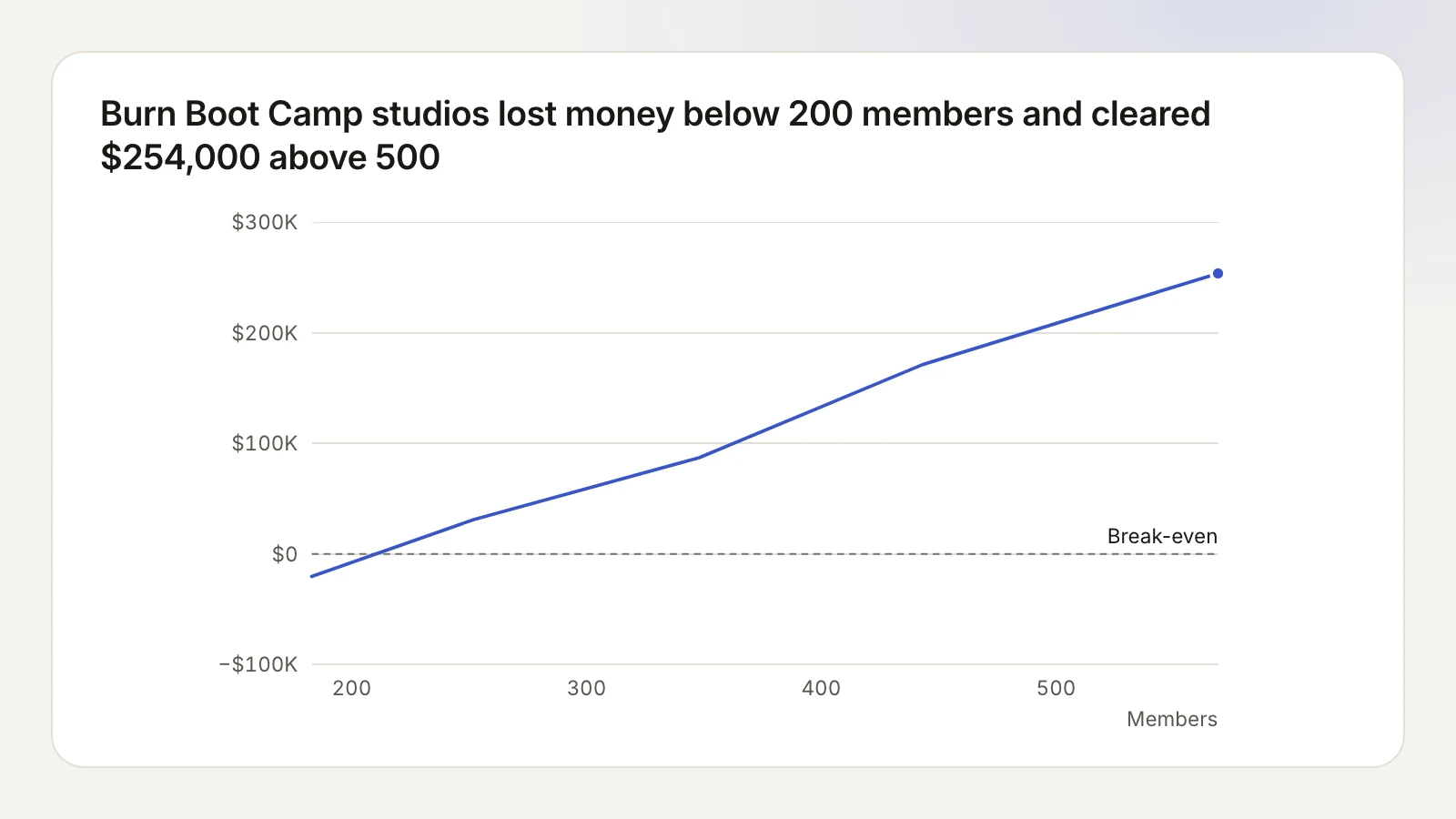
An owner of a small class gym typically keeps about $34,000 to $78,000 a year before income tax, and that is their pay and the profit together. That range is the "average" band for large-group class gyms, $2,800 to $6,499 a month, in Two-Brain Business's 2025 report on about 7,000 gyms.1 Two-Brain's own summary of that report puts large-group owner profit at a $52,200 median and a $97,656 mean, which a smaller group of high earners pulls up.2 Two-Brain's 2026 report, released in November 2026, puts the median owner at $60,000 a year, about $33 an hour, without saying which gyms that covers or what it counts.3 At larger studios the number follows member count: across 307 Burn Boot Camp franchises in 2025, median net operating income ran from a $20,382 loss below 200 members to $253,942 above 500.4 A gym is profitable when it covers its costs and also pays you what your time is worth, a test most income figures skip.
Check what each income figure measures
The published figures disagree because they count different people and different money.
| Figure | Amount a year | Who it covers | Is the owner's pay inside it? |
|---|---|---|---|
| Two-Brain owner profit, large-group class gyms | $52,200 median and $97,656 mean in Two-Brain's summary; $33,600 to $77,988 for the average band | Bands: about 7,000 gyms on Wodify and Kilo, 68.6% of them large-group, 2025. The summary does not restate its sample | Yes: what is left after all expenses, whether taken as salary or not |
| Burn Boot Camp net operating income | $109,155 median, on $699,718 revenue | 307 franchised class studios, 2025 | Yes: Burn says it does not deduct owner compensation. A hired manager's wage is deducted with the rest of payroll |
| BLS entertainment and recreation managers | $79,520 median, May 2025 | Employed managers | No owners: self-employed people are excluded |
| ZipRecruiter "gym owner" salary | $131,526 in 2023, $86,197 in 2024 | Job postings and third-party data | No: it is not drawn from owners' accounts |
The BLS figure is a wage survey that leaves out self-employed workers, so it describes hired managers across recreation businesses.5 It is useful later as the price of replacing you. ZipRecruiter's number is built from job postings and third-party data,6 and it fell by about $45,000 between those two quotes,7 which is a reason not to plan on it.
The first two rows come closest to what a business left its owner, and they differ in both size and measure. Two-Brain's average gym takes $162,000 to $300,000 a year and the Burn studio about $700,000. As a rough reading, owners in these two sources keep about 16% to 26% of revenue. That is our calculation across different measures, and pairing Two-Brain's income band with its revenue band assumes the same gyms sit in both, which the coverage does not say.
See how income moves with members
Of the nine gym franchisors' disclosure documents we read, only Burn Boot Camp reports operating income by member count:
Burn Boot Camp studios lost money below 200 members and cleared $254,000 above 500
Median net operating income a year at the median member count of each band.
Net operating income a year
307 studios open a year or more in 2025: 12 under 200 members, 75 at 200 to 299, 98 at 300 to 399, 72 at 400 to 500, 50 above 500. Expenses unaudited.
Show the numbers
| Members | Median studio |
|---|---|
| 183 | −$20,382 |
| 252 | $31,100 |
| 348 | $87,100 |
| 443 | $171,185 |
| 569 | $253,942 |
Median margin climbs with it: 6% at 200 to 299 members, 13% at 300 to 399, 20% at 400 to 500 and 23% above 500. The 229 studios open more than four years had a median margin of 17% and an average of 18%, and the median across all 307 was 16%.4
From the lowest band's medians to the highest's, each added member came with about $710 a year of operating income on about $1,970 of revenue. On the medians in the chart, a Burn studio crosses zero near 210 members and $100,000 near 360. Those are our own interpolations across different studios, so read them as the shape of the business and not as a forecast for one location.
Burn's member counts do not carry over to an independent. At 200 to 299 members, median revenue was $489,235 and median net operating income $31,100, so our subtraction of those two medians puts spending near $458,000 a year. We take that to include the 6% royalty and 2% brand fund, though the filing does not itemize its operating expenses.4 Two-Brain's report says a big-group class gym should break even before 50 members and be profitable by 100.8 Our example below needs 101 members because we priced in $17,338 a month of costs; the coverage gives no cost base for the 50. The count that matters is yours, set by your costs and your price.
Separate your pay from the profit
Owner pay is what the gym would have to pay someone else to do your job. Profit is what remains after that. A gym that pays you $70,000 and leaves nothing has given you a job, and a buyer who has to hire your replacement gets little from it.
Take the hypothetical gym from how to start a gym, for illustration only, in US dollars. It runs 30 classes a week with 20 places, pays $45 an instructor per class, sells one $179 unlimited membership and nets $172.26 a member after card and billing fees. Its rent, insurance, music licences, equipment and instructors come to $13,738 a month. We add an assumed $3,600 for utilities, cleaning, software, marketing and bookkeeping, for $17,338 a month before the owner gets anything. For the owner's job we use the BLS median of $79,520, an assumption you should replace with a local quote for a manager.
This gym pays its owner a manager's wage at 140 members, and profit starts there
What the example gym leaves its owner each year, before income tax and loan payments.
- Owner pay
- Profit
Owner income a year
Example gym: $17,338 a month before owner pay, $172.26 a member, pay capped at $79,520. It holds 180 members at 75% full, so the chart stops there.
Show the numbers
| Members | Owner pay | Profit | Total |
|---|---|---|---|
| 110 | $19,322 | $0 | $19,322 |
| 120 | $39,993 | $0 | $39,993 |
| 130 | $60,663 | $0 | $60,663 |
| 140 | $79,520 | $1,814 | $81,334 |
| 150 | $79,520 | $22,485 | $102,005 |
| 160 | $79,520 | $43,156 | $122,676 |
| 170 | $79,520 | $63,826 | $143,346 |
| 180 | $79,520 | $84,497 | $164,017 |
The gym covers its costs at 101 members, pays the owner's wage at 140 and has profit only above that. At 130 members it leaves $60,663, inside Two-Brain's average band. At 180 it leaves $164,017, of which $84,497 is profit.
Treat the right side of that chart as a ceiling. This gym has no desk staff, no payroll taxes and no loan, and its $17,338 a month is less than half of the roughly $38,000 a month that subtraction gives a Burn studio at 200 to 299 members. Every extra $1,000 a month of cost takes about six more members to cover.
Two lines make owner income look better than it is:
- Classes you teach. If you teach 15 of the 30 classes, the gym saves $2,925 a month and covers its costs at 84 members. That $35,100 a year is a coaching wage for hours you worked. It stops being yours the day you hire someone to take those classes.
- Loan payments. Principal is not an expense, so profit on paper can exceed the cash left. A hypothetical $150,000 loan at 10% over seven years costs $2,490 a month. If it paid for the equipment, drop the example's $1,114 equipment line so you do not count that twice.
The calculator starts from the same gym, with $14,000 a month besides instructors, which leaves $2,512 of that for your pay. Enter your own costs plus the pay you want in the first field. In the example, $18,115 returns 140 members.
Members a class gym needs, and members its timetable holds
Adds instructor pay for every class on the timetable to the month's other costs, divides by what one membership brings in after card fees, and sets the result against the members your classes can hold. The defaults are the guide's hypothetical gym; enter amounts in your own currency.
It takes 116 members to cover the month, and the timetable holds 180 members at 75% fill.
| Members needed to cover the month | 116 members |
|---|---|
| Members the timetable holds at 75% fill | 180 members |
| Average fill at the break-even count | 48.3% |
| Places on the timetable each week | 600 |
| Instructor pay (130 classes a month) | $5,850 |
| Monthly costs with instructor pay | $19,850 |
| Each membership brings in, after fees | $172.26 |
- Only memberships count as income here. Drop-ins, packs and retail lower the members you need; leave them out until they're steady.
- Monthly costs hold only what you enter, so add repayments on any loan for the build-out. Income tax is left out.
- A month is 52 weeks over 12, so it carries 4.33 weeks of classes and instructor pay.
If the members you need sit above the members your timetable holds, the plan needs a higher price, more classes or lower costs before it needs more marketing. How to price a gym membership works through the price side.
Is owning a gym profitable? Read the margin first
Yes, once members cover your costs and your pay, but plan on less than the headline margins. Going by Burn's filing, a class studio with several years behind it should expect margins in the teens, and single digits near break-even. Larger margins exist, but they come from other models or from measures that leave more out:
| Business | Margin | Measure | Revenue per location |
|---|---|---|---|
| Burn Boot Camp, 307 franchised class studios | 16% median | Net operating income, before owner compensation by Burn's account | $699,718 median |
| Anytime Fitness, 11 company-owned open-access centers | 28.67% average | EBITDA after $46,563 of manager base salary, with some costs adjusted to franchisee rates.9 | $521,854 average |
| Planet Fitness, corporate clubs | About 42.7%, or 35.3% after a 7% royalty | Four-wall adjusted EBITDA.10 | About $2.0 million, clubs open over 12 months |
Four-wall means before head-office costs. EBITDA comes before interest, tax and depreciation, and a gym's equipment does wear out. The open-access clubs in that table also sell memberships that do not each need an instructor in the room, while a class gym pays one for every class it runs. Don't budget a class gym on them.
The Health & Fitness Association's benchmarking report does measure EBITDA and payroll by club type, but the figures go to members and survey participants.11
Weigh the income against what you put in
Burn Boot Camp's own estimate of the cost to open is $291,145 to $678,003, before debt service.12 At the median $109,155, that is 2.7 to 6.2 years of operating income with nothing paid to the owner in between.
What these sources do not establish
- Whether reporting studios paid a manager. The disclosure document defines net operating income as revenue minus "all operating expenses", and Burn's franchise site says it does not deduct owner compensation, debt service or income tax.13 Burn requires a full-time operations manager, who may be you or a hire,4 and a hired manager's wage is an expense. If you run the studio yourself, the median is your pay and profit together; if you hire the manager, it is what is left after them. Ask existing franchisees which their figures reflect.
- How closed gyms did. Income figures describe gyms still running. Burn's excludes outlets open under a year and 43 with incomplete data. Title Boxing Club left out 15 franchised studios that closed in 2025,14 and 13 BFT studios ceased operating that year.15
- Audited expenses. Burn's are franchisee-reported and unaudited.
- All independent gyms. Two-Brain's 2025 sample comes from two software platforms, and the coverage itself says it doesn't show the whole picture. Two-Brain sells gym mentoring, and we read its figures through Morning Chalk Up's reporting and Two-Brain's own summaries, not the gated report. Its 2026 report no longer sorts gyms into large-group and other types,16 and its public summaries give no large-group owner band to replace the 2025 one. A typical Burn studio is also not a typical independent.
- Income per hour, after tax or in Canada. Apart from Two-Brain's 2026 figure of about $33 an hour, none of these figures accounts for the hours an owner works, and none accounts for income tax. The Burn, BLS and other filing figures are US figures in US dollars. The coverage does not state where Two-Brain's gyms are or what currency its bands use.
Watch the numbers that move owner income
Elara runs the class side of a gym: booking, memberships and check-in from the class roster. Elara does not run the door, so keep an access system if members enter outside staffed hours. Its reports show current members, total revenue and renewals that failed to collect.17 Elara holds no rent or loan figures and has no profit model, so profit still comes from your accounts. Elara is sold by quote: ask for a quote and tell us your timetable, class sizes and member count.