Gym liability waivers: where they hold up, state by state and province by province
GuideBy Elara team · Updated · 19 min read
In most of the US and in Canada's common-law provinces, a liability waiver signed before a class can stop a customer from suing your gym or studio for ordinary negligence, if it is clear, names negligence and stands out on the page. It does not work for injury claims in Louisiana, Virginia or Quebec, where a release of liability for personal injury is void, or at a gym in New York, where a statute voids releases at gyms, pools and other paid recreation facilities. Montana allows one only if it contains what its statute requires, and Hawaii's statute lets a recreation business release only inherent risks, not its own negligence. In Connecticut and Vermont, the supreme courts voided clearly worded releases at recreation businesses open to the public, so a gym's waiver may not hold there either.
We read the leading statute or court decision for each state and province. Of the 49 states and DC we could source, counted by each row's answer for ordinary negligence, 30 enforce waivers under ordinary contract rules, 14 enforce them but read them strictly, so wording and presentation decide most cases, 2 void them, 3 limit them by statute, and Kansas has no state appellate case on a recreation or fitness release. In the 25 states and DC whose rows say "Not covered", a court or statute holds that a waiver does not reach gross negligence, recklessness or willful misconduct; in Louisiana and Virginia it covers nothing. In the 7 states the children's table marks "Not enforced", a court decision we read holds that a parent cannot sign away a child's claim, and Florida limits a parent's waiver for a commercial activity to inherent risks. Nine provinces enforce waivers under Supreme Court of Canada tests; Quebec voids them.
Each row summarizes the leading authority we read on October 27, 2026; it is not legal advice and does not give you a waiver to copy. Have a lawyer licensed where you operate write or review yours, and check for cases decided since.
Check whether a waiver holds up in your state
"Enforced" means courts uphold a clear release of the business's ordinary negligence. "Enforced, strictly" means courts read releases narrowly against the business and have refused fitness or recreation releases under a demanding test, so wording and presentation decide most cases. "Void" means no wording works for a personal injury claim. "Limited by statute" means a statute voids releases in some settings or allows them only with contents it sets or for limited risks. Gross negligence means, roughly, a failure to use even slight care, such as leaving equipment in use after staff know it is broken.
| State | A release of ordinary negligence | Gross negligence or recklessness | What courts look for | Leading source |
|---|---|---|---|---|
| Alabama | Enforced | Not covered (wanton or willful conduct) | Clear release; a racetrack release was enforced though unread | Barnes v. Birmingham International Raceway (1989) |
| Alaska | Enforced, strictly | Not decided | Conspicuous, uses the word negligence, no safety promises | Donahue v. Ledgends (2014), a climbing gym |
| Arizona | Enforced, strictly | Not decided | A jury, not a judge, decides whether a signed release bars the claim (Ariz. Const. art. 18, sec. 5) | Phelps v. Firebird Raceway (2005) |
| Arkansas | Enforced | Not decided | Clearly sets out the negligence released | Jordan v. Diamond Equipment (2005) |
| California | Enforced | Not covered | Not a service affecting the public interest | City of Santa Barbara v. Superior Court (2007) |
| Colorado | Enforced | Not covered (willful and wanton) | Four factors, including clear and unambiguous intent | Jones v. Dressel (1981) |
| Connecticut | Enforced, strictly | Not a separate claim in Connecticut | Must name negligence; even a clear release can be void for recreation open to the public | Hanks v. Powder Ridge (2005) |
| Delaware | Enforced | Not decided | Unambiguous, not unconscionable, not against public policy | Ketler v. PFPA (2016), a Planet Fitness |
| District of Columbia | Enforced | Not covered | Clear and unambiguous | Moore v. Waller (2007), a hotel fitness center |
| Florida | Enforced | Not decided; intentional torts not covered | Clear; the word negligence is not required | Sanislo v. Give Kids the World (2015) |
| Georgia | Enforced | Not decided on appeal | Clear and express; health club releases upheld | Herren v. Sucher (2013) |
| Hawaii | Limited by statute | Not covered | A recreation business may release only inherent risks it disclosed in full, not its own negligence; disclose the waiver before taking a prepaid booking | HRS 663-1.54, in McKellar v. Outfitters Kauai (2025), Courbat v. Dahana Ranch (2006) |
| Idaho | Enforced | Not decided | Broad enough to cover future negligence | Morrison v. Northwest Nazarene University (2012) |
| Illinois | Enforced | Not covered (willful and wanton) | Clear, explicit language about the activities covered; strictly construed against the business | Harris v. Walker (1988), Garrison v. Combined Fitness Centre (1990), a health club |
| Indiana | Enforced, strictly | Not covered (the more extreme forms of negligence) | Must specifically and explicitly name the gym's own negligence | Powell v. American Health Fitness Center (1998), a gym |
| Iowa | Enforced | Not decided | Clear and unequivocal language releasing the business's own negligence | Huber v. Hovey (1993), a racetrack, Sweeney v. City of Bettendorf (2009) |
| Kansas | No state appellate case found | Not decided | No Kansas state appellate case on a recreation or fitness release; contracts are enforced unless illegal, against public policy or obtained by fraud, mistake, overreaching or duress | Corral v. Rollins Protective Services (1987) |
| Kentucky | Enforced | Not invalid on its face, strictly construed | Uses the word negligence, clearly releases the business's own conduct, can only be read as covering negligence, or clearly covers the hazard | Hargis v. Baize (2005), a sawmill's release signed by a log hauler |
| Louisiana | Void | Void | No wording saves a release for physical injury | Civil Code art. 2004 |
| Maine | Enforced, strictly | Not decided | Spells out negligence with the greatest particularity | Lloyd v. Sugarloaf Mountain (2003) |
| Maryland | Enforced | Not covered | Unambiguous; health clubs may limit liability for future negligence, with no magic words required | Wolf v. Ford (1994), Seigneur v. National Fitness Institute (2000), a fitness center |
| Massachusetts | Enforced | Not covered | Releases are favored | Sharon v. City of Newton (2002), Zavras v. Capeway Rovers (1997), a dirt bike race |
| Michigan | Enforced | Not covered | Fairly and knowingly made | Paterek v. 6600 Ltd. (1990), Lamp v. Reynolds (2002), a motocross track |
| Minnesota | Enforced | Not covered (Minn. Stat. 604.055) | Specific, express language releasing the gym's own negligence | Schlobohm v. Spa Petite (1982), a health spa |
| Mississippi | Enforced, strictly | Not decided | Clear and unmistakable, fairly negotiated, close scrutiny | Turnbough v. Ladner (1999) |
| Missouri | Enforced, strictly | Not covered (gross negligence or intentional torts) | Must use negligence or fault, conspicuously | Alack v. Vic Tanny (1996), a health club |
| Montana | Limited by statute | Not covered | Only a release that lists the activity's known inherent risks and carries the statute's bold notice, and even that can be challenged | MCA 27-1-753 and 28-2-702 |
| Nebraska | Enforced | Not covered | Clear and unequivocal; negligence need not be named if it is the only reading | Sinu v. Concordia University (2023), a university strength workout |
| Nevada | Enforced, strictly | Not decided | Must show consent to the operator's own negligence; whether the signer knowingly accepted the risk is for the fact finder | Mizushima v. Sunset Ranch (1987), Renaud v. 200 Convention Center (1986) |
| New Hampshire | Enforced, strictly | Not decided | Clearly releases the operator's negligence; within the parties' contemplation | McGrath v. SNH Development (2009) |
| New Jersey | Enforced | Not covered | Unequivocal; ordinary negligence only | Stelluti v. Casapenn (2010), a gym |
| New Mexico | Enforced, strictly | Not covered (intentional or reckless) | Clear, conspicuous, plain words; public-interest test | Berlangieri v. Running Elk (2003) |
| New York | Limited by statute | Not covered | Void at gyms, pools and paid recreation; a business that teaches for tuition can fall outside the statute | General Obligations Law 5-326, Lemoine v. Cornell University (2003) |
| North Carolina | Enforced | Not decided | Strictly construed; fails where the activity is heavily regulated | Fortson v. McClellan (1998) |
| North Dakota | Enforced | Not covered (willful injury, by statute) | Clear and unambiguous; strictly construed | Reed v. University of North Dakota (1999) |
| Ohio | Enforced | Not covered (willful or wanton) | Properly executed; Bowen sent back whether this one was | Bowen v. Kil-Kare (1992) |
| Oklahoma | Enforced | Not covered | Clearly shows intent and describes the damages; equal bargaining power | Schmidt v. United States (1996) |
| Oregon | Enforced, strictly | Not covered (gross negligence or recklessness) | Weighs all the circumstances; can be unconscionable even when conspicuous | Bagley v. Mt. Bachelor (2014) |
| Pennsylvania | Enforced | Not covered (gross negligence or recklessness) | Spells out with the greatest particularity that it releases the business's own negligence; strictly construed | Chepkevich v. Hidden Valley Resort (2010), Feleccia v. Lackawanna College (2019) |
| Rhode Island | Not sourced | Not sourced | We found no Rhode Island appellate case | None |
| South Carolina | Enforced, strictly | Not decided | Strictly construed; must name who is released; a racetrack release's clause covering "any persons" in a restricted area was void as overbroad | Fisher v. Stevens (2003) |
| South Dakota | Enforced | Not covered (willful) | Plain and clear statement before the signature | Holzer v. Dakota Speedway (2000) |
| Tennessee | Enforced | Not covered | Clear, specific, alerts the signer; totality of the circumstances | Copeland v. HealthSouth (2018) |
| Texas | Enforced | Not decided | Express negligence rule and conspicuousness | Dresser Industries v. Page Petroleum (1993) |
| Utah | Enforced | Not covered: a gross negligence claim survived the release | Not unclear or ambiguous | Rutherford v. Talisker Canyons (2019), Pearce v. Utah Athletic Foundation (2008) |
| Vermont | Enforced, strictly | Not decided | Clarity is not enough for a business open to the public | Dalury v. S-K-I (1995) |
| Virginia | Void | Void | No wording saves a release for personal injury | Hiett v. Lake Barcroft (1992) |
| Washington | Enforced | Not covered | Conspicuous; not against public policy | Chauvlier v. Booth Creek (2001) |
| West Virginia | Enforced | A general release does not cover it unless the circumstances clearly show the signer meant it to | Covers only what the parties contemplated; not a safety statute violation | Murphy v. North American River Runners (1991) |
| Wisconsin | Enforced, strictly | Not decided; intentional acts not covered | Not overbroad, set apart and highlighted, chance to bargain | Atkins v. Swimwest (2005), a fitness center |
| Wyoming | Enforced | Not decided | Clear and unambiguous; recreation is not an essential service | Massengill v. S.M.A.R.T. (2000), a sports medicine clinic's training membership |
In Rhode Island we found no appellate decision on a pre-injury release, so the state is left out of the counts above. Kansas's Supreme Court stated its freedom-of-contract rule in upholding a $250 cap on damages in an alarm system contract, not a release of an injury claim at a gym.1 A federal appeals court, applying Kansas law, left in place a ruling that a racetrack release barred ordinary negligence claims but not wanton conduct.2
Five of these rows change what a gym owner does, not just how the waiver is worded:
- New York. The statute covers the owner or operator of a "gymnasium" or "place of amusement or recreation" paid for its use, and makes a release of the operator's negligence "void as against public policy and wholly unenforceable".3 An appeals court applied it to a spa with a gym, pool, sauna and steam room, and said what counts is whether the facility's purpose is recreational or instructional, not what the member was doing when hurt.4 A business that teaches for tuition can fall outside the statute, as a university's climbing course did.5
- Montana. A release is allowed for a "sport or recreational opportunity" only for ordinary negligence and inherent risks, only if it lists the activity's known inherent risks, and only with the statute's notice in bold type.6 The statute does not apply to a claim based on the "maintenance of sports or recreational equipment", so even a compliant release may not reach a claim about a badly kept machine. No Montana court decision read says whether a gym class is such an opportunity.
- Hawaii. A business "providing recreational activities to the public" is liable for its own negligence. A signed release protects it only from inherent risks, and only if it first disclosed those risks in full and took reasonable steps to make sure each customer was physically able to take part and was taught to do it safely.7 The state's appeals court read the statute as precluding "a waiver of the recreational owner or operator's liability for negligence", in an unpublished 2025 order. No decision we read says whether a gym is such a business.
- Connecticut. The Supreme Court voided a snowtubing release that expressly named negligence, because the business served "the public generally" for a fee and controlled the risks, and it applied the same reasoning to horseback riding lessons the next year.8,9 We read no Connecticut appellate gym case, but a gym open to the public fits that reasoning.
- Arizona. The state constitution makes assumption of risk a question for the jury in every case, so a signed release cannot end a lawsuit before trial.10
Check whether a waiver holds up in your province
| Province | A release of ordinary negligence | Leading source | What it adds |
|---|---|---|---|
| Alberta, Saskatchewan, New Brunswick, Nova Scotia, Newfoundland and Labrador, Prince Edward Island | Enforced | Dyck v. Manitoba Snowmobile Association (SCC 1985), Tercon (SCC 2010), Crocker (SCC 1988) | We read no appellate waiver decision from these provinces; the Supreme Court of Canada's tests apply |
| British Columbia | Enforced | Loychuk v. Cougar Mountain Adventures (BCCA 2012) | A zip-line release held not unconscionable even for the operator's admitted negligence |
| Manitoba | Enforced | Dyck v. Manitoba Snowmobile Association (SCC 1985) | A race entry form's release held binding |
| Ontario | Enforced | Schnarr v. Blue Mountain Resorts (ONCA 2018) | The Occupiers' Liability Act lets an occupier limit its duty, and the Consumer Protection Act does not void those waivers |
| Quebec | Void | Civil Code arts. 1474 and 1477 | No one may exclude liability for bodily injury, and accepting a risk does not waive the claim |
Canadian courts ask three questions: does the release, read properly, cover what happened; was it unconscionable when signed; and is there an overriding public policy against enforcing it.11 A release can also fail if it is never pointed out: the Supreme Court refused one where the waiver "was not drawn to the plaintiff's attention", he had not read it, and he thought he was signing an entry form.12 In Ontario, Schnarr turned on the business being an occupier of the premises; the court said the Consumer Protection Act still governs consumer agreements that are not about entering premises.13 We did not verify the law in Yukon, the Northwest Territories or Nunavut.
Write the waiver the way courts read it
These are the 16 fitness and gym cases we read in full, several of them about saunas, steam rooms and whirlpools:
| Case | Business | What happened | Waiver held |
|---|---|---|---|
| Leon v. Family Fitness Center (Cal. App. 1998) | Health club | A sauna bench collapsed | No: the release had no heading and no bold type, and a bench collapsing was not a risk the member could be taken to have accepted |
| Powell v. American Health Fitness Center (Ind. App. 1998) | Health club | A member was hurt in the whirlpool | No: it did not name the club's own negligence |
| Skotak v. Vic Tanny (Mich. App. 1994) | Health club | A member died of a heart attack in the steam room | Yes |
| Debell v. Wellbridge Club Management (N.Y. App. Div. 2007) | Spa with gym, pool, sauna and steam room | A member was hurt in a free personal training session | No: void under New York's statute |
| Atkins v. Swimwest Family Fitness Center (Wis. 2005) | Fitness center pool | A swimmer drowned in the lap pool | No: it released "fault", which is too broad, on a card that was also the guest registration form |
| Alack v. Vic Tanny (Mo. 1996) | Health club | A member was hurt using the club's equipment | No: it did not use the word negligence or fault |
| Jimenez v. 24 Hour Fitness (Cal. App. 2015) | Health club | A member fell off a treadmill set about 3 feet 10 inches in front of another machine, where the maker called for 6 feet | No: a jury could find the spacing grossly negligent, which a waiver cannot release, and could find the manager misled a member who could not read the English form about what she signed |
| Stelluti v. Casapenn (N.J. 2010) | Gym spin class | A spin bike's handlebars came loose | Yes for ordinary negligence, but not for reckless or gross negligence |
| Benedek v. PLC Santa Monica (Cal. App. 2002) | Health club | A member touched the rack holding a television above an exercise machine; the set began to slide off, and he hurt his knee trying to hold it up | Yes: it covered injuries on the premises "whether using exercise equipment or not" |
| Schlobohm v. Spa Petite (Minn. 1982) | Gym or health spa | A member was hurt on a leg extension machine | Yes |
| Seigneur v. National Fitness Institute (Md. App. 2000) | Fitness center | A new member was hurt during strength testing | Yes |
| Ketler v. PFPA (Del. 2016) | Planet Fitness gym | A member was hurt on exercise equipment | Yes |
| Massengill v. S.M.A.R.T. (Wyo. 2000) | Sports medicine clinic's training membership | A pin fell out of a lat pull-down machine | Yes |
| Shields v. Sta-Fit (Wash. App. 1995) | Health club | A member did squats without his belt on a trainer's instruction | Yes |
| Garrison v. Combined Fitness Centre (Ill. App. 1990) | Health club | A bar rolled off a bench press | Yes |
| Donahue v. Ledgends (Alaska 2014) | Climbing gym | A beginner in a climbing class fell bouldering | Yes |
The waiver held in 10 of the 16 and failed in 6. The failures come back to the same few points, which a lawyer drafting yours will check:
- Name negligence. Indiana and Missouri courts refused health club releases that did not mention the club's own negligence,14,15 and Alaska requires the word itself.16 Florida does not require it,17 but naming negligence costs nothing where it is optional.
- Make it stand out. The Leon release had no heading and no bold type, and was in the same small print as most of the contract around it.18 Texas requires a release to be conspicuous as well as express about negligence.19 A waiver on its own page with its own heading avoids the problem that sank Leon and Atkins.
- Don't release everything. Wisconsin voided a release of "fault" partly because it reached intentional acts,20 and a South Carolina court held void a racetrack release's clause covering "any persons" in the restricted area, whoever they were.21
- Cover the whole premises. A waiver written around exercise risks may not reach a collapsing sauna bench or a falling television. Benedek held because its release said it covered injuries whether or not the member was using equipment.22
- Don't rely on it for gross negligence. The Jimenez waiver did not win summary judgment partly because spacing a treadmill well short of the maker's instructions could be gross negligence; the Stelluti waiver held for a loose handlebar only because nothing showed gross negligence or recklessness.23,24 Maintenance logs and spacing to the manufacturer's instructions do work no waiver can.
- Tell customers before they pay, and explain it. Hawaii's Supreme Court said a jury could find it a deceptive practice to take a prepaid booking without saying a waiver would be required on arrival.25 Explain it to anyone who cannot read it: in Jimenez, a jury could find a manager misled a member who could not read the English form.23
Courts in Washington, Wyoming and Minnesota held that a fitness membership is not an essential public service, which is why the public-interest exception did not void their waivers.26,27,28 Connecticut and Vermont reasoned the other way about recreation businesses open to the public, voiding a snowtubing and a ski area release that were clearly worded.8,29
Decide what to do when a child takes part
A parent's signature on a waiver does not reliably bind a child. Where courts have ruled:
| Where | A parent's waiver for a child | Source |
|---|---|---|
| Illinois, Iowa, Michigan, Utah, Washington | Not enforced | Meyer, Galloway, Woodman, Hawkins v. Peart, Scott v. Pacific West Mountain Resort |
| Kentucky, New Jersey | Not enforced for a for-profit or commercial business | Miller v. House of Boom, Hojnowski v. Vans Skate Park |
| Florida | Inherent risks only, for a commercial business, in the statute's wording | Kirton v. Fields, Fla. Stat. 744.301(3) |
| Alaska, Colorado | Enforced by statute | AS 09.65.292, C.R.S. 13-22-107 |
| Maryland | Enforced, for a store's play area | BJ's Wholesale Club v. Rosen |
| Massachusetts, Ohio, California | Enforced for a school or nonprofit (Massachusetts, Ohio); valid in principle, with the release's scope left for trial (California). We read no decision here on a commercial business | Sharon v. City of Newton, Zivich, Hohe |
| British Columbia | Not enforced, under the Infants Act, in a trial-level ruling | Wong v. Lok's Martial Arts Centre |
| Louisiana, Virginia, Quebec | Void for adults and children alike | See the tables above |
We did not read a ruling on parents' waivers for most other states, which does not mean none exists. If you run kids' or teen classes, this is the part of the waiver to take to a lawyer first.
Collect it electronically and keep proof of who agreed
A waiver accepted on a screen cannot be refused only because it is electronic. US federal law says a contract or signature "may not be denied legal effect, validity, or enforceability solely because it is in electronic form",30 and an electronic signature can be any "sound, symbol, or process" a person adopts with intent to sign,31 which we read to include ticking a box. State law says the same: Minnesota's version of the Uniform Electronic Transactions Act32 and New York's State Technology Law33 are two we read. Ontario, British Columbia, Alberta, Saskatchewan, New Brunswick, Newfoundland and Labrador and Prince Edward Island each say an electronic signature meets a legal requirement for a signature,34,35,36,37,38,39,40 Manitoba says a contract is not unenforceable because an electronic document, including a click on a screen, was used to form it,41 and Quebec accepts any process that meets the Civil Code's definition of a signature.42
The harder question in a lawsuit is proof: that this customer agreed to this text. The uniform act lets you show who signed "in any manner", including by the security procedure you used.43 So keep, for each acceptance, the customer's name, the exact wording they were shown, when they accepted it and how. When you change the wording, the customers who accepted the old text agreed to the old text, so ask returning customers to accept the new version rather than relying on the earlier signature.
Collect and keep waivers in Elara
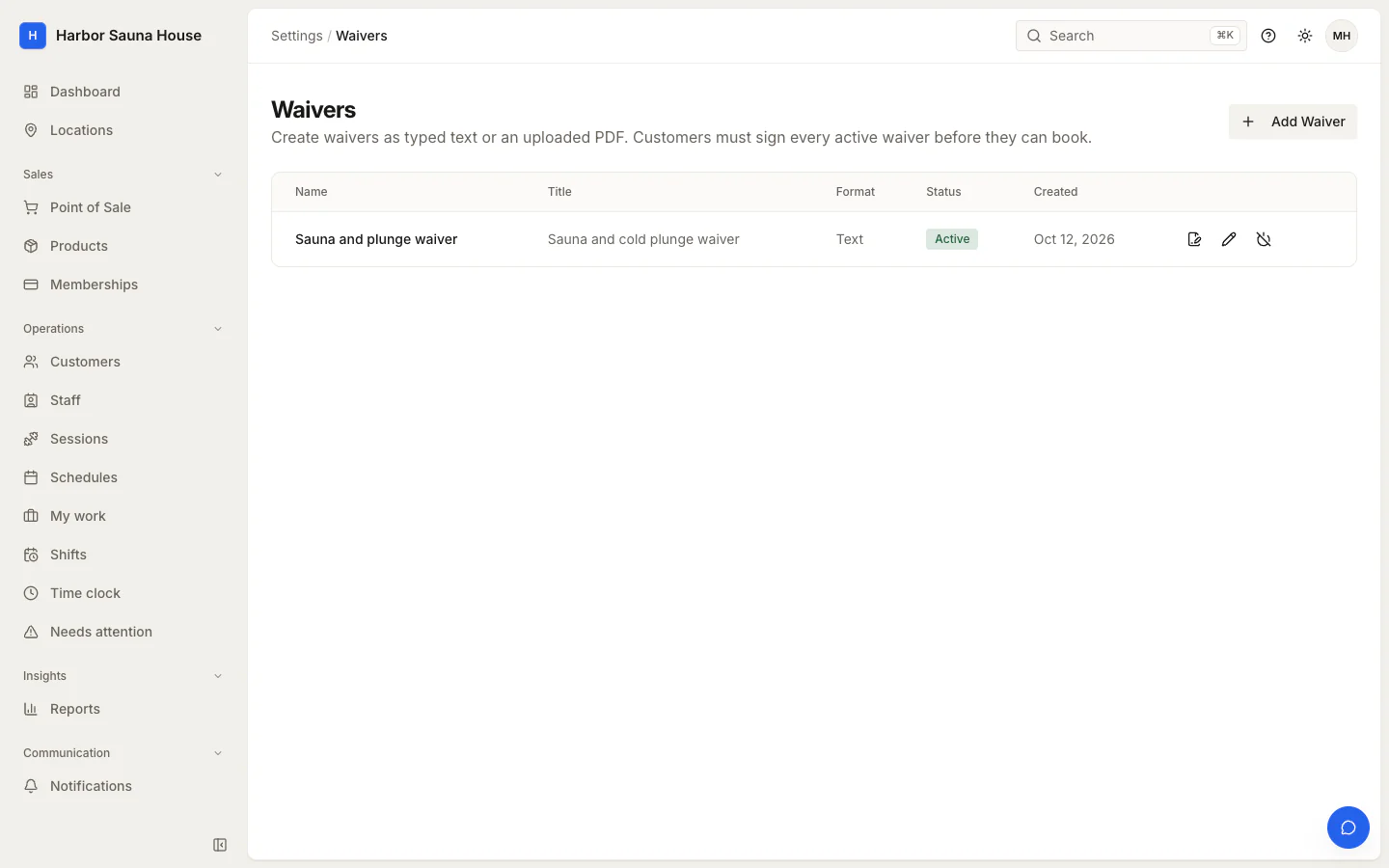
In Elara you write each waiver as text or upload it as a PDF or image, and you can run several at once, for example a general release and a separate one for cold plunge or sauna use. Every customer owes every active waiver they have not accepted at its current version, across all your locations, so a customer who never uses the plunge still owes the plunge waiver: a waiver can't be limited to one service or class.
- Online. At signup on your booking site, before booking a class or session, and under Waivers in their account, the customer ticks one box that names each outstanding waiver, and each waiver opens in full from its link. That tick is the acceptance; the customer does not type a name or draw a signature there. A tick at signup counts once the customer opens the emailed sign-in link in the same browser. Buying a membership, pack, pass or gift card online does not ask for a waiver, so the first booking or check-in is where it is collected.
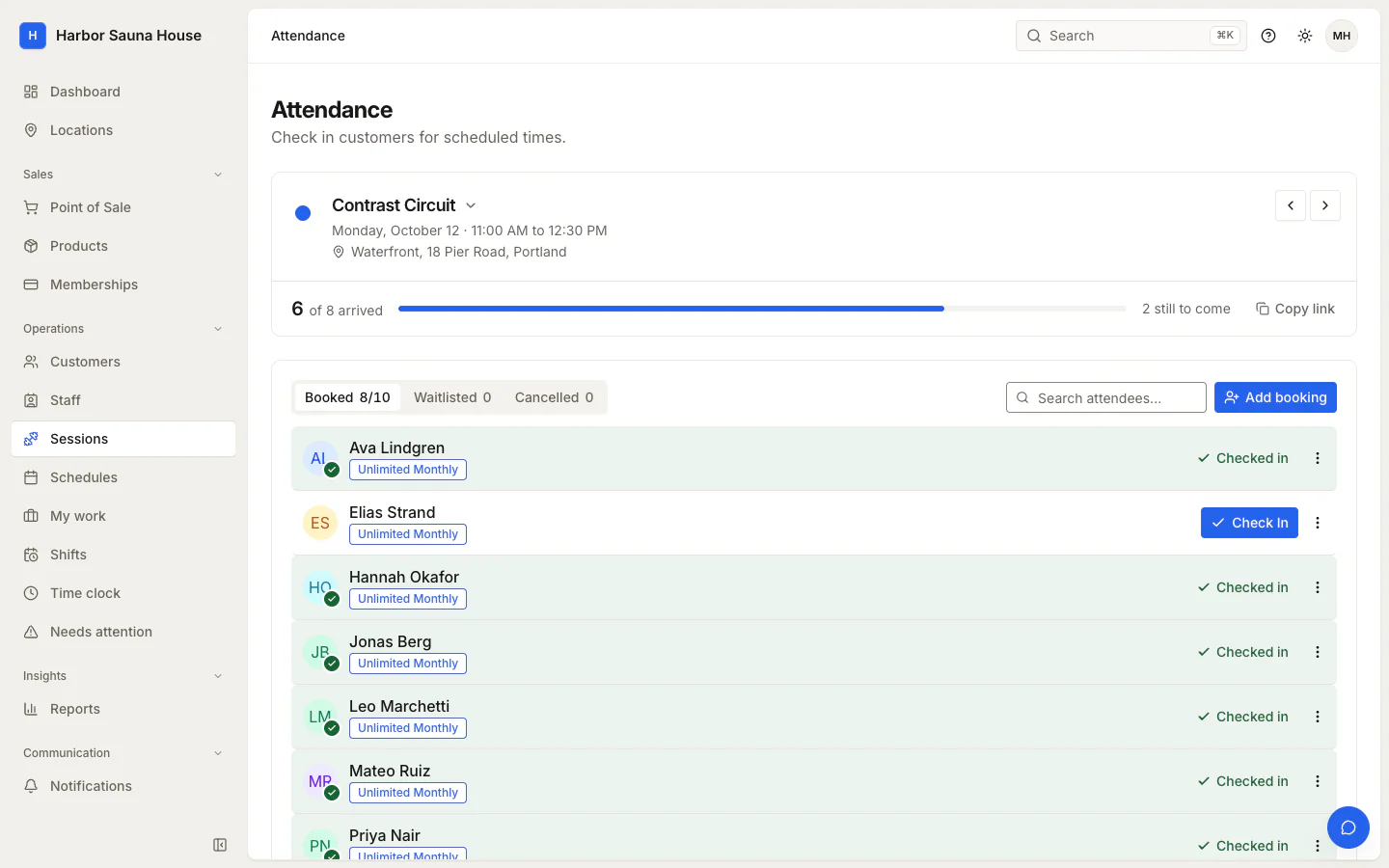
- At the front desk. From a booking on the class roster, staff open Sign Waiver in Person and hand over the device. The customer types their full name and ticks the box. If you turn on Offer a handwritten signature, they can also draw one. The record names the staff member who witnessed it. Staff can instead choose Send Waiver to email the customer a link to sign before the visit.
- Who signs when. The person booking online accepts before the booking goes through. Friends added to someone else's booking are not asked at booking, and a friend new to your studio gets an email inviting them to accept. Bookings staff add go through without a signature, as do returning friends who still owe one, and staff are alerted by an email automation you can turn off. Staff can't check in a customer who still owes a waiver, so the desk is where any missing one gets collected. Guests named on a private booking are recorded by name and do not sign. Each customer accepts waivers for themselves, so a parent cannot sign for a child in Elara: settle with your lawyer how you collect a parent's waiver before you run kids' classes.
- The record. Each acceptance keeps the signer's name at the time, the version and its exact text or file, the date and time, whether it was accepted online or in person, the tick or drawing, the typed name for in-person acceptances, and the witnessing staff member. It identifies the signer by their customer account, not by IP address or device. Staff find an acceptance in the signature registry by waiver and customer name and open it on screen, one record at a time; there is no bulk export.
- Changes. Editing the text or replacing the file creates a new version, and everyone who accepted an earlier one must accept again before their next online booking or check-in; renaming a waiver does not. A waiver anyone has accepted cannot be deleted, so its signed versions stay on file. Signatures from your previous software are not imported: each customer accepts again in Elara at their next online booking or check-in, so keep your old records.
Elara keeps the record of who accepted which text and when. Whether that text protects you is a question for your lawyer. The waivers page shows the signing and re-acceptance flow. Elara is sold by quote: ask for a quote and tell us how you collect waivers today.