Gym membership agreement template: every clause, and what 11 states require
GuideBy Elara team · Published · 20 min read
This template has 18 clauses, from the parties and the fees to the right to cancel and the signature. All 18 are below with the reason each one exists, ready to copy. Treat them as a working draft for your lawyer, because the state or province you operate in fills several of the blanks and overrides the rest.
Ten of the 11 large states in the table below set a three-day right to cancel, California sets five and Rhode Island ten business days. Illinois limits the first term to one year, while Florida, New York, Pennsylvania and Massachusetts allow 36 months. Six of the 11 can require a bond or other security of $10,000 or more per location. Five of those six let you avoid it through how you write and bill the contract, or through your record. Massachusetts gives a gym or studio no way out. In California,1 Illinois,2 Massachusetts,3 New York4 and Washington,5 a contract that does not comply with the health club law is void and unenforceable. In Pennsylvania it is voidable at the buyer's option.6 A wrong blank can cost you the contract itself.
The tables summarize statutes and government guidance we read for this page, not every rule that applies to you, and none of this is legal advice. Have a lawyer licensed where you operate review the final agreement, and tell them which clauses you changed.
Choose the term and billing before you write anything
In most of the bond states, the term and the way you collect money decide whether you need a bond, so settle them first. In Massachusetts they only set the amount.
| Where | What keeps you out of the bond or security |
|---|---|
| Florida | Monthly direct payment, the number of payments equal to the months in the contract, and any service fee at or under 10% of the contract price.7,8 Five clean years under the same ownership also qualifies |
| Pennsylvania | Terms of 12 months or less, equal monthly payments, an initiation fee no higher than six installments or your actual cost, whichever is lower, and the no-further-payments closure clause6 |
| Virginia | Contracts up to 36 months billed only at the monthly fee, with an initiation fee of $125 or less on contracts of 13 months or longer9 |
| North Carolina | No initiation or similar one-time fee, and never charging more than 31 days ahead10 |
| Texas | No term over 31 days, no draw or recurring debit on a bank or other financial institution, no initiation fee and no prepayment over 31 days, or a sworn statement of more than $50,000 in net book assets per location, five years under the same ownership and no closure complaints11 |
| Massachusetts | Nothing, for a gym or studio. The only exception needs no exercise facilities or classes, no obligation over 30 days and no initiation fee. Every other seller keeps the bond for its first five years of operating, and the term only sets the amount, $25,000 or $100,00012 |
Read together, those rules favor one shape for a small studio: a term of 12 months or less, billed in equal monthly payments, with a low initiation fee or none. Massachusetts, Texas and North Carolina are the exceptions. Massachusetts has no such route, Texas's first route needs a term of 31 days or less and no recurring bank debit, so ask your lawyer how it treats a recurring card charge, and North Carolina allows no initiation fee at all. A bond is still a reasonable price for selling paid-in-full annual memberships, so compare its premium with what those sales bring in. If you have not set the dues yet, start with how to price a gym membership.
Check the law where you operate
Each row is the state's health club law, in order of population among the states we read. "None in sections read" means the sections we read set no such rule, not that no rule exists anywhere.
| State | Right to cancel | Longest term | Bond or security | Refund due |
|---|---|---|---|---|
| California | Until midnight of the fifth business day. A contract priced at $1,500 or more adds a 20, 30 or 45 day window by price13 | 3 years, and total payments capped at $4,400 before finance charges14,15 | None in sections read for an open studio; pre-opening money goes in trust16 | 10 days |
| Texas | Until midnight of the third business day after the contract date, by certified mail17 | 3 years; payments on a financed contract may run up to five18 | Registration, and $20,000 to $50,000 as set by the secretary of state19 | 30 days |
| Florida | 3 days, not counting weekends and holidays20 | 36 months, then renewable annually | Registration at $300 for each location, and a $25,000 bond or equivalent for each location21,7 | 30 days |
| New York | 3 business days after the buyer receives a copy22 | 36 months, and no more than $3,600 a year23 | None in sections read; pre-opening money goes in escrow or the club shows it can cover claims24 | 10 business days |
| Pennsylvania | 3 business days after signing and receiving a complete copy6 | 36 months | Registration, and $50,000 to $200,000 for each location by term, or $25,000 to $50,000 with a certified member cap | 40 days |
| Illinois | 3 business days after the first business day after signing; 7 calendar days if the center is not open or the sale was not at an existing facility25 | 1 year, then renewals of up to a year each26 | None in sections read; pre-opening money goes in escrow27 | 30 days |
| Ohio | Until midnight of the third business day after the first service is available, or the seventh if nothing was available at signing28 | 3 years29 | None in sections read | 10 business days; $10 may be kept once the first service is received30 |
| North Carolina | Until midnight of the third business day after the contract date31 | None in the section read; the term must be a definite period | Bond for the greater of unearned prepayments or $10,000, capped at $250,000 per facility10 | 30 days on death, disability or a move32 |
| Virginia | 3 business days33 | 36 months, longer only on the conditions in the statute34 | Registration, and $10,000 to $100,000 per facility by contract count, capped at $300,0009 | 30 days |
| Washington | Until midnight of the third business day after signing35 | Payments over no more than 36 months | Pre-opening money in trust, or a $150,000 bond36 | 30 days |
| Massachusetts | 3 business days after the buyer receives the contract or a receipt37 | 36 months38 | $25,000 for each location, or $100,000 for terms over 24 months, for the first five years of operating12 | 15 business days |
Three smaller states show why a three-day habit is unsafe. Rhode Island runs to the tenth business day,39 Hawaii to the fifth,40 and Connecticut, which keeps three days, caps contracts at two years and generally bars automatic renewal.41
This page covers only the states named above. We could not read the current text for Georgia, Michigan, Arizona or New Jersey, and we did not review the rest. Don't treat any of them as having no rule: check with your state attorney general or consumer protection office and a lawyer licensed there.
Coverage is wider than the word "gym" suggests. New York and Massachusetts define a health club to include gymnasiums, martial arts schools and similar physical training,42,43 so assume a Pilates or barre studio is covered until a lawyer says otherwise. Florida lets a dance, aerobic exercise or martial arts program using no exercise equipment file for an exemption,44 and a reformer is equipment. Pennsylvania's act covers contracts for more than three months, so short-term sales fall outside it.6
Check the law in Canada
| Province | Right to cancel | Longest term | Other limits |
|---|---|---|---|
| Ontario | 10 days after receiving a written copy, when $50 or more is paid in advance45 | 1 year; renewal needs a notice 30 to 90 days before expiry | Initiation fees at most twice the annual fee, and a monthly payment option must be offered |
| British Columbia | 10 days after the consumer receives a copy of the contract46 | 2 years, including options and renewals, unless the consumer renews in writing in the last month46 | Applies to contracts designated by regulation; refunds within 15 days after a material change in circumstances |
| Quebec | Any time before service starts, then within the first tenth of the term, paying at most a tenth of the price47 | 1 year47 | Permit required (s. 321), no payment before service starts, at least two roughly equal installments (s. 201), refund in 10 days (s. 205) |
We did not read the rules for the other provinces. Ontario's row rests on the province's guidance rather than the regulation. The sources we found did not show the Consumer Protection Act, 2023 in force, so ask your lawyer which act applies when you sign off.
Add the federal rules that apply in every state
- Military members. Under the Servicemembers Civil Relief Act, a servicemember with orders to relocate for 90 days or more to a place that does not support the contract may end a gym membership or fitness program. You can't charge an early termination fee, and advance payments for later periods come back within 60 days.48
- Online sign-ups. If a membership renews automatically and sells online, the Restore Online Shoppers' Confidence Act requires clear disclosure of the material terms before you take billing details, express informed consent before charging, and a simple way to stop recurring charges.49 The FTC's broader click-to-cancel rule was vacated by the Eighth Circuit in July 2025,50 and in March 2026 the agency published an advance notice of proposed rulemaking asking whether to amend its Negative Option Rule,51 so check where that stands.
- Bank debits. A recurring debit from a consumer's account must be authorized in writing, with a copy given to the consumer.52
Copy the template
Square brackets are blanks. Replace every bracket, and use your own state's wording wherever the note says the statute prescribes the text.
1. Parties
This agreement is between [Studio legal name], [address], registration no. [number, if your state issues one] ("the Studio") and [member full name], [address, email, phone] ("the Member"). Date signed: [date].
Why: Massachusetts and Rhode Island tie deadlines to the signing or receipt date, Ohio requires the actual signing date, and Florida and Texas require a registration or identification number in the contract.21,53 Use the legal entity's name, the one on your bond and registration.
2. Membership
The Member joins the [plan name] membership at [location(s)]. It includes [access hours, classes per week or month, amenities]. Anything not listed here, including [personal training, private sessions, retail], is sold separately.
Why: California treats anything not described as an optional, separate contract.13 In a class studio this is the clause members argue about, so state a number of classes instead of "unlimited" if you limit them.
3. Term
The membership starts on [date] and ends on [date], a term of [number] months. [Or: The membership runs month to month from [date] until cancelled under this agreement.]
Why: A lifetime term is banned in Massachusetts, New York, Ohio and Washington.38 Check the longest term in the table above. California requires the minimum term in at least 14-point type above the signature line.14
4. Fees
Initiation fee: $[amount]. Monthly dues: $[amount] plus [tax]. Number of payments: [number]. Total payable over the term: $[amount]. No other fee applies unless listed here: [locker, late payment, card update].
Why: Illinois requires the total payment obligation in the contract, and Ontario's list includes the total, the number and the amount of payments.54,45 Massachusetts requires substantially equal installments, no more often than monthly.38
5. Payment authorization
The Member authorizes the Studio to charge [card or account ending in ____] $[amount] on the [day] of each month for the term. The Member will receive a copy of this authorization. To change the payment method, the Member contacts [email].
Why: This is the written debit authorization and copy that federal law requires for bank debits. Keep it in the agreement, so the copy is automatic.
6. Renewal
[Choose one, for your state.] When the term ends, the membership ends unless the Member signs a renewal. [Or: The membership renews for [period] at $[amount] unless the Member cancels before [date]. The Studio will send a reminder [number] days before renewal.]
Why: This clause varies most. Pennsylvania bars automatic renewal unless the buyer affirmatively accepts each renewal,6 Connecticut generally bars it, Florida allows only annual renewals signed within 60 days of expiry, and Illinois sends you to its Automatic Contract Renewal Act. New York lets a member cancel an annual renewal within 15 business days after it takes effect and a monthly one within three.22 Ontario needs a notice 30 to 90 days before expiry. Default to the first option unless your lawyer clears the second.
7. Right to cancel
BUYER'S RIGHT TO CANCEL. You may cancel this agreement without penalty by [written notice method] to [name, mail and email address] before midnight of the [number] business day after [the date you sign and receive a copy of this agreement]. If you cancel in that time, we will refund everything you paid within [number] days.
Why: This is the clause you cannot write yourself. California, Massachusetts, New York, Pennsylvania, Virginia, Washington, Rhode Island and Florida set the caption, the type size, the placement or the words, so paste your statute's text over this sample. New York wants at least 12-point bold and Massachusetts and Florida at least 10-point bold. Ohio goes further, requiring a detachable cancellation form in duplicate and an oral explanation at signing,30 and Massachusetts requires the notice posted on the premises as well.37
Don't require notice in person. New York requires clubs to accept cancellation by website, email, telephone, mail or in person, and through the website if that is where the member signed up.22 California allows in person, email or first-class mail.14 "Business day" also varies: Sundays and legal holidays are out in Pennsylvania, and in Illinois it means any day the facility is open.
8. Cancelling for death, disability, moving, closure or military orders
The Member or the Member's estate may cancel if: (a) the Member dies; (b) a physician certifies the Member cannot use a substantial part of the services for [period]; (c) the Member moves more than [distance] from the Studio and any comparable location that will honor this agreement; (d) the Studio closes or moves more than [distance] and offers no comparable facility; (e) the Member receives qualifying military orders. The Studio may ask for reasonable proof. The refund is calculated under clause 11.
Why: Nearly every act has these exits, and the distances differ. The table lists the ones in the sections we read, not every state.
| Trigger | Distance in the law |
|---|---|
| Member moves | 25 miles in Illinois, Massachusetts (home or work), New York, Ohio and Washington; 25 additional miles in Pennsylvania; 30 miles in North Carolina; 30 km farther in British Columbia |
| Studio moves or closes | 5 driving miles in Florida and Virginia; 8 miles in North Carolina (a move); 10 miles in Pennsylvania, Texas and Washington; 25 miles in Ohio; 30 km in British Columbia |
Disability thresholds differ too: 30 consecutive days in Virginia,33 more than three months in Massachusetts and New York, six months or more in Pennsylvania, and total disability in Washington. Use your state's figures.
9. Leaving early for any other reason
After [minimum period], the Member may cancel for any reason by giving [number] days' written notice. [The Studio may charge a cancellation fee of $[amount].]
Why: Decide this rather than leave it silent. In Washington a contract longer than a year can be ended for any reason on 30 days' written notice,35 and in Virginia a contract over 36 months must allow it after 12 months.34 California's limit on payments recognizes a termination notice period of up to 30 days.14
10. Freezes
The Member may pause the membership for up to [number] [weeks or months] per [year] by giving [number] days' notice. Dues [stop or continue at $[amount]] during a pause, and the end date moves by the paused time.
Why: Members will ask, and Pennsylvania requires a version of this for a temporary disability, extending the term at no additional cost.6 Our freeze policy guide works out how long a pause should be.
11. Refunds
If this agreement is cancelled under clause 8, the Studio will refund, within [number] days, what the Member paid above the value of the time used, calculated by [dividing the contract price by the weeks in the term and multiplying by the weeks elapsed], less [any fee your law allows].
Why: Several acts set the arithmetic. Florida and Pennsylvania divide by weeks, and Pennsylvania counts the initiation fee and allows a predetermined fee of up to $100, or $50 once more than half the term has passed. Virginia prorates the initiation fee over the contract or 12 months, whichever is longer.55 Washington caps what a studio keeps of the initiation fee at half, unless the buyer separately signs the clause its statute prescribes, and that exception covers only moving or leaving on notice.56
For an illustrative Pennsylvania member, with every figure assumed: a 12-month contract at $149 a month plus a $100 initiation fee costs $1,888 in total, or $36.31 a week over 52 weeks. The member moves in week 20, having paid five months and the fee, $845. Twenty weeks of use is worth $726.15, leaving $118.85, and a $100 predetermined fee leaves a refund of $18.85. Without a fee in the contract, the refund is $118.85, so the fee is worth writing down, and a clause promising no refund would short this member either way.
12. House rules and bookings
The Member agrees to follow the Studio's rules, a copy of which the Member has received. Class bookings, late cancellations and no-shows follow the booking policy at [link]. The Studio may suspend a Member who [conduct].
Why: Florida requires a current copy of the rules before signing, and Washington requires the rules or an acknowledgment of receipt.20,35 The numbers for a late cancellation or no-show fee belong in that policy, so you can change them without reissuing every agreement.
13. Risk and waiver
The Member will sign the Studio's separate liability waiver before first use. This agreement does not limit any right the Member has under consumer protection law.
Why: Keep the release out of the contract. A waiver on its own page with its own heading avoids the small-print problem that sank releases in California and Wisconsin, and whether one holds at all depends on the state. Our gym liability waiver guide has that table, and New York, Louisiana, Virginia and Quebec are places a release of negligence does not work.
14. Changes and closure
The Studio may change hours and classes on [number] days' notice. If the Studio closes for more than [number] days, it will extend the membership by the closed time. If it stops operating and offers no comparable location within [distance], no further payments are due, and prepaid amounts will be refunded.
Why: California lets a member cancel with a pro rata refund if described facilities are eliminated or substantially reduced, though not for reasonable temporary repairs. Washington allows dues to rise only once in a calendar year.35 Pennsylvania's bond exemption needs the closure wording in its statute, so use its text there.
15. Transfer and assignment
The Member may not transfer this membership without the Studio's written consent. The Studio will not assign this agreement to another club without the Member's written consent, except [sale of the business, where allowed].
Why: Massachusetts bars assigning a contract to another club without written consent, and New York bars it for a club at another location.38,23 If you may sell the studio, raise the exception with your lawyer now.
16. Member records
The Studio keeps the Member's contact, payment and attendance records under its privacy policy at [link]. It will return any personal assessments, questionnaires or photos on request or within 30 days after the membership ends.
Why: Ohio requires return of personal information such as questionnaires and photos within 30 days after the contract ends, and North Carolina within 30 days of a request. Illinois requires you to keep the contract for its term plus three years.57
17. Law and disputes
This agreement is governed by the laws of [state or province]. Nothing in it waives a right the Member has under that law.
Why: A waiver of the health club act is void in Illinois, Massachusetts, New York, Pennsylvania, Virginia and Washington, so a clause that tries one gains nothing. Massachusetts and New York also bar terms giving up claims or defenses. Ask your lawyer before adding arbitration, a class waiver or a clause moving disputes to another state.
18. Signature
[Your state's notices, in the required type, go immediately above this line.] Member: ____________ Date: ______ For the Studio: ____________ Date: ______ The Member has received a complete copy of this agreement.
Why: Florida and California want the cancellation language near the signature, and Illinois, Pennsylvania, Virginia, North Carolina and Ohio require a copy at signing. In Pennsylvania the three days do not start until the buyer has the copy, and until a seller complies, Ohio's cancellation period does not start at all.
Run the agreement in Elara
Elara does not generate this contract, and whether your wording complies is a question for your lawyer. It holds the parts below, but it cannot run every contract on this page, including the 12-month term billed monthly that the bond section favors. Check these limits before you settle clauses 3, 4, 6, 8, 9, 10 and 11.
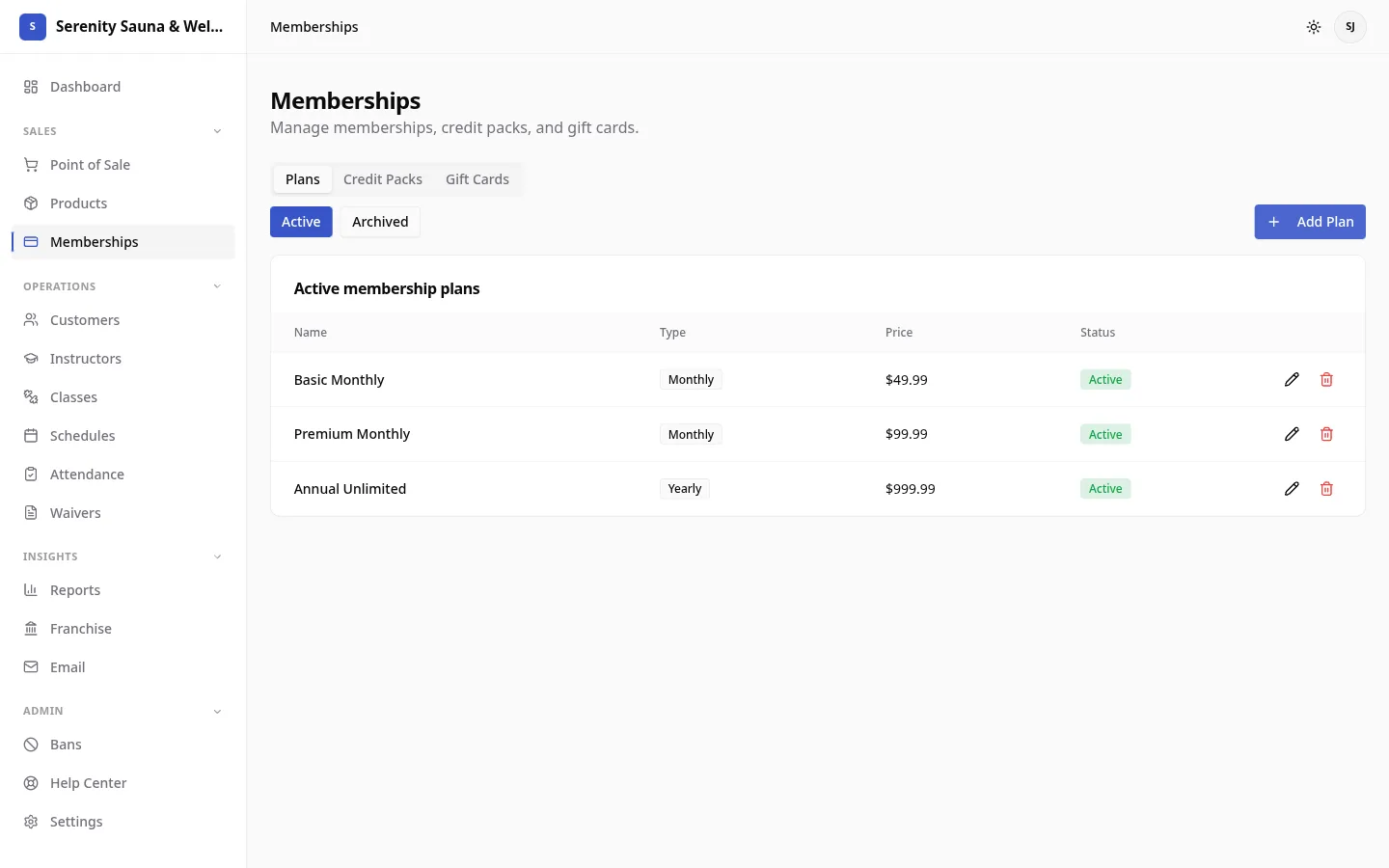
- Term. A membership plan is Monthly or Yearly, which renew until cancelled, or Fixed Term, which runs for a set number of days and stops.58 No plan bills a set number of monthly payments and then stops, and Elara does not enforce a minimum term. The closest fit is the month-to-month option in clause 3 on a Monthly plan, so ask your lawyer whether that stays within your state's route. If you sign a fixed term billed monthly, Elara keeps billing what the plan says, not what the PDF says, so someone has to cancel the plan when the term ends.
- Fees. A plan has no initiation, sign-up or enrollment fee, so clause 4's fee cannot sit on the plan. Sell it as a separate product at the Point of Sale when the member joins. Keep the plan out of that cart: a Monthly or Yearly plan sold at the Point of Sale covers one period and does not renew,59 so a member on monthly billing buys the plan online. A plan can carry the tax in clause 4 only on Stripe, not on Square.58
- Renewal. Fixed Term never renews, but it is one payment up front, which makes it a paid-in-full sale. Where the bond table has a monthly route, it takes you off that route, including in Pennsylvania and Florida, which also limit renewal. Elara sends no notice before a plan billed through Stripe or Square renews, so where the law requires one, as in Ontario, or clause 6 promises one, you send it yourself.
- Cancelling. Members can cancel online from their account, with no notice period, and a plan billed through Stripe or Square then runs to the end of the paid period. Elara will not hold a member to a minimum period or notice you write into clause 9.
- Dues changes. A plan's price is fixed once it is linked to Stripe or Square, so members on it keep paying that price. To charge a new price, create a new plan and archive the old one.58
- Acceptance. You can load the agreement as a waiver, as text or a PDF, and Elara records the acceptance date and time and the signed version.60 Every customer owes every active waiver before booking online, including drop-ins, and online acceptance is one box covering all active waivers. That suits a contract only if every customer signs it, so most studios should collect a membership agreement outside Elara and keep Elara's waiver for the release.
- Refunds. Refund a whole payment from the customer's Payments & refunds. A refund does not cancel a recurring membership, so cancel it as a separate step.61 Elara cannot issue a partial refund on a connected card, there or from a Point of Sale order: refunds by amount work only for record-only tenders such as cash and gift card.61 Clause 11 usually produces a partial refund, and Elara does not calculate it. Elara has no route for it on dues billed through Stripe or Square, so the workaround is that provider's dashboard: issue the figure there, then reconcile it in Elara. Elara's help center reserves provider refunds for disputes, imported payments and used value, so this is an exception to its usual rule. The payment still shows Completed and the membership keeps running. For a card sale at the Point of Sale, Elara's help center says not to issue a partial provider refund, so return the money another way and keep your own record.
- Used passes. Elara refuses to refund or void a fixed-term pass or credit pack once its value has been used, which is the usual case when a member leaves under clause 8. Its error tells you to cancel or reconcile the bookings it funded and the value used first.61 If value stays used, refund the remainder manually. On cash or gift card, a by-amount refund that leaves part of the balance unrefunded still works. On a connected card, use the provider's dashboard, which Elara's help center allows here, unless the sale was a Point of Sale order, where the card rule above applies.
- Pauses. Staff can pause a membership with a resume date, and the paused days are added to its end date. Elara has no freeze fee setting, so to charge reduced dues under clause 10, sell the fee as a product at the Point of Sale each time it is due.
If you want to see how plans and pauses would map to your agreement, ask for a quote and tell us what you sell today.