Membership freeze policy: when a pause keeps members and when it costs dues
GuideBy Elara team · Updated · 9 min read

Allow members to pause, but keep each pause short and offer it to people who are about to cancel, not to everyone who is going away. A pause gives up the dues of members who would have kept paying through their absence, and earns back the dues of members who would otherwise have left and come back. In the illustrative studio below, a one-month pause pays for itself if about 1 in 13 of the members who take it would otherwise have canceled; a three-month pause needs 1 in 5, and far more if a member you save leaves a few months after coming back. A freeze fee changes that threshold less than it seems, and most of the 21 studios whose policies we read cap a pause at one to three months.
See what studios allow
We read the posted freeze or pause terms of gyms, barre and Pilates studios, sauna studios and bathhouses in the US and Canada on October 27, 2026. Twenty-one state at least one term. Grouped by the longest pause they allow:
| Longest pause | Studios |
|---|---|
| About a month at a time | Chicago Strength Club (30 days, twice a year), The Bar Method South Loop (30 days a year, in up to two freezes), United Boxing Club (4 weeks at a time, 2 months a year), Lift Corktown (4 weeks a year free, then $3 a day), The Studio Pilates (30 days, once every 3 months), MindFuel Method (30 days, four times a year), Lore Bathing Club (one month), Pocketbook Hudson Baths (one month a year) |
| Two months | 3rd Street Boxing Gym (per request), Orangetheory West Harlem (60 days, twice a year) |
| Three months | CrossFit South Brooklyn, CrossFit East River, Chicago Strength, CrossFit Iron Horse, Pvolve, Pause Studio (3 months a year), Remedy Place (3 months a year) |
| Six months | Prevail Boxing (medical only) |
| Set by commitment | Eastside Boxing Club (2 to 6 weeks a year, more for longer terms) |
| Not stated | Barre Groove, Sauna Culture |
Five charge for it. Pvolve charges $25 a month in place of dues, MindFuel Method $20 a month, Barre Groove $10 for each 10 days, and Lift Corktown $3 a day after the free weeks; Pocketbook Hudson Baths charges a single $25 maintenance fee. Prevail's medical freezes and Lore's month are free, and the other 14 do not say. Most attach conditions instead of a price: a minimum of a week or a month, notice of 3 to 30 days, no pause in the first two months, pauses only on 6- or 12-month contracts (CrossFit East River), or only with a doctor's note (Prevail). Chicago Strength Club, CrossFit East River and Eastside Boxing Club add the paused time to the end of the commitment, and Lore and Prevail do the same for annual and prepaid members. The Studio Pilates says a freeze does not extend the commitment, and Pocketbook resets it to zero.
The terms cluster, but none of these pages says what the policy does to cancellations, and we found no study that measures whether offering a pause keeps members who would otherwise leave. The arithmetic below shows which unknown decides it.
Work out whether a pause pays
Everyone who takes a pause is one of two people. A member who would have kept paying while away costs you the dues for the paused months. A member who would have canceled costs you nothing to pause, and if they come back you keep their dues for as long as they would have stayed. The pause pays when the second group is large enough:
break-even share of pausers who would have canceled = paused months ÷ (share of savers who resume × months a saved member then stays + paused months)
For an illustrative studio, with every figure assumed:
- A $150 monthly membership, which nets $145.35 after card fees of 2.9% plus 30 cents.
- Members leave at 5% a month, so a member who comes back stays 20 more months on average (1 divided by 5%).
- 60% of the members who would have canceled come back when the pause ends. The rest cancel then, which costs nothing compared with canceling straight away.
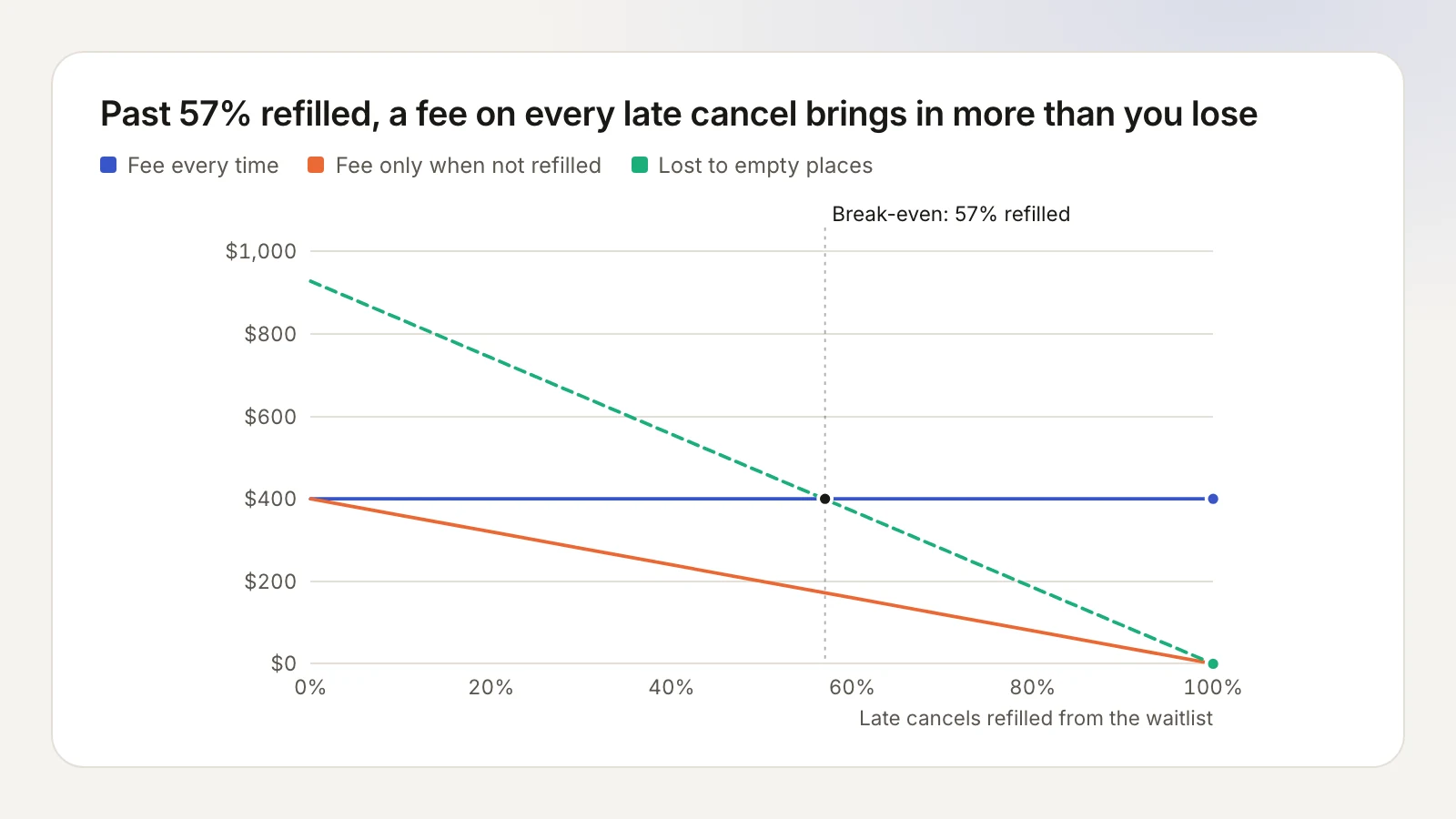
A one-month pause pays if 1 in 13 who take it were leaving
Each line assumes a different share of would-be leavers come back after the pause. The title and marker use the 60% line.
- 40% come back
- 60% come back
- 80% come back
Takers who must have been leaving
Example studio: 5% of members leave each month, so a member who comes back stays 20 more months. The membership price does not change the result.
Show the numbers
| Months paused | 40% come back | 60% come back | 80% come back |
|---|---|---|---|
| 1 | 11.1% | 7.7% | 5.9% |
| 2 | 20.0% | 14.3% | 11.1% |
| 3 | 27.3% | 20.0% | 15.8% |
| 4 | 33.3% | 25.0% | 20.0% |
| 5 | 38.5% | 29.4% | 23.8% |
| 6 | 42.9% | 33.3% | 27.3% |
The price drops out of the formula, so the shares hold for a $90 sauna membership as well as a $250 reformer plan. A month's pause pays if 7.7% of its takers would have canceled. Three months need 20%, and six months a third.
A month in the illustrative studio, with 200 members and 10 canceling: six members ask to pause for two months. Two were going to cancel and four are traveling and would have kept paying. The four cost 4 × 2 × $145.35 = $1,162.80 in dues. If 60% of the two come back, that is 1.2 members kept for 20 months, worth 1.2 × 20 × $145.35 = $3,488.40. The pause earns $2,325.60, because 2 of 6 (33%) is above the 14.3% a two-month pause needs. Had all six been travelers, it would have cost $1,744.20 and saved nobody.
Check how long a saved member stays
The 20 months is the weakest input. A member who asks to pause instead of canceling may be closer to leaving than your average member, and if they stay only a few months after coming back, the threshold climbs:
The sooner saved members leave, the more takers must have been leaving
- 1-month pause
- 3-month pause
Takers who must have been leaving
Example studio: 60% of members who would have canceled come back after the pause.
Show the numbers
| How long a saved member stays | 1-month pause | 3-month pause |
|---|---|---|
| 3 months | 35.7% | 62.5% |
| 6 months | 21.7% | 45.5% |
| 9 months | 15.6% | 35.7% |
| 12 months | 12.2% | 29.4% |
| 15 months | 10.0% | 25.0% |
| 20 months | 7.7% | 20.0% |
| 24 months | 6.5% | 17.2% |
A one-month pause stays cheap across the range: even if saved members stay only six months, it pays when about one taker in five was leaving. A three-month pause with six months of tenure afterwards needs nearly half. Nothing in the example tells you your own numbers. Follow each pause to its end, resumed or canceled, and how long the resumed members then stay; after a few dozen pauses you can put your own figures into the formula. Gym member retention shows how to count pauses apart from cancellations so they do not flatter your churn rate.
Decide on a freeze fee
A fee is collected from every pauser, so it cuts the cost of pausing members who would have paid anyway. In the example, a $25 monthly fee lowers the break-even share for a three-month pause from 20.0% to 16.7%, and for one month from 7.7% to 6.4%. That is a small effect against the pause's length.
The larger effect is on who pauses, and it runs both ways. A traveler who would rather keep paying $150 than pay $25 for nothing may simply keep the membership, which helps you. A member on the way out may cancel rather than pay, which is the person the pause was for. No source we found measures which happens more. If you charge one, keep it well below the dues, as the studios above do (Pvolve $25 and MindFuel $20 a month, Barre Groove $10 for each 10 days), and waive it for medical pauses: Prevail's are free, and CrossFit East River does not count injury holds toward its limits.
Offer the pause at the cancel request
The break-even share depends less on the policy's length than on who is offered it. A pause you advertise on the price page, open to anyone, is taken mostly by people planning a trip, who were never going to leave. A pause offered when a member asks to cancel goes to people who were leaving by definition, although some will cancel at the end anyway. The studios' notice periods, approvals and yearly limits cap what an open pause can cost, and the ones that allow a pause only for illness, injury or travel admit the members least likely to leave. None of those rules picks out the members who are leaving; only the cancel request does.
So a policy that keeps the share high:
- Offer a pause of up to a month when a member asks to cancel. Nearly everyone who takes it then was leaving, so on these numbers a longer pause would pay too. The month is a margin for members who learn that asking to cancel brings a pause: it still pays if only 1 in 13 of its takers was leaving. Allow longer for a medical reason as a courtesy, not because it pays: an injured member was rarely about to cancel, so that pause costs dues rather than saving a member.
- Limit how often, such as twice a year, so a pause cannot become a seasonal discount.
- Set a resume date on every pause, so it ends without anyone remembering to end it.
- Say whether the paused time extends a commitment, since members will ask.
Run pauses in Elara
Staff pause a membership from the customer's profile. Give every pause a resume date: staff pauses have no maximum length, and one without a date holds until someone resumes it. On resume, the paused days are added to the membership's end date, and Elara emails the member when the pause starts and again when it ends.
When the pause starts depends on who bills the membership. A plan staff assigned, a plan sold at the Point of Sale, a fixed-term pass or a credit pack pauses from the day you choose, so you can agree a date with the member and cancel the pause before it begins (an unused pass or pack that starts on its first visit can pause only from today). A monthly or yearly plan billed through Stripe can also pause from a day you choose, from today up to its renewal date, and on resume its next charge waits until the member has used the paid days they had left. On Square, the member keeps coming until the next billing date and the pause starts then.
A member who has already set their plan to cancel at the end of the period, often the member you most want to offer a pause, has to be reactivated first and then paused. A plan whose latest renewal payment failed cannot be paused until you collect that payment.
Check the member's bookings when you set a pause. On a Stripe plan, classes booked for the days the member had already paid for stay booked after the pause begins, and on a membership no provider bills, every booking stays. Elara cancels the other free bookings in the paused dates and releases their places to the waitlist; a booking that includes a payment or guests waits in Needs attention for you to decide.1 While the pause runs, the membership covers no class, even one after the resume date, so the member books their first class back on it once it has resumed. Until then they can still pay the drop-in price or use another pack they hold.
Members can also pause their own Stripe or Square monthly or yearly plan from their account, once you turn that on in booking settings. That is the pause open to anyone, which the break-even above warns about, so leave it off if you want to offer pauses only at the cancel request. If you turn it on, set a maximum length: a member's pause then ends after that many days even when they leave the resume date blank. Elara does not limit how often a member pauses, so a twice-a-year rule holds only while staff set every pause and keep the count.
Elara has no freeze fee setting: to charge one, sell it as a product at the Point of Sale, on a card reader or the member's saved card, each time it is due. Paused members leave Current members in the Memberships report and are not counted as churned, and the customer list filters to Paused membership, which shows who is paused today. Elara does not report past pauses or how they ended, so record each pause and its outcome yourself: those are the figures the formula above needs. The memberships page shows how plans, passes and packs work. Elara is sold by quote: ask for a quote and tell us how you bill memberships and what your pause policy is.