Sales tax on gym memberships: every US state, DC and Canada
GuideBy Elara team · Updated · 17 min read
In the US it depends on the state and on what you sell. Of the 50 states and DC, 22 tax gym and fitness memberships statewide, Arizona and New York tax them only in some cities, 17 do not tax them and 5 have no state sales tax, by each state's own statutes, rules and guidance; we could not confirm the other 5 (Alabama, Georgia, Ohio, Utah and Wyoming). Classes often take a different rule: of the 24 jurisdictions that tax memberships somewhere, 10 leave classes or instruction out in some form (listed under the class rule), and Washington and New York City exempt a studio that offers only yoga, so a studio that sells only classes can owe nothing where a gym down the street charges tax on every member. In Canada, a membership at a commercial gym or studio carries GST or HST everywhere: 5% in Alberta, British Columbia, Saskatchewan, Manitoba and the territories, 13% in Ontario, 14% in Nova Scotia, 15% in the other Atlantic provinces, and GST plus 9.975% QST in Quebec.
Each answer below is what the jurisdiction's own statute, rule or published guidance says, read on October 27, 2026, with a link to it. It is not tax advice. Tax turns on how you describe and bill what you sell, rules change, and several answers rest on a ruling given to one business, so confirm your own case with your state revenue department or provincial finance ministry, or an accountant, before you set rates.
Find your state
The table gives the state-level answer for a membership that includes use of the gym or studio, then what the same source says about other charges. "Not taxable" is the state answer: a city or county may still tax admissions (see local rates). "Not confirmed" means we read no official source that answers the question, and those states are left out of the counts.
| State | Memberships | Classes and other charges | Source |
|---|---|---|---|
| Alabama | Not confirmed | No official source on gym dues found. The 4% amusement tax reaches places of amusement and any other place where an admission fee is charged; it does not name gyms | Ala. Code 40-23-2, as quoted in Tax Tribunal 07-587 |
| Alaska | No state sales tax | Cities and boroughs set their own. Juneau taxes admission to a place, and its exemption for dues to 501(c) nonprofits does not cover charges that buy admission to a place | ARSSTC, Juneau guideline 411 |
| Arizona | Some cities only, for most gyms | The state deducts memberships of 28 days or more, and accompanied guest fees, at a facility that earns at least 80% of its monthly revenue from them; below that, memberships owe state tax too, and day passes are outside the deduction. Instruction is outside the state tax if the books show it separately. Some cities tax memberships and classes, such as Surprise at 2.8% | A.R.S. 42-5073, Surprise brochure |
| Arkansas | Taxable | Dues to health spas, health clubs and fitness clubs | Ark. Code 26-52-301, as amended by Act 521 of 2023 |
| California | Not taxable | Health club access fees are generally not taxable, even when the club sells merchandise | CDTFA guide |
| Colorado | Not taxable | Services the statute does not name are untaxed, as a ruling on a delivery subscription states (no gym ruling found); home-rule cities collect their own tax and must be checked separately | PLR 23-006 |
| Connecticut | Taxable | 6.35% on health and athletic club services, classes and personal training at a club included; a 2011 act repealed the yoga studio exemption the 2007 notice describes. Services provided by a municipality or a 501(c) organization are excluded | Gen. Stat. 12-407(a)(37)(FF) and its history note, SN 2007(1) |
| Delaware | No sales tax | There is no state or local sales tax; the seller pays a gross receipts tax on its receipts | Division of Revenue |
| District of Columbia | Taxable | Health club services and drop-in fees at 6%, which the tax office says applies through September 30, 2027; personal training an individual hires is not taxed | D.C. Code 47-2001, OTR Notice 2014-09, OTR |
| Florida | Taxable | Club dues with fitness facilities are taxable admissions at 6% plus any county surtax; charges purely for instruction are not | Stat. 212.02, Rule 12A-1.005 |
| Georgia | Not confirmed | No rule on gym dues. A 2015 letter ruling taxed one climbing gym's memberships, day passes and classes as admissions | LR SUT-2015-18 |
| Hawaii | Taxable | 4% general excise tax on the business's income plus a 0.5% county surcharge; the business may pass on up to 4.712% | HRS 237, GET FAQ |
| Idaho | Taxable | Charges to use a facility for physical conditioning; an instructor-led class is not taxed | IDAPA 35.01.02.129 |
| Illinois | Not taxable | Membership fees are receipts for an intangible, not a sale of goods, under the general gross receipts rule, whose example is a membership that buys the right to purchase at wholesale; no gym-specific source found. Chicago's amusement tax was not confirmed | 86 Ill. Adm. Code 130.401 |
| Indiana | Not taxable | Services are generally untaxed | Bulletin 17 |
| Iowa | Taxable | 6% on commercial recreation, fitness facilities included; instruction is exempt only when billed separately and not required to use the facility, and dance studios are taxed, exercise taught there included | Iowa Code 423.2, Rule 701-216.3 |
| Kansas | Taxable | Membership, initiation and guest fees | K.S.A. 79-3603, Fitness fact sheet |
| Kentucky | Taxable | 6% on fitness center and gymnasium fees as admissions; since 2023, personal fitness training and exercise classes too, whoever provides them | KRS 139.200, 103 KAR 28:010, Recreation and Fitness FAQ |
| Louisiana | Taxable | Gym memberships are named as taxable admissions; the state rate is 5% from January 1, 2025 through December 31, 2029 | Revenue FAQ, State rate |
| Maine | Not taxable | Fitness is not on the statute's list of taxable services | 36 M.R.S. 1752 |
| Maryland | Not taxable | Not a taxable service at state level; counties and cities may levy an admissions and amusement tax on use of a recreational or sports facility | Tax-General 11-101, Tax-General 4-101, 4-102 |
| Massachusetts | Not taxable | The only taxable services are telecommunications | c. 64H s. 1 |
| Michigan | Not taxable | Sales tax covers goods, not services | MCL 205.52 |
| Minnesota | Taxable | Dues, initiation fees and access to saunas, steam baths and tanning; optional, separately stated classes and personal training are not | Fact Sheet 124 |
| Mississippi | Not taxable | Membership fees are not admissions, but a one-time gym admission is taxed at 7% | Rule 35.IV.3.08.102 |
| Missouri | Taxable | Membership and guest fees; classes, personal training and massage are exempt, and a 2024 ruling found a classes-only studio's memberships untaxed | Fitness centers matrix, LR 8280 |
| Montana | No sales tax | Department of Revenue | |
| Nebraska | Taxable | Gymnasium and health club memberships are admissions; instruction charges are not | Reg-1-044 |
| Nevada | Not taxable | Sales tax applies to tangible goods; the department's FAQ names no tax on fitness services | Sales tax FAQ |
| New Hampshire | No sales tax | Only a meals and rooms tax | RSA 78-A:6 |
| New Jersey | Taxable | Membership, initiation and sign-up fees; separately stated classes, class-only plans and personal training are not taxed; massage and tanning are | LR 2017-2-SUT, ANJ-19 |
| New Mexico | Taxable | Gross receipts tax on services, 4.875% at state level and 5.25% to 9.4375% with local taxes from July 1, 2026; no fitness deduction | FYI-105, Rate schedules |
| New York | New York City only | No state tax on health and fitness facility dues or classes; New York City taxes dues, classes, personal training, spa and guest fees at those facilities, but not at yoga-only studios | TB-ST-329, TB-ST-615 |
| North Carolina | Not taxable | Gym memberships are participation, not a taxable admission | SUTB 7-3 |
| North Dakota | Not taxable | Dues for health-focused fitness are untaxed; if they also cover recreation such as a pool or courts, the whole fee is taxed unless itemized | Guideline 21952 |
| Ohio | Not confirmed | The official code site refused connections. An unofficial copy of the fitness rule taxes open-use memberships of a month or more but not class-only plans or class packs | Adm. Code 5703-9-62 (unofficial copy) |
| Oklahoma | Taxable | Dues to clubs, health spas included, at 4.5% | 68 O.S. 1354, as printed in HB 1482 |
| Oregon | No sales tax | Department of Revenue | |
| Pennsylvania | Not taxable | Health club fees, tanning, massage and gift cards are listed as nontaxable | REV-717 |
| Rhode Island | Not taxable | Fitness is not among the listed taxable services | Gen. Laws 44-18-7.3 |
| South Carolina | Not taxable, with conditions | A center under the Physical Fitness Services Act escapes the 5% admissions tax only if it offers just the listed activities, such as aerobics, weights and exercise equipment; anything else taxes the whole charge | Code 12-21-2420 |
| South Dakota | Taxable | Membership or entrance fees for use of a facility, at 4.2% (4.5% from July 1, 2027) plus municipal tax | SDCL 10-45-5 |
| Tennessee | Not taxable | Exempt since July 1, 2019 for businesses mainly offering fitness, yoga, Pilates, spin, barre, HIIT and boxing classes included | Notice 19-11 |
| Texas | Taxable | Health clubs and fitness centers are amusement services; a 2019 ruling found one studio's class-only memberships untaxed, and separately stated one-on-one training is not taxed | Publication 96-259, PLR 201902001L |
| Utah | Not confirmed | The statute taxes admission or user fees for recreation or athletic activity but names no gym, and its definitions exclude lessons and annual membership dues to private organizations; the Tax Commission's rulings on club dues would not load | Code 59-12-103, 59-12-102 |
| Vermont | Taxable | Gym memberships are amusement charges; punch cards and unlimited plans for instruction only are not | Ruling 2016-08 |
| Virginia | Not taxable | Membership fees not tied to goods are untaxed; no gym ruling found | P.D. 96-231 |
| Washington | Taxable | Every charge at an athletic or fitness facility, classes and personal training included; separately stated massage is excluded. A studio offering only yoga, tai chi, chi gong or martial arts classes charges no sales tax and pays business and occupation tax instead | RCW 82.04.050, DOR guide |
| West Virginia | Taxable | Fitness programs are taxable services; personalized fitness programs are exempt | TSD-300, Code 11-15-9 |
| Wisconsin | Taxable | Access to athletic facilities and clubs, dues and initiation fees included | Stat. 77.52, Tax 11.65 |
| Wyoming | Not confirmed | Admissions to places of recreation are taxed. The Department of Revenue's lodging matrix lists club membership, weight room fees and lessons as untaxed, but it is written for hotels | W.S. 39-15-103, Lodging Tax Matrix |
Two kinds of answer in that table rest on no gym-specific source. In 10 of the 17 states that do not tax memberships (Colorado, Illinois, Indiana, Maine, Maryland, Massachusetts, Michigan, Nevada, Rhode Island and Virginia), the answer follows from a sales tax that reaches goods and only the services its statute lists, and fitness is not listed. Hawaii and New Mexico work the other way: their general excise and gross receipts taxes reach almost every service and fall on the business, which may pass them on.
Check the class rule if you sell classes
A studio that sells classes, packs and training needs more than the membership answer. Connecticut, Kentucky, Washington and New York City tax classes along with access (see the table), though Washington and New York City do not tax a studio that offers only yoga, and Washington also exempts one that offers only tai chi, chi gong or martial arts. Ten jurisdictions that tax memberships leave classes or instruction out, each on its own condition:
- Instruction is excluded, access is not. Florida, Idaho, Nebraska and Vermont exclude charges for instruction but not a fee that also buys use of the facility. Florida says a club cannot turn taxable dues into untaxed instruction fees by relabelling them.1 Vermont found punch cards and unlimited plans sold only for instruction untaxed.2
- Only if billed separately. Iowa exempts instruction contracted and billed apart from facility use, at a reasonable price, as a real class with a trained instructor, and not required to use the facility.3 Minnesota exempts class fees and personal training that are optional and stated separately from the membership.4
- Class-only plans. Missouri excludes instructional classes, and in 2024 found a studio's per-class, monthly and annual memberships untaxed because every class was instructor-led.5 New Jersey does not tax a separately stated class charge or a class-only "membership" that is a prepaid set of classes.6 Texas, in a 2019 private ruling, found monthly memberships untaxed at a studio whose members could attend only scheduled coach-led classes.7 A letter ruling binds the state only for the business that asked.
- State and city split. Arizona's state tax leaves out instruction, though some cities tax classes.8
In those states, the line that decides the tax is usually on your invoice: a class pack with no access to the floor, or a class charge priced apart from open gym time. A membership that bundles both is usually taxed whole.
Three other charges often take their own rule:
- Personal training is not taxed in DC when an individual hires the trainer,9 in New Jersey,6 or in Texas when it is genuine one-on-one training charged separately.10
- Sauna, steam and tanning. Minnesota taxes access to saunas, steam baths and tanning,4 Iowa lists Turkish baths and tanning as taxable services,11 and New York City taxes sauna and spa use at a health and fitness facility.12 A sauna studio in a state with a rule for baths or spa services needs that rule as well as the gym one.
- Day passes. Mississippi taxes a one-time gym admission at 7% though not a membership,13 and Arizona's state deduction covers only memberships of 28 days or more.8
Some exemptions turn on who sells. Minnesota exempts memberships at the YMCA, YWCA, JCC and similar nonprofits (501(c)(3) organizations whose mission is to support youth and families and that offer free or reduced-price memberships to seniors or low-income persons or families), though separate charges for use of their athletic facilities stay taxable.14 Connecticut excludes health club services provided by a municipality or a 501(c) organization.15
Canada: GST or HST everywhere, provincial tax rarely
Most services are taxable for GST/HST, and no exemption covers a commercial gym or studio membership.16 A non-profit's membership stays taxable when the club's main purpose is recreational or sporting facilities.17 The province decides what is added:
| Province or territory | Tax on a membership | Rate | What else the source says | Source |
|---|---|---|---|---|
| Alberta, Yukon, Northwest Territories, Nunavut | GST | 5% | No provincial or territorial sales tax | CRA rates |
| British Columbia | GST only | 5% | PST does not reach memberships or admissions unless taxable goods come with them; personal training, yoga instruction, massage, spa and tanning are not subject to PST | PST FAQ, PST 301, PST 138 |
| Saskatchewan | GST only | 5% | PST on recreation exempts gym and fitness memberships, classes and passes that include gym access; a pass for a pool or rink only is taxable | PST-76 |
| Manitoba | GST only | 5% | RST reaches only the services the Act lists, and fitness is not one; spa services are exempt, ultraviolet tanning is taxable | RST 030, Bulletin 062 |
| Ontario | HST | 13% | CRA rates | |
| Quebec | GST and QST | 5% + 9.975% | QST follows Quebec's own act; Revenu Québec's pages would not load for us, so check its guidance on courses and memberships | CRA rates |
| Nova Scotia | HST | 14% | 15% until March 31, 2025 | CRA rates |
| New Brunswick, Newfoundland and Labrador, Prince Edward Island | HST | 15% | CRA rates |
Kids' classes at a private studio are taxed like adult ones. The GST/HST exemption for a supervised recreational program mainly for children 14 and under applies only when a public sector body runs it, such as a non-profit organization, municipality or school authority (charities have their own exemption).18
A business whose taxable sales stay at CA$30,000 or less over four consecutive calendar quarters is a small supplier and need not register for GST/HST, though it may; going over $30,000 in a single quarter ends that status at once.19
Tax a gift card when it is spent, not when it is sold
Every jurisdiction we found with a rule taxes a gift card at redemption, and only if what it buys is taxable. Federally, selling a gift certificate is not a supply, and GST/HST applies when it pays for something taxable.20 British Columbia,21 Manitoba for cards with a dollar value,22 Idaho,23 North Carolina24 and Wyoming25 say the same, and Pennsylvania lists gift cards as nontaxable when sold.26 A $100 card later spent on a taxed membership carries the membership's tax at that point; spent on an untaxed class pack, it carries none. A card sold at face value does not reduce the taxable price.25 Sauna gift cards covers the other side: recording unredeemed balances as money you owe.
Work out the tax on a mixed sale
The studio here is hypothetical, in USD, in a state that taxes memberships and retail goods at a combined 8% and does not tax classes sold apart from facility access. It lists prices before tax.
| Sale | Price | Taxable amount | Tax at 8% | Customer pays |
|---|---|---|---|---|
| Monthly membership with open gym access | $179.00 | $179.00 | $14.32 | $193.32 |
| 10-class pack, classes only | $250.00 | $0.00 | $0.00 | $250.00 |
| The same pack in a state that taxes classes | $250.00 | $250.00 | $20.00 | $270.00 |
At the front desk a member buys the class pack and a $25 water bottle with 10% off the whole sale. The $27.50 discount, spread over the two lines in proportion to their prices, takes $25.00 off the pack and $2.50 off the bottle. Tax is then worked out per discounted line: the pack stays untaxed, and the bottle is taxed on $22.50, so its tax is $1.80 rather than $2.00. The member pays $225.00 + $22.50 + $1.80 = $249.30. States differ on how a discount on a mixed sale is treated, so check yours.
If you would rather keep a member's total at $179, the tax comes out of your price: at 8%, a $165.74 price plus $13.26 of tax, which is $159.12 a year less per member than adding the tax on top. In Ontario, the same choice is between charging $202.27 ($179 plus $23.27 of HST) and keeping $158.41 of each $179.
Expect local rates and rate changes
The rate on a sale is often the state rate plus a city, county or district rate, so two locations of one studio can charge different amounts:
- New Mexico's gross receipts tax runs from 5.25% to 9.4375% by location from July 1, 2026.27
- Each of Hawaii's four counties adds 0.5% to the 4% general excise tax through 2030, and the most a business may pass on visibly is 4.712%.28
- South Dakota municipalities add 1% to 2%;29 Florida counties may add a surtax to anything the state taxes, admissions included.30
- Where the state does not tax memberships, a locality may: Arizona cities such as Surprise,31 New York City, Maryland counties and cities with an admissions and amusement tax,32 and Alaska boroughs and cities such as Juneau. Colorado's home-rule cities collect their own sales tax, which the state's rulings do not cover.33
When a rate changes, the change's own transitional rules decide which rate a prepaid or renewing membership bears. When Nova Scotia cut HST from 15% to 14% on April 1, 2025, the CRA said a monthly fee paid before April 1 bore 15% even for April, a fee invoiced before April 1 bore 15% even if paid later, and only a fee that first became due and was paid on or after April 1 bore 14%.34 Read the agency's notice for any change that affects you, and decide before it takes effect how members on renewing plans move to the new rate. South Dakota's rise to 4.5% on July 1, 2027 is the next one in this table.35
Set the rates up in Elara
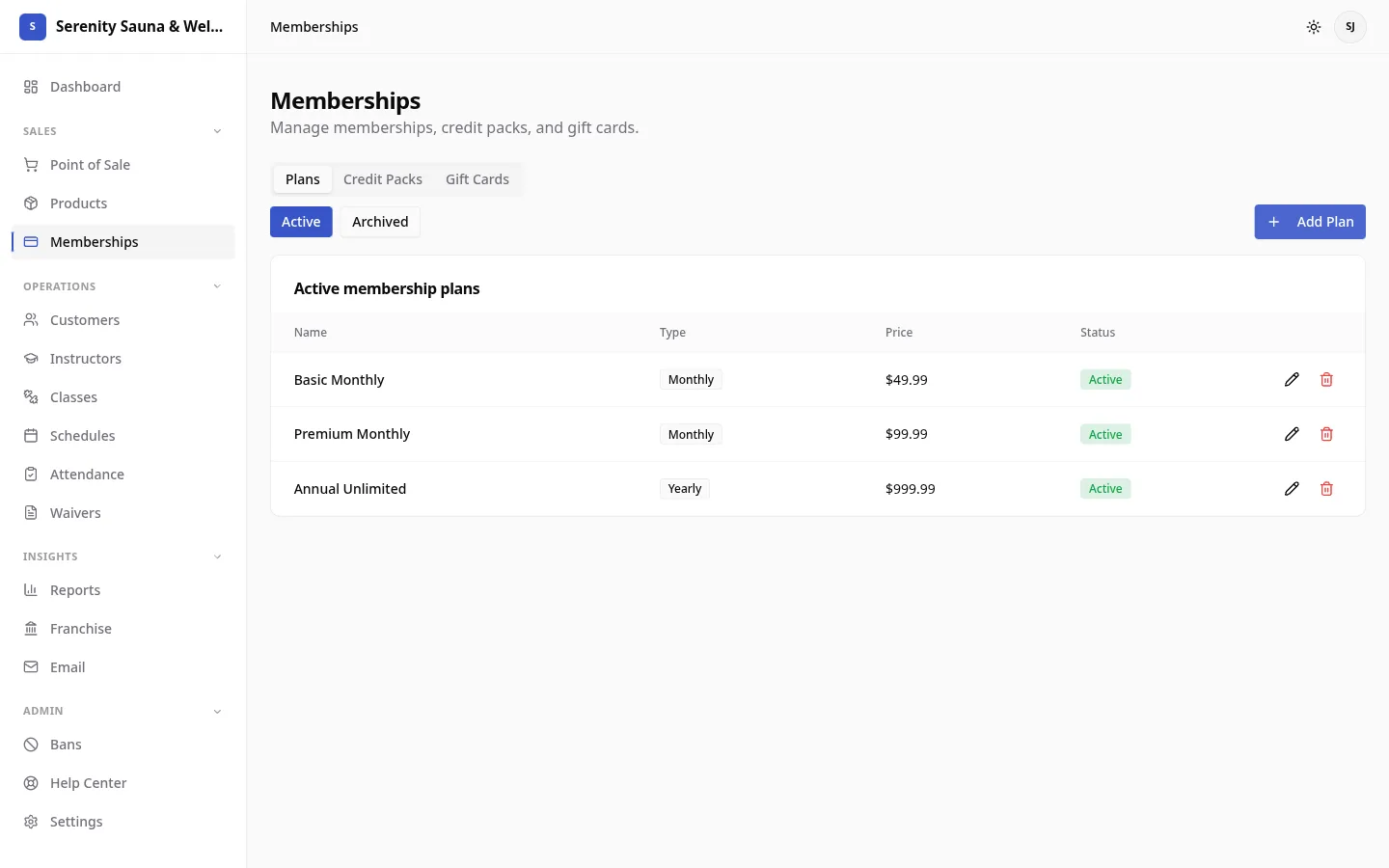
Elara keeps three kinds of rate, so a studio can tax retail, plans and drop-in bookings differently, which the class rules above can require. Prices are listed before tax and checkout adds the tax as its own line (tax settings).
- Retail at the front desk uses the product's own rate, then the rate of the location the sale is rung up at, then your studio's default. A product rate of 0 keeps it untaxed at a location that charges tax.
- Memberships, passes and packs each carry their own rate and never take a location or default rate, so a class pack can stay untaxed while an open-gym membership is taxed. A plan has one rate wherever it is sold and can't be limited to one location, so if your locations tax memberships at different rates, ask your accountant how to handle it before you set the plan up. Taxing a plan needs Stripe. Elara sets up the plan's price and tax rate in your Stripe account itself, when you save the plan on a studio connected to Stripe or at its first online sale if you connect Stripe later, so there is nothing to copy in. The rate is fixed once the plan is linked, so set it when you create the plan: an untaxed plan that should become taxed needs a new plan.
- Drop-in and private session bookings are untaxed until you turn on tax for bookings. Then online booking checkout uses the rate of the location the session runs at, or your default. A booking staff add is not taxed, so tax on a drop-in paid at the desk is not in Tax Collected; record it yourself.
Each line carries one rate and Elara's receipt shows one tax line, so a Quebec studio enters GST and QST as one combined rate, 0.14975 (14.975%); ask Revenu Québec what your receipts must show. A front-desk discount is spread across the lines in proportion to their prices before tax, as in the example above.
Plan your rate changes around how Stripe works. Stripe does not let a tax rate's percentage change after it is created,36 and a member renews at the rate their membership started with. When your rate changes, create a new plan at the new rate for new members and archive the old one; archiving leaves existing members renewing at the old rate. A renewing membership can't be moved onto or off a taxed plan, so to charge an existing member a new rate, or to start taxing one, cancel their membership at the end of its current period and have them buy the new plan.
A monthly or yearly plan sold at the Point of Sale is taxed at the plan's rate but covers one period and does not renew. On Stripe, the member can then choose Keep my membership in their account (taxed plans), and each renewal adds the plan's tax.
Gift cards are sold without tax. When one pays for a taxed pack or pass, tax is charged on the full price. Online checkout will not take a gift card for a renewing membership that adds tax; the front desk can, for one period (gift cards and tax). File from Tax Collected on the Financial report, which nets out refunds and voids and can be filtered by location, rather than from Stripe's tax reports: when a gift card pays part of a taxed sale online, Stripe charges the rest with no tax rate attached, and a sale a gift card pays in full never reaches Stripe. Tax on online membership sales and renewals counts toward the member's home location, so give members one if you file by location.
The payments page shows how locations, rates and receipts fit together. Elara is sold by quote: ask for a quote and tell us which states or provinces your locations are in and what you sell.