Yoga studio business plan: template and worked numbers
GuideBy Elara team · Published · 15 min read
A yoga studio business plan has to prove one number: how many students each class must average to pay the rent, the teachers, the loan and you. The template below uses the sections the US Small Business Administration lists for a traditional plan,1 filled in for an illustrative 25-mat studio. Unheated, that studio breaks even at 8.19 students a class; heated to 100°F, it needs 8.89. It plans for 10 in both, which leaves the owner about $65,700 a year unheated and $49,500 heated, before tax. Teacher training income stays out of those figures. The weakest line in either plan is what a member really pays: at the $108 a month we work out from YogaSix's disclosure, neither studio breaks even at 10 students. Owner's pay comes next: at $5,000 a month, the heated studio fails a lender's coverage test even at 10 students.
Fill in the template
Each row shows the illustrative studio's own answer. Drop any section that does not fit your studio, as the SBA allows. The last row is ours.
| Section | What to write | Illustrative studio |
|---|---|---|
| Executive summary | What you will open, where, how much you are asking for and how it gets repaid | 25 mats in 1,800 sq ft. Unheated: $131,000 project, $104,800 ten-year loan. Heated: $181,000 and $144,800. 10 students a class by month 10 |
| Company description | Legal entity, owners and their shares, heated or unheated, independent or franchise, why this location | One owner, independent, leased retail unit |
| Market analysis | Each competing studio's style, heat, peak class times and prices, read from its booking page, plus who lives and works nearby | A table of every yoga studio within your drive time, with its intro offer and unlimited price |
| Organization and management | Who runs the studio each day, who teaches, and how teachers are paid and classified | Owner on site, part-time teachers on 25 classes a week at $40 |
| Services and pricing | Styles, class length, weekly timetable, mats, price list and what an average visit brings in | 25 mats, 25 one-hour classes a week, 108 classes a month, $17.67 a visit |
| Marketing and sales | Presale target, intro offer, members needed, and new members needed each month to replace those who leave | 81 members plus 379 pack, drop-in and intro visits a month; about 7 new members a month |
| Funding request | Amount, debt or equity, terms, what the money buys and any collateral | The uses table below |
| Financial projections | Monthly for the first year, then a five-year outlook, with every assumption stated | The cost table, surplus chart and cash chart below |
| Risks and fallbacks | What goes wrong first, the number that tells you, and what you will cut | Below 8.9 students a class at month 10, drop from 25 to 20 classes a week |
Count the mats before you count the money
Every percentage in a yoga plan depends on how many mats you say the room holds, and that number has two tests. The first is comfort. One studio software vendor suggests 21.5 sq ft a student for gentle classes and 27 to 32 for vinyasa and ashtanga.2 The second is the code. Washington's fire code, for example, calculates the occupant load of an exercise room at one person per 50 gross sq ft, and permits a higher load if every other requirement is met, up to one person per 7 sq ft.3 North Carolina's fire marshal lists dance studios at the same 50 gross.4 Cities and states amend these tables, so ask the local building official which figure applies before you print a capacity.
Here is what that does to a 900 sq ft practice room:
| Basis | Sq ft a mat | Mats in 900 sq ft | Break-even fill, unheated | Break-even fill, heated |
|---|---|---|---|---|
| Exercise-room table figure | 50 | 18 | 45% | 49% |
| This plan | 36 | 25 | 33% | 36% |
| Vinyasa at the tight end of the vendor's range | 27 | 33 | 25% | 27% |
The break-even students do not change in that table: 8.19 and 8.89 are the same, and only the percentage moves. A plan that says "33% full" can rest on a mat count the building official has not accepted, so write the students a class first and the percentage second. If 25 needs a higher approved load, get that answer before you sign the lease, since it can decide what the exits and the unit have to provide.
Work out what a visit brings in
The plan below is illustrative, in USD. It uses the studio from our opening guide: 1,800 sq ft, a 900 sq ft room, 25 mats, 25 classes a week, a $159 unlimited membership. That guide sells only memberships. A plan has to model the mix, so this one adds packs, drop-ins and an intro offer. Prices and shares are assumptions. Card fees use Stripe's US rates of 2.9% + 30¢ a payment, plus 0.7% on recurring billing, which only the membership pays.5 That leaves $152.98 of each $159 membership, spread over 8.67 visits a month.
| How the student pays | Share of visits | Brought in per visit, after card fees |
|---|---|---|
| $159 unlimited, attending twice a week | 65% | $17.65 |
| $190 ten-class pack, every credit used | 25% | $18.42 |
| $25 drop-in | 5% | $23.97 |
| $49 intro month, six visits | 5% | $7.88 |
| Average visit | 100% | $17.67 |
The $17.67 is the number to attack first. Each extra visit a member makes lowers it, and every discount lowers it, so the drop-in price tells a lender nothing.
Set teacher pay and the monthly costs
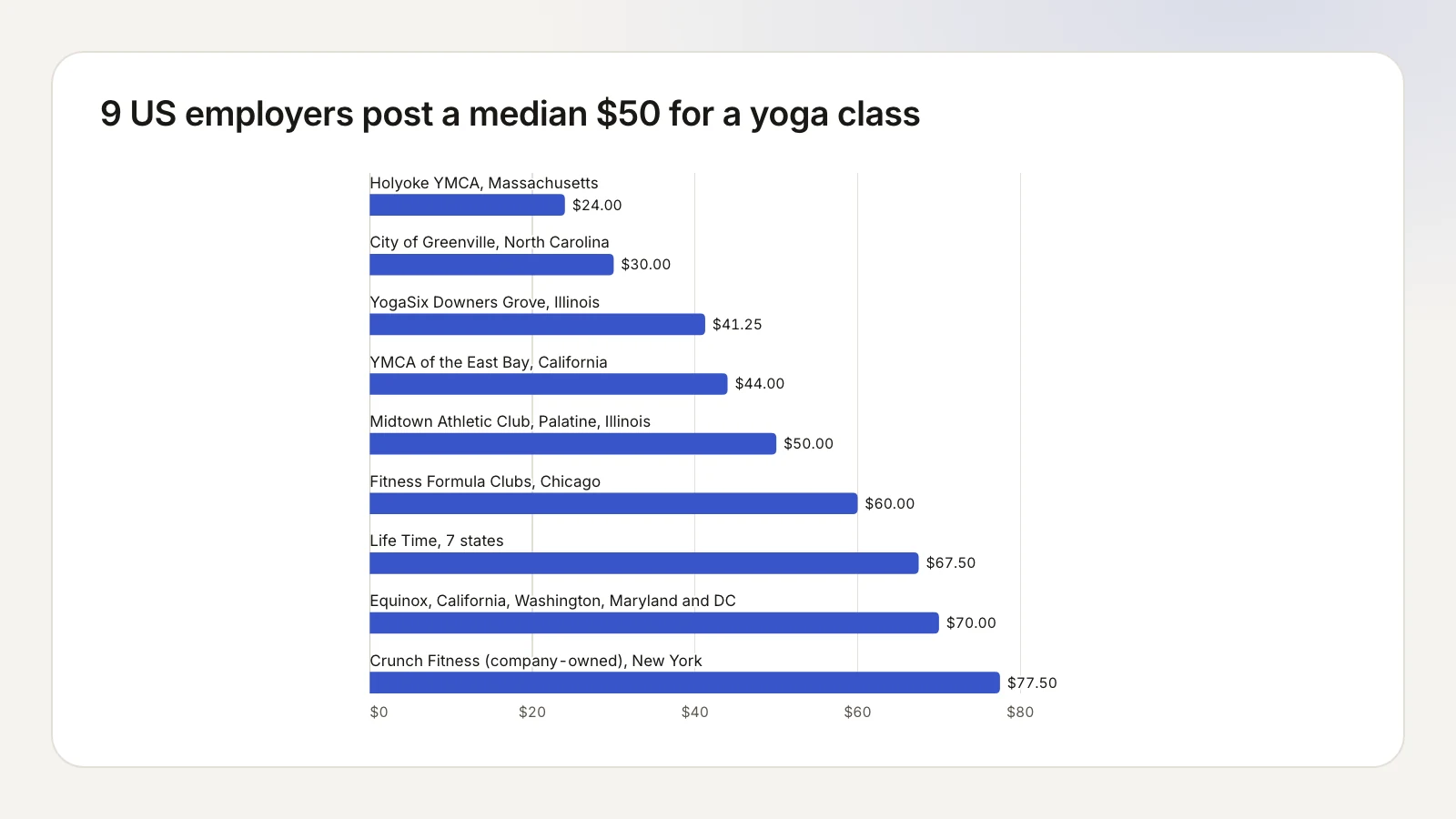
Teachers cost $40 a class here, 25 a week over 52 weeks. The government figure covers every fitness instructor: a median of $22.67 an hour in the US in May 2025.6 Two YogaSix franchisee ads in Downers Grove, Illinois, post $30 to $50 an hour for a teacher and $35 to $50 for a lead teacher, though they describe the pay as per class,7,8 and Mariana Tek gives $19 to $65 a class across markets.9 Those are small samples, so ask teachers what studios near you pay. If your teachers are employees, a US employer pays another 7.65% in Social Security and Medicare tax,10 which the stress test below adds back. Canada's employer costs differ. Whether teachers are employees depends on how you direct the work, under tests that differ by state and province, so ask an employment lawyer or accountant where you open before you choose. Paying per head changes this table, and our per-class and per-head guide finds the class size where the two cross.
| Cost a month | Unheated | Heated |
|---|---|---|
| Rent, 1,800 sq ft at $25.82 a year11 | $3,873 | $3,873 |
| Taxes and shared costs, assumed $6 per sq ft a year | $900 | $900 |
| Insurance and music licences, from the opening guide | $319 | $319 |
| Other utilities | $350 | $350 |
| Cleaning, assumed $300 more for a heated room | $600 | $900 |
| Software, accounting and phone | $350 | $350 |
| Marketing | $500 | $500 |
| Desk cover | $1,000 | $1,000 |
| Electricity for heat, seven hours a day at the US average | $499 | |
| Teachers, 108.33 classes at $40 | $4,333 | $4,333 |
| Owner's pay | $2,000 | $2,000 |
| Before the loan | $14,225 | $15,024 |
| Loan payment | $1,444 | $1,995 |
| Costs the classes must cover | $15,669 | $17,019 |
The unheated $14,225 is the opening guide's $13,326 plus the $900 of shared costs, with its "everything else" line itemized. The heat electricity estimate comes from that guide too. The guide spreads the heating equipment over 36 months; here it goes in the loan.
Find the class fill that breaks even
Divide the costs by 108.33 classes and each class has to bring in $144.64 unheated and $157.10 heated. At $17.67 a visit, that is 8.19 students and 8.89 students.
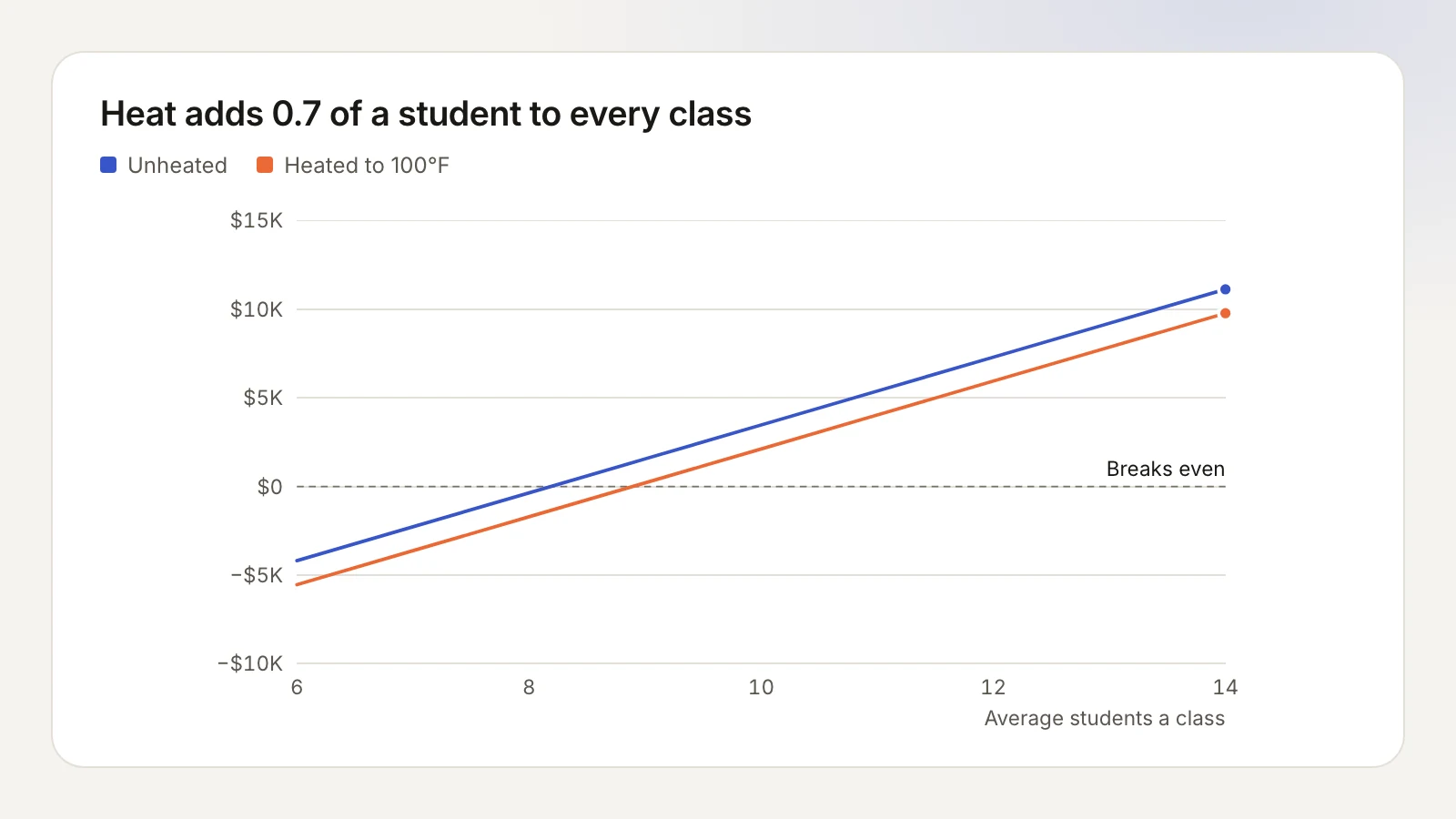
Heat adds 0.7 of a student to every class
Monthly surplus of the illustrative 25-mat studio after every cost, the loan and $2,000 of owner's pay, by average students a class.
- Unheated
- Heated to 100°F
Surplus a month
Illustrative: 25 classes a week, $17.67 a visit, $40 a class for teachers. Costs from the table above.
Show the numbers
| Average students a class | Unheated | Heated to 100°F |
|---|---|---|
| 6 | −$4,184 | −$5,534 |
| 7 | −$2,270 | −$3,620 |
| 8 | −$355 | −$1,705 |
| 9 | $1,559 | $209 |
| 10 | $3,473 | $2,123 |
| 11 | $5,387 | $4,037 |
| 12 | $7,302 | $5,952 |
| 13 | $9,216 | $7,866 |
| 14 | $11,130 | $9,780 |
That 0.7 is 76 more visits a month. At the same 10 students a class, heat costs the owner $1,350 a month, or $16,200 a year: $499 of electricity, $300 of cleaning and $551 more loan payment. A heated room closes that gap only if it fills better or charges more. Matching the unheated break-even takes $1.52 more a visit, 8.6%, which would turn the $159 membership into about $173. Your competitor table will show whether heated rooms near you get that.
An average of 10 hides the timetable. It is 250 visits a week. If eight peak classes hold 20 students, the other 17 need 5.3 each. Write that split into your plan, because a lender can check your peak hours against your competitors' timetables, and because the peak is capped by the mats you counted above.
A class pays for its teacher at 2.26 students ($40 / $17.67), so a quiet class at 5 is not losing money. It is not earning its share of the rent either. Adding classes lowers the fill you need only if they bring new visits: at 30 classes a week the unheated studio breaks even at 7.20 students, but that takes 936 visits a month against 887, and the same students spread across more classes add only teacher pay. At 20 classes it needs 9.67 students on 838 visits.
Set the budget to open
| Use of funds | Unheated | Heated |
|---|---|---|
| Build-out, 1,800 sq ft at an assumed $50 per sq ft | $90,000 | $90,000 |
| Less landlord allowance, assumed $20 per sq ft | -$36,000 | -$36,000 |
| Heating and humidity equipment at list | $24,255 | |
| Heat installation and ventilation, assumed | $12,000 | |
| Flooring that tolerates sweat, assumed | $6,000 | |
| Furniture, props, sound and signage | $12,000 | $12,000 |
| Two-month deposit, two months of rent during the build | $19,092 | $19,092 |
| Permits and professional fees | $5,000 | $5,000 |
| Opening marketing | $6,000 | $6,000 |
| Loan payments before opening, rounded up | $4,908 | $6,653 |
| Working capital | $30,000 | $36,000 |
| Total | $131,000 | $181,000 |
Build-out is the assumption most likely to be wrong. Mariana Tek puts a full commercial build-out at over $100,000,9 and YogaSix's $543,999 to $1,026,853 includes a franchise fee and a brand-standard build-out. Replace ours with a contractor's quote and the landlord's offer before anyone else reads this.
The owner puts in 20%, $26,200 or $36,200, and borrows the rest for ten years at an assumed 11%. The SBA caps a variable rate on a 7(a) loan of $50,001 to $250,000 at prime plus 6%,12 which is 13% with prime at 7.00%.13 The budget leaves out loan fees, so get those from your lender. Our Pilates business plan works through the lender's and landlord's checks in full, including how lease term and a landlord's allowance interact with the loan. They apply to a yoga studio unchanged.
Test what a lender will push on
Debt service coverage is operating cash flow divided by loan payments, after what the owner draws. Both of this plan's loans are $350,000 or less, so the SBA's 7(a) Small test applies first: 1.10 within one year of funding, on a start-up's projections. Your lender can ask for more.12 That floor sits at 8.26 students unheated and 9.00 heated, barely above break-even, because the loan is a small share of this studio's costs: 9% unheated and 12% heated. Teachers and rent alone are about half of those costs. A loan that misses 1.10 has to go through the Standard 7(a) or SBA Express procedure instead. On Standard, the start-up test is 1.15 within two years of funding, which here is 8.30 students unheated and 9.05 heated.
The budget pays three loan payments before opening, so funding comes about three months ahead and the one-year window closes at month 9 of trading. The planned ramp has 9.5 students by then, past both floors. If each step comes three months late, month 9 has 8 students, which misses 1.10 in both studios and sends the loan to the Standard route. That late ramp reaches 1.15 at month 10 unheated and month 12 heated, 13 and 15 months after funding. Those are single months, so ask your lender how it measures the year.
Each row moves one assumption.
| Change from the plan | Break-even students, unheated | Coverage at 10, unheated | Break-even students, heated | Coverage at 10, heated |
|---|---|---|---|---|
| None | 8.19 | 3.41 | 8.89 | 2.06 |
| Owner needs $5,000 a month, not $2,000 | 9.75 | 1.33 | 10.46 | 0.56 |
| Members bring in $108 a month, not $153 | 10.10 | 0.89 | 10.97 | 0.25 |
| Teachers cost $50 a class, not $40 | 8.75 | 2.66 | 9.46 | 1.52 |
| Employer payroll taxes on the $40 | 8.36 | 3.18 | 9.06 | 1.90 |
| Rent and shared costs 10% higher | 8.43 | 3.07 | 9.14 | 1.82 |
| Loan at 13%, not 11% | 8.25 | 3.14 | 8.98 | 1.90 |
| Heat 15 hours a day in California | 9.71 | 1.28 |
Interest and rent barely move the answer. Your own pay and what a member really brings in move it by more than a student and a half. The $108 row comes from YogaSix's disclosed figures, explained below, and at that number neither studio breaks even at 10 students.
Check the plan against YogaSix's disclosed numbers
We found no published class-fill figure for any yoga brand. The closest thing is Item 19 of YogaSix's amended 2025 franchise disclosure, which reports 162 US studios open for all of 2024.14 We read a copy on an outside file host, not a state registry copy. It is a national brand with its own class formats, not an independent, and the franchisor warns that your results may differ.
| Per studio, 2024 | Average | Bottom quartile average | This plan at 10 students |
|---|---|---|---|
| Gross revenue a year, before card fees | $488,615 | $231,707 | $238,300 |
| Monthly active members | 264 | 137 | 81 |
| Memberships as a share of revenue | 73% | not given | 65% |
Item 19 defines gross revenue as a studio's total revenue, less only sales tax, so we count the plan at list prices too, before the card fees taken out above. That puts the plan's revenue about 3% above what YogaSix's bottom quartile averaged, which is a modest claim, on far fewer members than its lowest member quartile, which is not. Item 19 ranks each measure into quartiles separately, so the $231,707 and the 137 need not come from the same studios. The plan gets there because its 81 members are assumed to pay $159 each, or $153 after card fees. Multiplying the 73% share by average revenue and dividing by average members gives about $113 a member a month, or $108 after card fees. That is our arithmetic on averages. It includes every freeze and discount, and YogaSix does not report visits. If your members come less often than twice a week, each visit brings in more and there are fewer of them, so the real check is members times what they actually pay. At $108 each, it takes 115 members to bring in the $12,429 a month the plan expects from 81.
YogaSix's studios signed 24 new memberships a month on average against 264 active members. If that base was holding steady, about 9% of it left each month, which is our inference and not a disclosed churn rate. At that rate 81 members lose about 7 a month, so the $500 marketing line has to win a member for about $68.
Find the month cash runs lowest
A studio reaches 10 students a class only after months of thinner classes. The plan's ramp is an assumption and counts no presale: 4 students a class in month 1, 7 by month 4, 8 by month 6 and 10 by month 10.
A ramp three months late runs out of cash in month 4
Cash at the end of each month of the illustrative studio's first year, from $30,000 of working capital unheated and $36,000 heated.
- Unheated, planned
- Heated, planned
- Unheated, three months late
- Heated, three months late
Cash at month end
Illustrative: 108.33 classes every month, $17.67 a visit and the costs above, including the loan payment and $2,000 of owner's pay.
Show the numbers
| Month after opening | Unheated, planned | Heated, planned | Unheated, three months late | Heated, three months late |
|---|---|---|---|---|
| 1 | $21,988 | $26,638 | $21,988 | $26,638 |
| 2 | $15,890 | $19,190 | $13,975 | $17,275 |
| 3 | $11,706 | $13,656 | $5,963 | $7,913 |
| 4 | $9,436 | $10,036 | −$2,049 | −$1,449 |
| 5 | $8,124 | $7,374 | −$8,147 | −$8,897 |
| 6 | $7,768 | $5,668 | −$12,331 | −$14,431 |
| 7 | $8,370 | $4,920 | −$14,601 | −$18,051 |
| 8 | $9,929 | $5,129 | −$15,913 | −$20,713 |
| 9 | $12,445 | $6,295 | −$16,269 | −$22,419 |
| 10 | $15,918 | $8,418 | −$15,667 | −$23,167 |
| 11 | $19,391 | $10,541 | −$14,108 | −$22,958 |
| 12 | $22,865 | $12,665 | −$11,592 | −$21,792 |
On the planned ramp, cash bottoms at $7,768 in month 6 unheated and $4,920 in month 7 heated. If each step comes three months late, the unheated studio is $16,269 short by month 9 and the heated one $23,167 short by month 10. Say in the plan which fix you would use, and size it. Borrowing at the start takes about $19,500 unheated and $28,500 heated, more than the shortfall, because the extra loan adds a payment each month. Deferring your $2,000 of pay or cutting from 25 to 20 classes, which saves $867 a month if students move to the classes that remain, narrows the gap, but neither closes it alone.
A presale is what shortens a ramp. YogaSix's 30 studios that opened in 2024 averaged 277 active members in their first month and $31,200 of revenue in their second, about 79% of the roughly $39,500 they settled at. Member counts then drifted down, from 308 in month 3 to 254 in month 10, though fewer and fewer studios report as the months pass, so that slide may be partly a change in which studios are counted. Read together, those numbers say the opening weeks set the year, and that a presale moves cash forward without adding any. Set a presale target in the plan, and see what to promise founding members.
Keep teacher training out of the base plan
Teacher training income is an assumption in any plan, so show it on its own line beneath a base plan that already works. A plan that needs it to pass has not passed, and we found no published figure for what a studio earns from one or for typical cohort size. Here is the illustrative sum for one 200-hour training a year, at the $3,099 one Yoga Alliance registered program lists,15 inside the $2,800 to $5,000 a seller of online training estimates for local studios.16 Costs are $12,000 for 200 hours of paid trainer time at an assumed $60, $640 for Yoga Alliance's $400 application and $240 annual fee,17 and $600 of materials.
| Trainees | Tuition | Net a year after costs and card fees | Same as this many more students a class |
|---|---|---|---|
| 4 | $12,396 | -$1,205 | |
| 6 | $18,594 | $4,813 | 0.21 |
| 8 | $24,792 | $10,831 | 0.47 |
| 12 | $37,188 | $22,866 | 1.00 |
It breaks even at 4.4 trainees. Twelve trainees a year is worth one more student in every class, so a training can rescue a marginal plan only by filling, every year, from the same local students your classes depend on. The sum also treats the room as free. A training held across eight weekends, as the program above is, takes hours your peak classes use, unless you run it around them. Paid trainings can also need approval as vocational training in some states and provinces, so ask your state's private postsecondary education agency or your province's private career college regulator before you count on one.
Adjust the plan for Canada
The operating plan carries over in Canadian dollars, with your own rent and pay, except the 7.65% payroll row. Outside Quebec, an employer matches each employee's Canada Pension Plan contribution18 and pays 1.4 times their Employment Insurance premium,19 so ask your accountant what that adds to $40 a class. Quebec employers deduct for the Quebec Pension Plan instead of CPP,20 at their own rates, so the same question goes to the accountant there. Financing changes: the Pilates plan's Canadian section covers the federal small business loan program and what banks ask for, and the opening guide has Canadian wage figures. The occupant load comes from your province's building code. We did not confirm a Canadian figure for exercise rooms, so ask your municipal building department.
Track students a class after you open
In Elara, the reports show each session by weekday and start time with average seats booked, capacity and fill rate, so you can see whether your peak and off-peak split matches the plan.21 Average booked counts seats sold, no-shows included. That figure is per slot, with no timetable-wide average, so to compare the whole timetable with the plan's 8.9 fallback line, export the report and divide total seats sold by total sessions. Elara's reports have no profit model, so keep coverage and profit in your spreadsheet. The memberships page shows the plans and packs behind the visit price, and the yoga studio page shows the weekly timetable with workshops at their own price.
Elara is sold by quote: ask for a quote and tell us your room size, timetable and whether it is heated.