How to open a yoga studio: costs, heated rooms and members needed
GuideBy Elara team · Updated · 11 min read
Before you sign a lease, work out two numbers for the space: the members it takes to cover a month, and the members its timetable can hold. In this model, heating the room changes only the first number. In the hypothetical studio below, an unheated room covers its month at 88 members and a room heated to 100°F needs 95, because ceiling panels and a humidifier list at about $24,300 and seven hours of heat a day uses about $500 of electricity a month at the US average commercial price. At an average of 30% of mat places filled, 25 classes a week hold 93 members: enough for the unheated room, two short for the heated one. Then allow a year from signing to the first class, longer if the building needs new electrical service for the heat.
Read the franchise figures as an outer bound
YogaSix, which its franchisor calls "the largest franchised yoga brand worldwide," puts the investment for one studio at $543,999 to $1,026,853, citing its 2026 disclosure document.1 That total includes the franchise fee and a build-out to the brand's standard, neither of which an independent studio has to pay. It is a ceiling to test your own quotes against, not a budget.
The franchisor's annual report is more useful for what it shows about opening. Xponential reports 194 YogaSix studios open and 637 licences sold at December 31, 2025.2 The report does not say how many of the other 443 licences were terminated and how many are still due to open. Across all its brands, Xponential says about 30% of the licences due to open in North America are more than 12 months behind schedule and currently inactive.
Price the heat before you choose the space
A heated room needs heaters sized to the temperature you teach at, a way to hold the humidity and an electrical service that can carry both. Humidity is the part owners underestimate: a humidifier maker describes a hot yoga studio in Tempe, Arizona, meant to run at 105°F and at least 40% humidity, whose old humidifiers never got the room above 25%, and whose owner refunded classes.3
For suspended ceilings over 9 ft, one panel seller sizes its 2 by 4 ft, 1,250 W ceramic ceiling panels by temperature: one per 80 sq ft for rooms up to 85°F, per 65 sq ft up to 90°F, per 50 sq ft up to 95°F and per 40 sq ft at 100°F and above.4 The hypothetical room in this guide is 900 sq ft, heated to 100°F or more, priced from that seller's list on October 27, 2026:
| Item | Quantity | Price each | Total |
|---|---|---|---|
| Ceramic ceiling panel, 2 by 4 ft, 1,250 W | 23 (900 / 40, rounded up) | $905 | $20,815 |
| Heat relay, one per 4 panels | 6 | $137 | $822 |
| Thermostat | 1 | $209 | $209 |
| Transformer for the low-voltage thermostat | 1 | $49 | $49 |
| Wall-mounted humidifier package5 | 1 | $2,360 | $2,360 |
| Equipment total | $24,255 |
The humidifier is the seller's base package, not one sized for this room: have it sized for 900 sq ft at 40% humidity and 100°F, and expect a larger unit to raise the total. The total also leaves out installation, ventilation to clear wet air between classes, flooring that tolerates sweat and any upgrade to the building's electrical service. The 23 panels draw 28.75 kW together, so before you sign, have an electrician confirm the unit can carry that on top of the lights, and get the upgrade priced if it cannot.
Electricity depends on how many hours a day the panels run. Assume one hour at full power to heat the room each morning, then half power on average for every further hour of classes and gaps, every day. Seven hours of heat is 115 kWh a day and 3,450 kWh over 30 days, which at August 2026 commercial prices costs $499 at the US average, $309 in Texas, $796 in New York and $1,036 in California.6 A studio that holds the heat from 6 a.m. to 9 p.m. runs the panels twice as long:
Heating the room costs $309 to $2,071 a month in electricity
A 900 sq ft room heated every day: one hour at full power, then half power.
- California
- New York
- US average
- Texas
Electricity for heat a month
US Energy Information Administration average commercial prices for August 2026, per kWh: California 30.02¢, New York 23.06¢, US 14.47¢, Texas 8.96¢.
Show the numbers
| Hours of heat a day | California | New York | US average | Texas |
|---|---|---|---|---|
| 7 | $1,036 | $796 | $499 | $309 |
| 9 | $1,295 | $994 | $624 | $386 |
| 11 | $1,554 | $1,193 | $749 | $464 |
| 13 | $1,812 | $1,392 | $874 | $541 |
| 15 | $2,071 | $1,591 | $998 | $618 |
Those are averages across each state's commercial customers. A tariff with a demand charge bills the 28.75 kW morning peak separately, so the heat-up costs more than the average suggests; read your utility's commercial tariff for the unit. In Canada, use your utility's general service rate: we found no national figure.
Spread over 36 months, the equipment is about $674 a month. Add seven hours of heat a day at the US average and the heated room costs about $1,173 a month more than the unheated one. At 15 hours of heat in California it costs about $2,745 more.
Count the members you need and the members the timetable holds
The studio below is hypothetical, in USD, with one 900 sq ft practice room of 25 mat places in 1,800 sq ft. Its price, attendance and costs are assumptions to replace with your own:
| Monthly cost | Amount | Basis |
|---|---|---|
| Rent | $3,873.00 | 1,800 sq ft at $25.82 per sq ft a year, the US average shopping-center asking rent in Q3 2026; the report does not say whether tax, insurance and common-area charges are included, so ask the landlord7 |
| Insurance | $188.00 | Median quotes for gyms and fitness centers: $86 for a business owner's policy, which includes general liability, and $102 for workers' compensation8 |
| Music licences | $131.17 | BMI, ASCAP and SESAC for this timetable, worked out below |
| Teacher pay | $4,333.33 | 25 classes a week at $40 a class, over 52 weeks |
| Everything else | $4,800.00 | Assumed: other utilities, cleaning, software, marketing, desk cover and the owner's pay |
| Total, unheated | $13,325.50 | |
| Heat, from the section above | $1,172.97 | Equipment over 36 months plus seven hours a day at the US average price |
| Total, heated | $14,498.47 |
In Canada, average triple-net asking rents were C$36.36 per sq ft a year in Toronto9 and C$38.83 in Vancouver10 in Q2 2026.
The studio sells one unlimited membership at $159 a month. After Stripe's 2.9% + 30¢ per card payment and 0.7% for recurring billing,11 each membership brings in $152.98. The unheated studio covers its month at 88 members and the heated one at 95.
Classes 30% full cover the unheated room but not the heated one
The unheated room breaks even at 88 members, the heated one at 95.
- Unheated
- Heated to 100°F
Profit a month
Example studio: $159 unlimited, 25 classes a week of 25 mats, members coming twice a week. Costs from the table above, card fees at Stripe's US rates.
Show the numbers
| Members | Unheated | Heated to 100°F |
|---|---|---|
| 60 | −$4,147 | −$5,320 |
| 70 | −$2,617 | −$3,790 |
| 80 | −$1,087 | −$2,260 |
| 90 | $442 | −$731 |
| 100 | $1,972 | $799 |
| 110 | $3,502 | $2,329 |
| 120 | $5,032 | $3,859 |
| 130 | $6,561 | $5,388 |
| 140 | $8,091 | $6,918 |
The break-even only matters if the timetable can seat it. Each member here comes to two classes a week, and 25 classes of 25 places offer 625 places a week. If classes average 30% full, the timetable holds 93 members: the unheated studio covers its month, the heated one does not. At 40% it holds 125 members and at 60% it holds 187, and both clear. So the heated studio's break-even asks for its classes to average about 30% full, and the unheated one's about 28%.
Test that fill against the classes you teach now, at the hours you plan to run. If yours average below 30%, the heat is a cost the room may not cover, however good the classes are.
Two other levers move the break-even:
- Price. At $139 a month the unheated studio needs 100 members and the heated one 109; at $179, 78 and 85. Price changes the members you need, not the members the timetable holds.
- Classes. At 30 classes a week, teacher pay rises to $5,200 and the members needed to 93 unheated and 101 heated, with an hour more heat a day; at 35 classes, to $6,066.67, 99 and 107, with two more hours. Each extra class holds about 3.75 more members at 30% fill, but only if it fills like the others. A class at an hour nobody wants adds its $40 and no members.
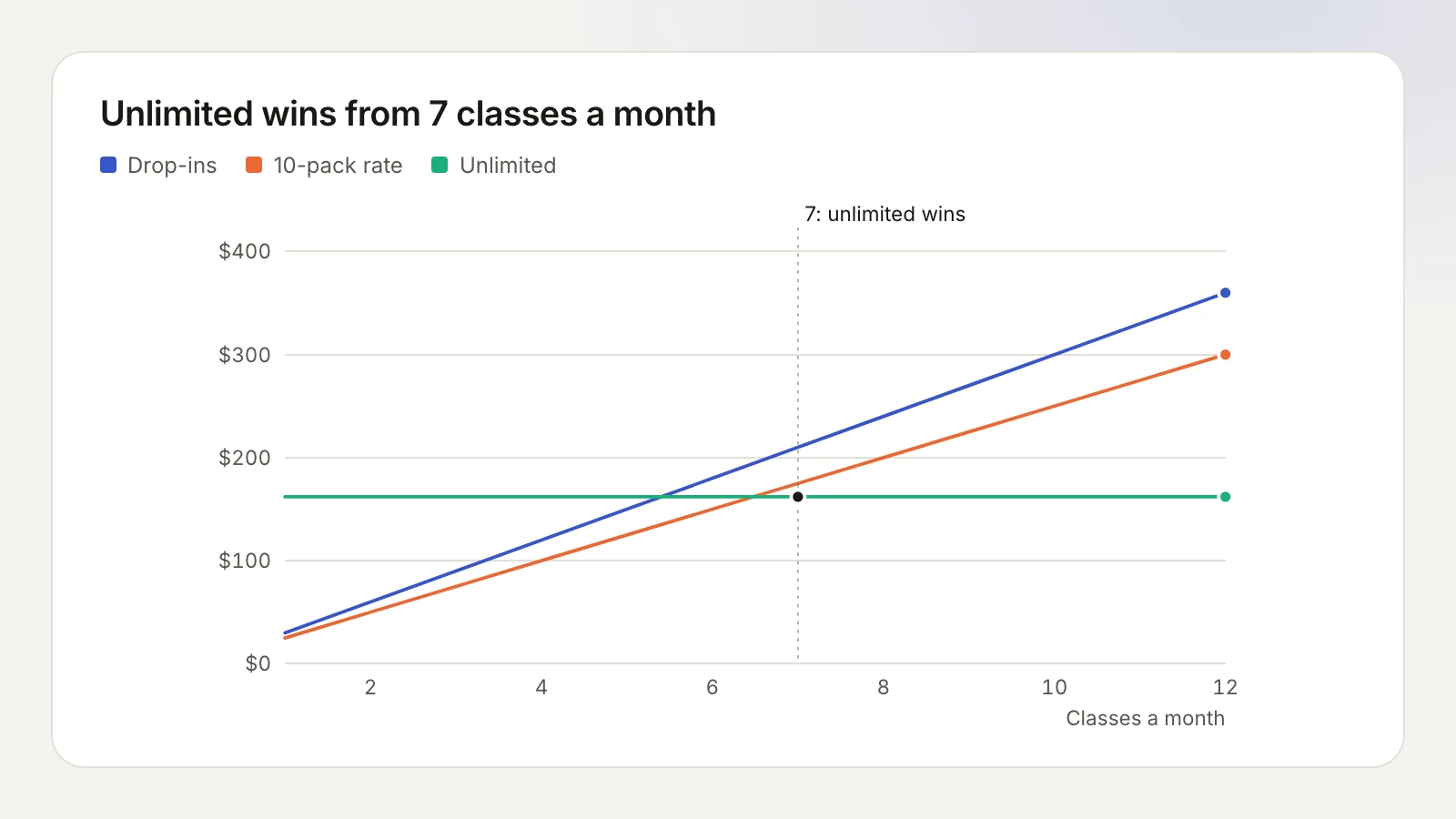
This model sells only memberships. A student on a 10-class pack pays a different amount per class than a member who comes eight times a month, so if you sell packs and drop-ins, model your own mix. It is also a steady month: the first months run below it, and the months before opening are paid from savings.
Budget a year from lease to first class
In 2026, New York's Attorney General settled with Xponential over disclosure documents for its brands, YogaSix among them, that told buyers a studio could be expected to open about six months after signing. Its franchisees' New York studios took about 13.3 months on average, across the brands.12 Xponential agreed to pay $3,971,250 to New York franchisees.13 In a separate case filed in March 2026, the FTC alleged that Xponential misrepresented the cost and time to open across its brands, and announced a settlement that returns $17 million to franchisees.14
Those franchisees had a site team and a brand's build-out plan behind them. An independent studio signs its own lease, hires its own contractor and gets its own permits, so treat a year as the minimum until a contractor has walked the space. Rent usually starts when the lease does, so ask the landlord for free months during the fit-out: the rent you pay while the room is a building site is part of the opening cost.
Set teacher pay per class
The government figures cover every fitness instructor, not yoga teachers alone. In the US, exercise trainers and group fitness instructors earned a median of $22.67 an hour and a mean of $25.20 in May 2025.15 In Canada, program leaders and instructors in recreation, sport and fitness earned a median of C$19.00 an hour in 2023 to 2024, with C$23.74 in British Columbia, C$20.00 in Alberta, C$18.50 in Ontario and C$18.75 in Quebec.16
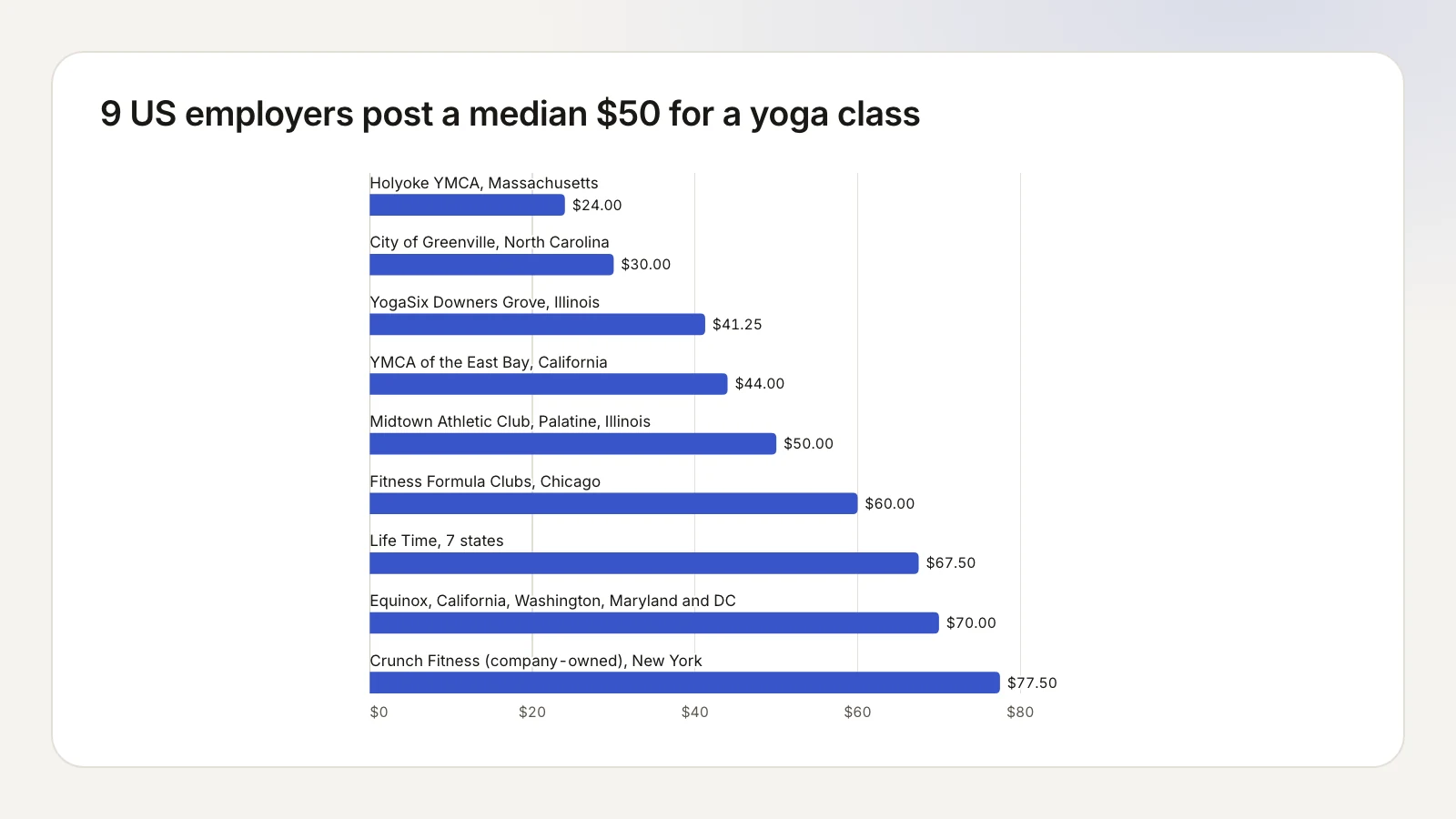
Yoga-specific pay shows in individual ads, not in a dataset. Two YogaSix franchisee ads in Downers Grove, Illinois, open on October 27, 2026, post $30 to $50 an hour for a teacher and $35 to $50 for a lead teacher, though they describe the pay as per class.17,18 The hypothetical studio's $40 a class sits inside that range for an hour-long class. Two ads are not a market rate; ask teachers what the studios near you pay.
Whatever the rate, it is a cost of every class on the timetable, full or not, which is why the class count moves the break-even. Whether a teacher is an employee or a contractor depends on how you direct the work, under tests that differ by state and province; ask an employment lawyer or accountant where you open before you choose.
If you pay by the hour, Elara's payroll turns the hours each person records on the time clock into regular, overtime and double time hours under your pay rules, and estimates pay as those hours times the hourly rate you enter. A manager approves each pay period and exports it as CSV for your payroll provider. Elara does not run payroll, pay anyone or work out a per-class rate; for per-class pay, its Staff Attendance report counts each teacher's sessions that had bookings.
Register a teacher training only if you will sell one
A teacher training is a second business inside the studio: a fixed group of students who attend every date of a course. Registering it with Yoga Alliance as a Registered Yoga School costs a one-time $400 application fee and $240 a year for each credential, and lets graduates register as RYTs; the 200-hour and 300-hour standards set the curriculum, the lead trainer's qualifications and the hours.19 Registration is voluntary, since Yoga Alliance is a private organization, not a licensing body. Some states and provinces regulate paid vocational training separately, so ask your state's private postsecondary education agency, or your province's private career college regulator, whether a training you sell needs approval.
In Elara, each date of a course is a separate booking. Give the course's sessions their own category, sell the training as a credit pack with one credit per date, limited to that category, and limit the sessions to that pack. Set each session's credit cost to 1 and leave its drop-in price empty: a drop-in price would let anyone buy a single date, and a session with neither is free to book. Customers can book only as far ahead as the studio's advance booking limit, 30 days by default, up to 365, and the same for every class. Staff bookings are not held to it, so for a longer course, book each student's dates for them when they buy, and a place on one date does not hold a place on the next.
License the music before the first class
Playing recorded music in classes needs a public performance licence, and in the US the rights are split between societies that each license their own catalog. Their 2026 fitness rates, from the schedules they file with Colorado's Secretary of State:
| Organization | Licence | Rate |
|---|---|---|
| BMI | Fitness clubs with group classes | $0.387 per member a year, minimum $432 and maximum $2,944 for each location20 |
| ASCAP | Fitness clubs with group classes | $545 a year for up to 500 places a week, $708 for 501 to 1,000, counting places as classes a week times the room's capacity21 |
| SESAC | Yoga studios that are Yoga Alliance members | $386 a year per location, or $434 once a studio is no longer a member; its health club licence is $434 for each location of a business with up to nine22 |
| GMR | By quote; no published rate |
For the hypothetical studio, 187 members at 60% fill put BMI's rate at $72.37, below the $432 minimum; 625 places a week fall in ASCAP's $708 band; SESAC adds $434. That is $1,574 a year, the $131.17 a month in the cost table, before GMR. Teachers who teach at several studios can license their own classes instead (ASCAP's fitness instructor licence is $226 a year and SESAC's for exercise, dance and yoga instructors $156), so ask each society whether an instructor's licence covers classes in your room. Canada's rates come from SOCAN and Re:Sound; the gym guide sets them out.
Before you sign
Bring three quotes to the lease negotiation: the electrician's on whether the unit can carry the heat, the mechanical engineer's on ventilation, and your insurer's on whether a heated room changes the premium. Then run the member count with your own rent, class count and price, and compare the fill it needs with the fill your classes get today.
The yoga studio page shows how Elara runs the timetable, class packs and memberships once you open. Classes are in person: Elara does not stream them. For a plan built around reformers, see the Pilates studio guide. Elara is sold by quote: ask for a quote and tell us your timetable, class sizes and whether you run a teacher training.