Pilates studio business plan: template and worked example
GuideBy Elara team · Published · 12 min read
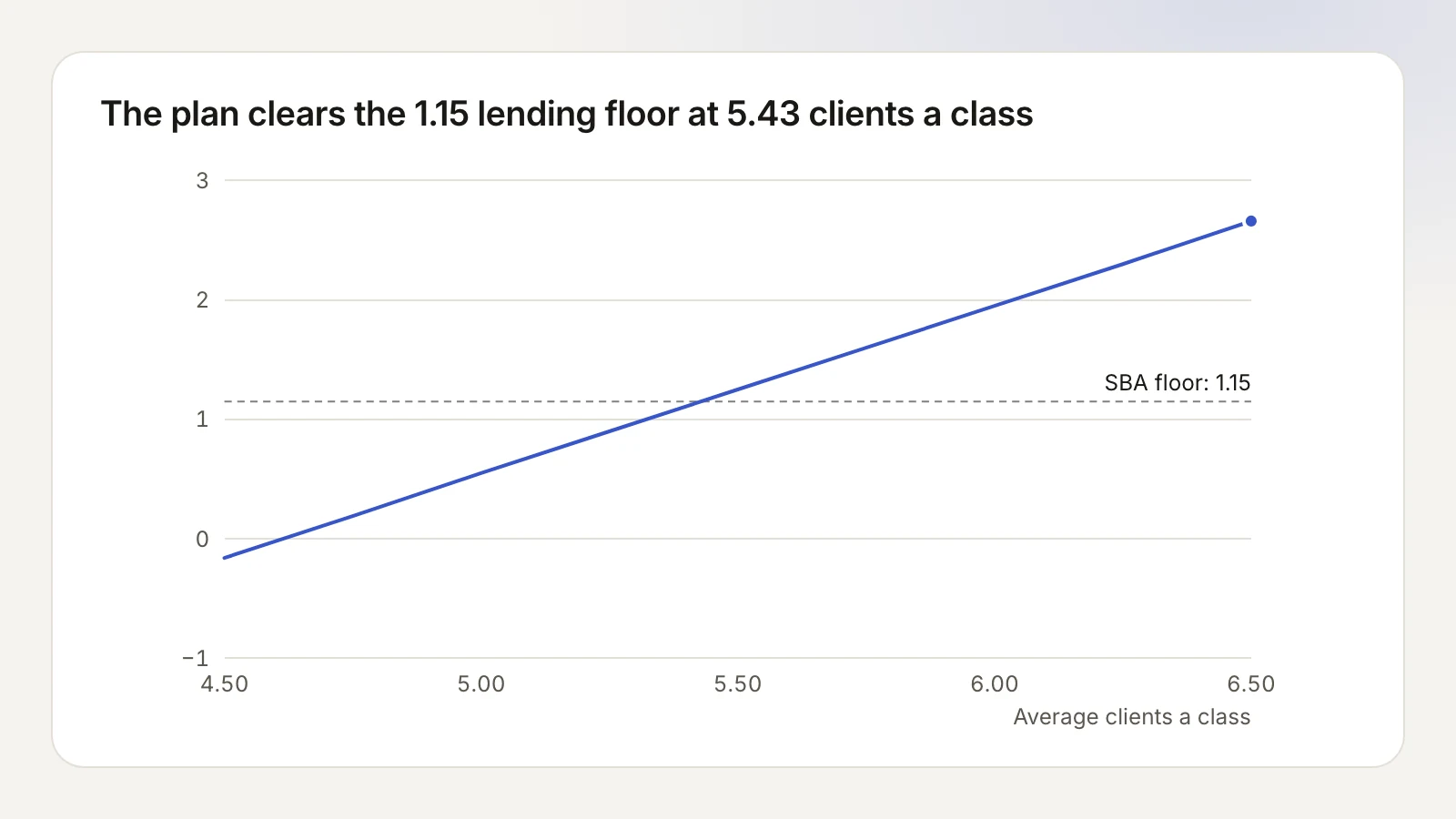
A Pilates studio business plan has to prove that enough clients will come to each class to pay the rent, the instructors, the loan and you. The template below follows the sections the US Small Business Administration lists for a traditional plan.1 The illustrative eight-reformer plan under it needs $240,000, breaks even at 5.32 clients a class, and clears the SBA's 1.15 debt coverage floor at 5.43 clients, about 68% of its reformers. It assumes 6. The gap between 5.43 and 6 is what a lender or landlord will test, so most of the plan's work goes into defending it.
Fill in the template
The right-hand column is the illustrative studio's answer, so you can see how specific each section needs to be. The SBA says to use the sections that fit your business. We added the last row, because the rest of this page shows why it decides the plan.
| Section | What to write | Illustrative studio |
|---|---|---|
| Executive summary | What you will open, where, how much you are asking for, and how it gets repaid | Eight reformers in 1,000 sq ft, a $192,000 ten-year loan, $48,000 of owner cash, 6 clients a class by month 10 |
| Company description | Legal entity, owners and their shares, independent or franchise, why this location | One owner, independent, leased retail unit |
| Market analysis | Each competing studio's reformer count, peak times and pack price, read from its booking page, plus your own count of who lives and works nearby | A table of every reformer studio within your drive time |
| Organization and management | Who runs the studio each day, who teaches, and their experience in the industry | Owner on site daily, three part-time instructors teaching 120 classes a month at $60 |
| Services and pricing | Class types, reformers, weekly timetable, places offered, price list and the average a visit brings in | 28 classes a week, 960 places a month, $33 a visit from a $330 ten-class pack |
| Marketing and sales | Presale target, intro offer, active clients needed, and new clients needed each month to replace those who leave | 144 active clients at five visits a month, 9 new clients a month |
| Funding request | Amount, debt or equity, terms, what the money buys, and any collateral | The uses table below |
| Financial projections | Monthly for the first year, then a five-year outlook, with every assumption stated | The cost table, coverage chart and cash chart below |
| Risks and fallbacks | What goes wrong first, the number that tells you, and what you will cut | Below 5.4 clients a class at month 10, cut the timetable to 100 classes |
Lenders read the projections hardest. The SBA's lending manual asks for no set plan format, and for a start-up it asks for detailed projections with their supporting assumptions.2
Set the room, the timetable and the monthly costs
The studio in this plan is illustrative, in USD. Its class figures match our reformer pricing guide: eight reformers, 120 classes a month, $60 instructor pay a class, $33 brought in by each visit and $2 of costs for each visit. The site, loan and owner's pay are planning assumptions, not market rates.
The room is 1,000 sq ft, using the 125 sq ft a reformer of Club Pilates' 12 reformers in 1,500 sq ft.3 Rent is $36 per sq ft a year, the lowest rate implied by JETSET's rent guidance to franchisees,3 against a US shopping-center average of $25.82.4 The $60 sits above the $52.50 median of the 14 US employers in our instructor pay research, and it has to cover employer payroll taxes if your instructors are employees. Employee or contractor is decided by the facts of the work, not by what you call the role, so check your setup with your accountant, the IRS or, in Canada, the CRA before you fix this line.
| Cost a month | Amount |
|---|---|
| Rent $3,000, plus taxes and shared costs $600 | $3,600 |
| Front desk and cleaning wages | $2,000 |
| Insurance | $200 |
| Utilities | $350 |
| Software, accounting and phone | $350 |
| Marketing | $600 |
| Reformer springs, parts and repairs | $300 |
| Running costs | $7,400 |
| Loan payment | $2,645 |
| Owner's pay | $2,555 |
| Costs the classes must cover | $12,600 |
That is $105 a class. Add the instructor and each class costs $165 before anyone arrives. Each client adds $31 ($33 less $2), so a class breaks even at 165 / 31 = 5.32 clients, 67% of the reformers. At the plan's 6 clients the studio takes $23,760 a month and has $2,520 left after every line above, so the owner earns $60,900 a year before tax: $30,660 of pay and $30,240 of surplus.
Six is an average across the timetable, and a class cannot go above eight. If 60 of the 120 classes sell out, the other 60 need 4 clients each to reach it. Write your own version of that split into the plan, because peak hours are limited and a lender can check them against your competitors' timetables. The 720 visits a month are 144 active clients at five visits each. Club Pilates reports 6.4% monthly attrition across its studios, and at that rate 144 clients lose about 9 a month, so the $600 marketing line has to bring in a new client for about $65.3
List what the money pays for
| Use of funds | Amount |
|---|---|
| Build-out, 1,000 sq ft at $150 per sq ft | $150,000 |
| Less landlord allowance at $55 per sq ft | -$55,000 |
| Eight Allegro 2 reformers at $4,050 list | $32,400 |
| Freight, sales tax, one tower, mats and small equipment | $9,600 |
| Furniture, lockers, sound and signage | $14,000 |
| Two-month deposit, two months of rent during the build | $14,400 |
| Permits and professional fees | $6,600 |
| Opening marketing | $12,000 |
| Loan payments before opening | $8,000 |
| Working capital | $48,000 |
| Total | $240,000 |
The owner puts in $48,000 (20%) and borrows $192,000 for ten years at an assumed 11%, which is $2,645 a month. The SBA caps a variable rate on a loan of $50,001 to $250,000 at prime plus 6%,2 which is 13% with the prime rate at 7.00%.5 Loan fees are left out; ask your lender for them.
The build-out figure sits inside the $108 to $265 per sq ft that JETSET's reported gross costs work out to, and the allowance is the low-end assumption in BODYBAR's disclosure. Both come from the franchise disclosures in our opening guide, which owns the full cost and timeline comparison. Replace them with your contractor's quote and your landlord's offer before you show this to anyone.
Show the coverage a lender will calculate
Debt service coverage is operating cash flow divided by loan payments. Operating cash flow means earnings before interest, taxes, depreciation and amortization, and lenders adjust it for what the owner draws.2 At 6 clients the classes leave $15,120 a month after instructors and visit costs. Take off $7,400 of running costs and $2,555 of owner's pay and $5,165 remains, which covers the $2,645 payment 1.95 times.
The plan clears the 1.15 lending floor at 5.43 clients a class
Debt service coverage of the illustrative eight-reformer studio by average clients a class, after $2,555 a month of owner's pay.
Debt service coverage
Illustrative: 120 classes a month, $31 from each client, $60 instructor pay, $7,400 running costs, $2,555 owner's pay, $2,645 loan payment.
Show the numbers
| Average clients a class | Coverage |
|---|---|
| 4.50 | −0.16 |
| 4.75 | 0.19 |
| 5.00 | 0.55 |
| 5.25 | 0.90 |
| 5.50 | 1.25 |
| 5.75 | 1.60 |
| 6.00 | 1.95 |
| 6.25 | 2.30 |
| 6.50 | 2.66 |
Coverage climbs fast because almost all of a client's $33 falls through: each extra tenth of a client adds 0.14. The same steepness works in reverse, and 5 clients a class leaves coverage at 0.55.
The SBA requires 1.15 within two years of funding on a start-up's projections, or 1.10 within one year for a loan of $350,000 or less, with the loan fully counted.2 Those are minimums for one program. Your lender can ask for more, so ask for its number before you finalize the loan size.
Test the assumptions that break the plan
The plan's 6 clients are 75% of the reformers. The one average class size we found in the franchise disclosures is Studio Pilates' 8.5 across 12 US studios, on the 12 to 14 reformers its disclosure prices, which is 61% to 71%.3 A smaller room can fill a larger share, so this is a rough comparison, but a lender is told to compare projections with industry trends, and the plan has to explain why its studio beats that figure.
Each row changes one assumption and holds the others.
| Change from the plan | Coverage at 6 clients | Clients a class for 1.15 |
|---|---|---|
| None | 1.95 | 5.43 |
| Owner needs $5,000 a month, not $2,555 | 1.03 | 6.09 |
| Average visit brings in $30, not $33 | 1.14 | 6.01 |
| Instructors cost $75 a class, not $60 | 1.27 | 5.91 |
| Rent and shared costs 10% higher | 1.82 | 5.53 |
| Loan at 13%, not 11% | 1.80 | 5.50 |
Rent and interest move the answer by a tenth of a client or less. What you need to live on and what a visit really brings in move it by more than half a client, and either one alone takes the plan below the floor at 6 clients. The $33 is the easiest number to overstate, because it assumes a ten-class pack with every credit used. A blend with unlimited members and intro offers brings in less, and the pricing guide shows how much. Lenders also weigh what the owner draws, so put in the pay you actually need, not the figure that makes the ratio pass.
At 65% of the reformers, 5.2 clients a class, coverage is 0.83. The studio falls $456 a month short of its loan payment, and that comes out of the owner's $2,555.
Replace the defaults in the calculator with your own room, costs and attendance. It starts at this studio's $12,600, so its break-even and target prices tie to the figures above.
Price floor for a reformer class
Divides what a class costs to run by the clients you expect, not the reformers you own, then checks each product's price per visit against the target. The defaults are the guide's USD example; enter amounts in your own currency.
At 6 clients a class, each visit has to bring in $32.83 to leave the surplus and $29.50 to break even.
| Target price per visit, with the surplus | $32.83 |
|---|---|
| Break-even price per visit, expected clients | $29.50 |
| Break-even price per visit, every reformer full | $22.63 |
| Cost to run one class | $165.00 |
| Drop-in per visit | $40.00 ($7.17 above the target) |
| Class pack per visit, every credit used | $33.00 ($0.17 above the target) |
| Membership per visit | $32.38 ($0.45 below the target) |
| Intro offer per visit | $19.67 ($13.16 below the target) |
| Most member visits a month at which the membership still meets the target | 7.8 |
- The floor moves with the clients you expect, so test the attendance you see today, not a full room.
- A pack's price per visit assumes every credit is used. Credits that expire unused are not counted as income.
- An intro offer below the floor is a cost of finding clients; whether it pays depends on how many buyers stay.
Forecast the cash month by month
Coverage at a full run rate says nothing about the months before it. The plan's ramp is a planning assumption: 2.5 clients a class in month 1, rising half a client a month to 5 in month 6, then a quarter a month to 6 in month 10. The monthly first-year forecast is where it shows.
A ramp three months late runs out of cash in month 5
Cash at the end of each month of the illustrative studio's first year, from $48,000 of working capital.
- Planned ramp
- Three months late
Cash at month end
Illustrative: 120 classes every month and $12,600 of costs including the loan payment and owner's pay. No presale cash is counted.
Show the numbers
| Month after opening | Planned ramp | Three months late |
|---|---|---|
| 1 | $37,500 | $37,500 |
| 2 | $28,860 | $27,000 |
| 3 | $22,080 | $16,500 |
| 4 | $17,160 | $6,000 |
| 5 | $14,100 | −$2,640 |
| 6 | $12,900 | −$9,420 |
| 7 | $12,630 | −$14,340 |
| 8 | $13,290 | −$17,400 |
| 9 | $14,880 | −$18,600 |
| 10 | $17,400 | −$18,870 |
| 11 | $19,920 | −$18,210 |
| 12 | $22,440 | −$16,620 |
On the planned ramp cash bottoms at $12,630 in month 7. If each step comes three months late, the studio is $18,870 short by month 10. Three ways to close that gap, and the plan should say which you would use:
- Borrow more working capital. About $70,000 instead of $48,000 gets the late studio to month 10 with nothing left. The gap takes more than $18,870 because the extra $21,900 adds about $300 to the monthly payment, which also lifts the 1.15 floor to about 5.52 clients. Ask for a cushion on top, and for more if the money funds before opening, since those payments start earlier.
- Cut the timetable. Going from 120 to 100 classes saves $1,200 a month in instructor pay, provided clients move to the remaining classes rather than leave. Going to 80 saves $2,400 but works only early in the ramp: 80 classes offer 640 places a month, fewer than the 648 visits of 5.4 clients across 120 classes.
- Defer the owner's pay. That saves $2,555 a month, which works only if you can live on savings, and a lender will ask how.
Presales help less than they look. JETSET's franchise agreement requires at least $45,000 presold before a studio opens,3 but a presale moves cash forward: the visits it paid for bring in nothing when they are used. Founding memberships works through what to promise.
Over the whole first year on the planned ramp, the studio takes $225,720 and coverage is 0.19. Read month by month, it passes 1.10 around month 8, at 5.5 clients. Ask your lender which reading it uses and how far ahead of opening the loan funds, since the one-year clock starts at funding, months before the first class.
Check the numbers a lender and a landlord will ask for
| Number | This plan | Who asks | The test |
|---|---|---|---|
| Owner's cash | $48,000, 20% of project cost | Lender | SBA: at least 10% for a business with a year or less of revenue, counting every cost to open |
| Coverage | 1.95 at 6 clients, floor at 5.43 | Lender | SBA: 1.15 within two years, or 1.10 within one on smaller loans |
| Working capital | $12,630 at the low point | Lender | SBA: adequacy analyzed over at least the next 12 months |
| Lease term | Five years plus a five-year option | Lender and landlord | See below |
| Personal guaranty | One owner, full guaranty | Lender and landlord | SBA: unlimited guaranty from anyone owning 20% or more. Have a lawyer read any guaranty before you sign |
| Occupancy cost | 15.2% of sales at plan, 17.1% at break-even | Landlord | Their own comparison; no studio benchmark found |
| Allowance | $55,000 | Landlord and lender | See below |
The SBA figures are from its current lending manual, and they hold for 7(a) loans only. Expect a lender to review your personal credit and to decide whether it needs life insurance on you.
The lease has to outlast the loan. Once leasehold improvements reach 30% of the loan or $500,000, whichever is less, the SBA expects the lease, counting renewal options only you can exercise, to run as long as the loan. If the loan pays for the $95,000 of build-out, that is 49% of $192,000, so a five-year lease needs a five-year option in your name. The lender should also seek an assignment of the lease and a landlord's waiver, which lets it reach the equipment if the loan fails. Raise both before you sign a letter of intent, because the landlord has to agree to them, and have a commercial lease lawyer review the lease, the assignment and the waiver.
The allowance may not be cash at opening. If the landlord reimburses the improvements after you pay for them, the SBA says that money goes to paying down the loan, unless the lender has counted it in its working capital analysis. The uses table nets $55,000 off the build-out, which holds only if the landlord pays the contractor directly or the bridge is arranged. Otherwise you are financing $55,000 more until the check arrives.
Landlords read the same plan for a different risk. A property manager's guide lists what a start-up tenant may be asked for: a business plan, projected financials, bank references, investor letters or a personal guaranty.6 Occupancy cost is rent plus shared costs divided by sales, and fitness centers sit among the highest of retail tenants.7 We found no published target for studios, so show the ratio at plan and at break-even and don't claim it meets a benchmark. A landlord that puts in $55,000 recovers it only if you stay, so it has its own reason to read your cash forecast.
Adjust the financing section in Canada
The operating plan carries over in Canadian dollars; the financing section changes. The federal Canada Small Business Financing Program is open to most start-ups, with a line of credit of up to C$150,000.8 The program's C$1 million term loan limit is not a leasing studio's limit: at most C$500,000 can go to anything but buying or improving property you own or will own, which covers leasehold improvements and equipment, and at most C$150,000 of that to working capital and intangible assets.9 Variable term rates cap at the lender's prime plus 3%, and the 2% registration fee can be financed.8 With National Bank's prime at 4.70%,10 that cap is 7.70%. The program leaves the share financed to you and your lender, and we found no published coverage floor, so ask.
BDC's own start-up loan requires 12 months of operation and revenue, so it is not a source for a studio that has not opened.11 BDC says banks typically want a monthly cash flow forecast for the rest of the current year and the next, and generally size loans with a fixed charge coverage ratio.12 The cash chart above is the start of that forecast. Ask each bank how it defines the ratio before you size the loan.
Compare the plan with your bookings after you open
Once classes run, the plan's assumptions become numbers you can read. In Elara, reports show each session by weekday and start time with average seats sold, no-shows included, plus capacity and fill rate,13 so you can check the peak and off-peak split. That figure is per slot, with no timetable-wide average, so to compare the whole timetable with the plan's 5.4 fallback line, export the report and divide total seats sold by total sessions. Coverage and profit stay in your own spreadsheet, because Elara's reports have no profit model. The memberships page shows the packs and plans behind the visit price, and the Pilates studio page shows reformer classes with their own credit costs beside mat classes.
Elara is sold by quote: ask for a quote and tell us your reformer count, timetable and opening offers.