How much do yoga studio owners make? Income by class size
GuideBy Elara team · Published · 11 min read
No yoga franchisor we could read publishes what its studios earn after costs, so the closest yoga measure is a survey. In BFS Network's 2024 survey of 369 boutique studios, 40% of them offering yoga, 214 made a profit, and yoga studios reported the lowest margins: 41% of the profitable ones kept under 10% of revenue.1 The broadest count is Statistics Canada's: in 2024, one in four Canadian fitness and recreational sports centres lost money, and the rest averaged C$82,100 of net profit.2 Neither says what owners took home. To see where an owner's income comes from, we worked the illustrative 25-mat studio from our yoga studio business plan. It leaves its owner nothing at 6.4 students a class and $83,006 a year at 10, before loan payments and income tax. It shows a profit beyond what a manager would cost only above 9.9 students. So a yoga studio can be profitable, and at a given timetable and price, the students each class holds decide whether yours is.
Check what each income figure measures
Published figures disagree because they count different businesses and different money.
| Figure | Amount | Who it covers | Is the owner's pay inside it? |
|---|---|---|---|
| BFS Network profit margin | 214 of 369 studios profitable; 41% of profitable yoga studios at 1% to 9% | Boutique studios, mostly independent, that answered BFS's survey from September 2024 to January 2025 | No, by BFS's chief executive on a podcast; its written summaries do not say |
| Statistics Canada net profit | C$82,100 average at the 75% that made money, C$63,200 average loss at the rest (graded "use with caution") | 7,086 Canadian fitness and recreational sports centres with revenue of C$30,000 to C$5 million, 2024 | Not stated: the table mixes incorporated and unincorporated businesses |
| YogaSix gross revenue | $488,615 average, $231,707 for the bottom quarter | 162 franchised studios open for all of 2024 | Yes, and so is everything else: it comes before rent, teachers, royalties and the owner |
| Indeed "yoga studio owner" salary | $51,705 average base salary | Pay posted in job ads over 36 months; the page says 5 ads in one place and 43 in another | Pay only, with no studio's accounts behind it |
| Software vendors' figures | $49,000 to $113,765 a year | Payscale, ZipRecruiter and Glassdoor figures quoted second-hand, and an $86,000 credited to the vendor's own unspecified data | Unknown |
BFS's figures come from studios that chose to answer, so they describe owners engaged enough to fill in a survey, not a random sample. Its own summary says yoga studios had "tighter margins" than Pilates studios, and that 61% of profitable yoga studios take under $500,000 a year.3 BFS's chief executive said on a podcast that the survey counts profit after owners pay themselves,4 which makes 1% to 9% a margin beyond the owner's wage, not the owner's income. Neither source says how much those owners paid themselves.
Statistics Canada's table is the only one here that counts every business that lost money. Net profit was 12.0% of revenue across the industry, from a 17.0% loss in the bottom quarter to 60.1% in the top one, where labour and commissions were only 6.6% of revenue, which suggests owners doing the work themselves.2 The category covers fitness and recreation broadly and does not separate yoga, so read it as a base rate for the question "is this kind of business profitable", not as a yoga result.
Franchise disclosures, which give the most detailed studio figures for gyms and Pilates, stop at revenue for yoga. YogaSix's Item 19, the financial section of its disclosure document, reports revenue and members only.5 Modo Yoga's 2025 Item 19 reports gross revenue alone, for seven franchised studios.6 Both copies come from an outside file host, because the state registry refused our requests. A revenue line comes before rent, teachers, royalties and the owner, so it says how big a studio is, not what it pays.
Indeed's figure is pay offered in job ads titled "yoga studio owner".7 An owner is not hired through a job ad, so read it as what those few ads offered. The vendor figures reach owners second-hand: Amelia quotes a Glassdoor median of $113,765 in a 2023 article,8 WodGuru credits $49,000 to Payscale,9 and Smart Health Clubs credits $58,444 to ZipRecruiter.10 We could not open any of those salary pages to see what they count. StudioGrowth gives $86,000 a year, credited to its own data from "hundreds of studios" with no method, sample size or date.11 Don't plan on any of them.
See how income moves with students a class
The studio below is illustrative, in US dollars, and every input is an assumption from our yoga studio business plan, not a market rate.
- 25 mats in a 900 sq ft room, unheated, and 25 one-hour classes a week, 108.33 a month.
- Teachers at $40 a class, $4,333 a month.
- $7,892 a month of rent, shared building costs, insurance, music licences, utilities, cleaning, software, marketing and desk cover.
- 65% of visits on a $159 unlimited membership used twice a week, the rest on a $190 ten-class pack, $25 drop-ins and a $49 intro month. After card fees, that averages $17.67 a visit.
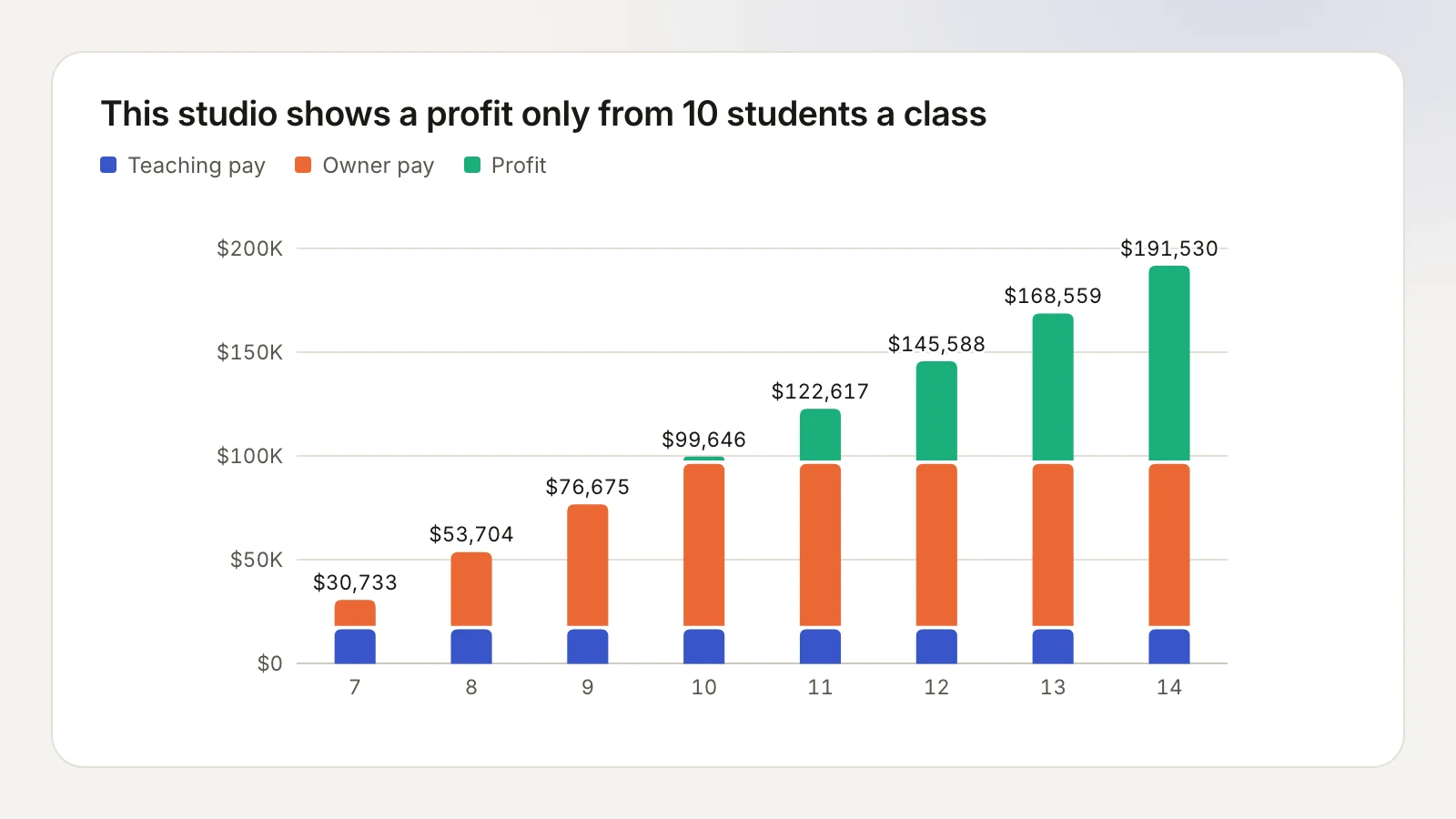
Each student a class adds $1,914 a month, and $12,225 a month is spent before the owner gets anything. At 10 students a class, 40% of the mats, the studio takes $229,710 a year after card fees and leaves $83,006, which is 36.1% of revenue.
The chart splits that income into three kinds of money: pay for teaching, pay for running the studio, and what is left. It assumes the owner teaches 8 of the 25 classes a week. An owner who teaches none has the same chart without the bottom layer.
This studio shows a profit only from 10 students a class
What the illustrative 25-mat studio leaves an owner who teaches 8 classes a week, each year, before income tax and loan payments.
- Teaching pay
- Owner pay
- Profit
Owner income a year
Illustrative: 108.33 classes a month, $17.67 a visit, $12,225 a month before the owner, teaching at $40 a class, owner pay capped at $79,520.
Show the numbers
| Average students a class, of 25 mats | Teaching pay | Owner pay | Profit | Total |
|---|---|---|---|---|
| 7 | $16,640 | $14,093 | $0 | $30,733 |
| 8 | $16,640 | $37,064 | $0 | $53,704 |
| 9 | $16,640 | $60,035 | $0 | $76,675 |
| 10 | $16,640 | $79,520 | $3,486 | $99,646 |
| 11 | $16,640 | $79,520 | $26,457 | $122,617 |
| 12 | $16,640 | $79,520 | $49,428 | $145,588 |
| 13 | $16,640 | $79,520 | $72,399 | $168,559 |
| 14 | $16,640 | $79,520 | $95,370 | $191,530 |
Across the timetable, one more student a class is worth $22,971 a year, which is why class size matters more than any other line in this example. The studio covers its costs at 6.4 students, 26% of the mats. Count students first and the percentage second: the share depends on how many mats you say the room holds, and the business plan shows how far a code's occupant load can move it.
No yoga brand we found publishes class size or fill, so the nearest check is revenue and members. YogaSix's 162 studios averaged $488,615 of revenue and 264 active members in 2024, and its bottom quarter averaged $231,707 of revenue and 137 members, each ranked separately.5 At 10 students, the example takes $238,290 at list price, before card fees, which is how Item 19 counts it. It does that with about 81 members, because it assumes each pays $159. YogaSix's own averages work out to about $113 a member a month, $108 after card fees, by our arithmetic in the business plan. If yours pay that, the table below shows what happens to the owner.
Separate your pay from the profit
Owner pay is what the studio would have to pay someone else to do your job. Profit is what remains after that. For the job, we use the $79,520 US median for entertainment and recreation managers, in May 2025, which excludes the self-employed.12 It covers all kinds of recreation business, so replace it with a local quote. The test it sets is plain: can the studio run without you?
- At 10 students, only just. The $83,006 is $3,486 more than a manager's wage. A hands-off owner of this studio needs 9.9 students a class to break even on the arrangement, and 10.6 once the loan payment below is counted.
- At 8.4 students, you match an instructor. That leaves $47,160, the US median for exercise trainers and group fitness instructors in May 2025.13 Below it, an owner who teaches nothing earns less than the median employee teaching in someone else's room.
- At the plan's break-even, you are paid $24,000. The business plan breaks even at 8.19 students with $2,000 a month of owner pay and the loan. A studio can read as break-even while paying its owner about half an instructor's median.
Read a margin with the owner's pay taken out
A yoga studio's profit margin depends on whether the owner's pay comes out first, and sources rarely say. The same studio, at the same class sizes, measured both ways:
| Average students a class | Kept before any owner pay | Kept after a manager's $79,520 |
|---|---|---|
| 8 | 20.2% | -23.1% |
| 9 | 29.0% | -9.4% |
| 10 | 36.1% | 1.5% |
| 11 | 41.9% | 10.5% |
| 12 | 46.8% | 17.9% |
Both columns are shares of revenue after card fees, before loan payments and income tax. At 10 students, the second column lands inside the 1% to 9% where BFS found 41% of profitable yoga studios, which is what a margin after owner pay looks like for a studio that just pays its manager. In this example, a margin of 20% or more after a manager's pay takes more than 12 students a class, so when a source quotes 20% or more, ask whether the owner was paid first and how full the classes were before you compare.
Count the classes you teach as a wage
If you teach 8 of the 25 classes a week, the studio saves $1,387 a month, $16,640 a year. At 10 students you take home $99,646 rather than $83,006. At 7 students, where the studio leaves only $14,093, you still take home $30,733.
That money is a wage for hours you worked, at the $40 you would have paid someone else. It disappears on the day you hire a replacement, and on any week you cannot teach, the studio pays cover. Teaching can carry an owner through thin months. It does not make the studio more profitable, and a buyer who does not teach will pay the teacher out of the same earnings.
See what changes the answer
Each row changes one input from the 10-student case, for an owner who teaches nothing, before income tax.
| Change | Owner income a year |
|---|---|
| The example as it stands | $83,006 |
| One student fewer a class, 9 | $60,035 |
| Members bring in $108 a month after card fees, not $153 | $39,456 |
| Teachers cost $50 a class, not $40 | $70,006 |
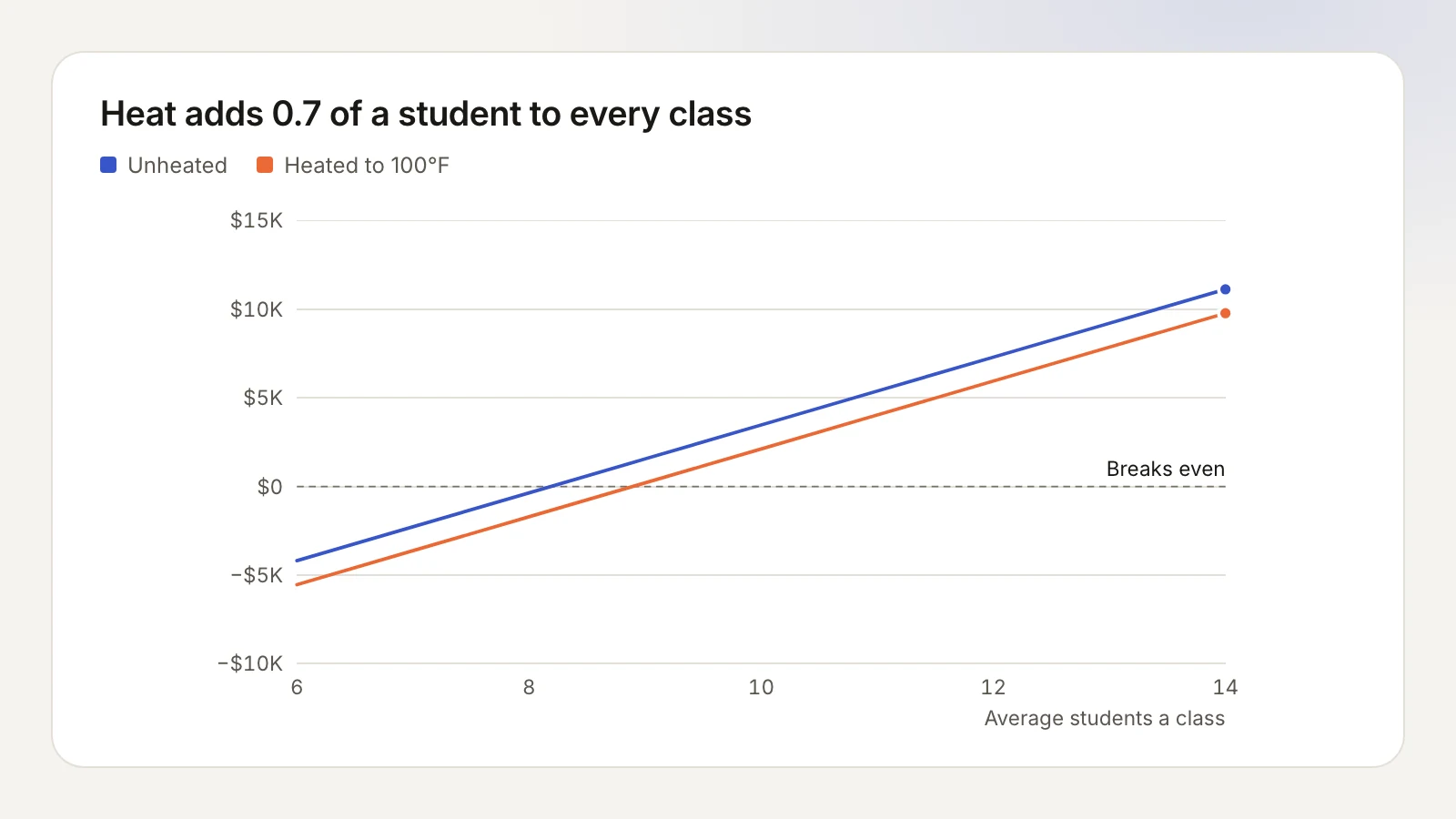
| Heated to 100°F: $499 of electricity and $300 more cleaning a month | $73,418 |
| Rent and shared costs 10% higher | $77,278 |
| The plan's $104,800 ten-year loan at an assumed 11% | $65,678 |
The members row uses YogaSix's averages and moves the answer most: at $108, this studio needs 7.9 students to cover its costs and 12.2 to pay a manager. The heated row leaves out the larger loan a heated room needs, which the business plan adds. The loan row is the plan's payment, $1,444 a month, and $65,678 is the plan's "about $65,700 a year" for its owner. Principal is not an expense, so profit on paper can exceed the cash you can take out.
Weigh the income against what you put in
The plan's unheated studio costs $131,000 to open. At 10 students that is 1.6 years of all the owner's income with nothing taken out to live on, and at 8 students it is 3.5. The plan borrows 80% of it, which is why the loan row above matters more than the opening cost itself. YogaSix estimates $543,999 to $1,026,853 to open one of its studios, so a franchise starts much further back, on about twice the revenue (how to open a yoga studio).
A sale may not get that money back. A buyer who hires a manager to run this studio at 10 students would start with $3,486 a year of profit before the loan. We found no yoga studio sale prices we could read at the source, so before counting on a sale, ask a broker what studios with earnings like yours have actually sold for. Plan to recover what you put in from income over the years.
What these sources do not establish
- What yoga owners earn as a group. BFS's survey is self-selected, mixes yoga with other studios and gives margins, not pay. Statistics Canada groups yoga with gyms and recreation centres. The franchise disclosures stop at revenue. No source here gives a yoga owner's take-home from a stated sample.
- How closed studios did. BFS surveyed studios that were open, and Statistics Canada counts businesses that lost money in 2024, not those that had already shut. Modo Yoga's franchised studios fell from 12 at the start of 2022 to 8 at the end of 2024, with two more due to leave the system on March 31, 2025, and the pages we read do not say how each one ended.6 A picture built from survivors overstates what a new owner should expect.
- Whether a franchise would pay you. No yoga franchisor we read discloses expenses or earnings, only revenue and members. If you are buying a franchise, read Item 19 of the current disclosure document and ask existing owners what they take home.
- Anything audited. The survey answers are owners' own reports, and YogaSix's and Modo's figures are franchisees' sales, as the franchisors present them.
- Income per hour or after tax. None of these figures accounts for the hours an owner works or for income tax. Our example excludes both, and it holds every class at one average when real timetables mix full and quiet rooms.
Watch the number that moves owner income
The input that matters most here is students a class, and Elara for yoga studios reports it by time slot, not as one average for the studio. In reports, Sessions by Time Slot shows average seats booked, capacity and fill rate for each session at each weekday and start time, so you can see which classes to move, resize or drop.14 Fill rate there is seats sold divided by seats offered, and a no-show still counts as a seat sold, so it runs above attendance on days with no-shows. To get the single average for the whole timetable, export the report as a CSV and divide total seats sold by total sessions. Elara has no profit report and holds no rent or loan figures, so profit still comes from your accounts. Elara is sold by quote: ask for a quote and tell us your mat count, timetable and whether the room is heated.