How much do Pilates studio owners make? Income by reformer fill
GuideBy Elara team · Published · 11 min read
The best public measure we found is JETSET's 2026 franchise disclosure: ten Pilates studios open for all of 2025 averaged $349,103 of EBITDA on $1,137,299 of revenue (median $302,930), with 89% of their class spots booked.1 That is not take-home. It comes before debt and depreciation, and apparently before owner pay. Franchisees reported it, JETSET did not verify it, and a franchisor publishes it to sell franchises. Outside one brand, the broadest count we found is Statistics Canada's: in 2024, one in four Canadian fitness and recreational sports centres lost money, and the rest averaged C$82,100 of net profit.2 To see where an owner's income comes from, we worked an illustrative eight-reformer studio. It leaves its owner nothing at 55% of its reformers filled and $72,612 a year at 75%. It shows true profit only above 77%, after paying the owner what a manager would cost. So a Pilates studio can be profitable, and at a given timetable and price, the fill you can hold decides whether yours is.
Check what each income figure measures
Published figures disagree because they count different people and different money.
| Figure | Amount a year | Who it covers | Is the owner's pay inside it? |
|---|---|---|---|
| JETSET EBITDA | $349,103 average and $302,930 median, on $1,137,299 average revenue | Ten franchised Pilates studios open for all of 2025, as reported by franchisees | Appears so: owner pay is not charged above it in the studios shown |
| Statistics Canada net profit | C$82,100 average at the 75% that made money, C$63,200 average loss at the rest (graded "use with caution") | 7,086 Canadian fitness and recreational sports centres with revenue of C$30,000 to C$5 million, 2024 | Not stated: the table mixes incorporated and unincorporated businesses |
| Boutique Fitness Broker discretionary earnings | $50,000 to $150,000 or more | One broker's experience of studios it has handled, with no sample or method given | Yes, plus other add-backs |
| StudioGrowth owner earnings | $71,900 to $360,993, by studio type | Four Pilates studio types at high utilization, one of them Club Pilates, with no sample count | Not stated: labelled net profit |
| "Average" of $69,600 | $69,600 | Repeated across software blogs; the StudioGrowth page that gives it names no source | Unknown |
| Glassdoor, Club Pilates "franchise owner" | $64,000 median | A salary-site figure quoted by a software vendor in 2024, whose live page no longer names the site | Pay only, with no studio's accounts behind it |
Statistics Canada's table is the only one here that counts the businesses that lost money, and one in four of them did.2 Net profit was 12.0% of revenue across the industry, from a 17.0% loss in the bottom quarter to 60.1% in the top one, where labour and commissions were only 6.6% of revenue, which suggests owners doing the work themselves. The category covers fitness and recreation broadly, so read it as a base rate for the question "is this kind of business profitable", and not as a Pilates result.
The broker at least says where its range comes from, its own deals, and it puts well-run studios at 15% to 25% net.3 What it calls take-home is seller's discretionary earnings, salary and profit plus add-backs, so read it as a seller's figure and not as pay.
The other Pilates-only table we found is StudioGrowth's, which says it drew on "real-world data from hundreds of studios" using its software.4 It gives no count, shows no method for its expenses and limits itself to studios running at high utilization, while warning that startup years pay little. An 88.1% margin at its smallest studio suggests the owner's own work is not charged. Read it as a software vendor's model of studios going well, and not as a measure of owners.
StudioGrowth's other page gives the $69,600, which appears as "gross monthly income" of $5,800 with nothing behind it,5 and the Glassdoor figure reaches owners second-hand, through a vendor page that has since dropped its link.6 Don't plan on either.
JETSET's Item 19 goes past revenue, which is where some disclosures stop, and a revenue line alone comes before rent, instructors, royalties and the owner. Its EBITDA ran from $160,566 to $683,183, a margin of 19.0% to 45.1% with a median of 27.7%.1 That EBITDA does not appear to charge for the owner's work: the three studios whose accounts show owner wages, Merrick Park's $80,000 among them, list them below it, and the other seven show none. After the lines below it, the ten studios averaged $268,090 of net income, the lowest $90,803. The filing's text says thirteen franchisees, while its tables name ten studios and its averages divide by ten, so we say ten.
See how income moves with reformer fill
The studio below is illustrative, in US dollars, and every input is an assumption from our Pilates studio profit calculator, not a market rate.
- Eight reformers and 120 classes a month.
- $60 instructor pay a class, $7,200 a month.
- $9,600 a month of rent, reformer finance or replacement, front desk, software, insurance and cleaning.
- Half of visits on a $259 unlimited membership at 8 visits a month, the rest mostly a $330 ten-class pack and some $40 drop-ins. That averages $33.74 a visit, less $2 of visit costs.
Each client adds $31.74, and $16,800 a month is spent before the owner gets anything. At six clients a class, 75% of the reformers, the studio takes $291,492 a year and leaves $72,612, which is 24.9% of revenue.
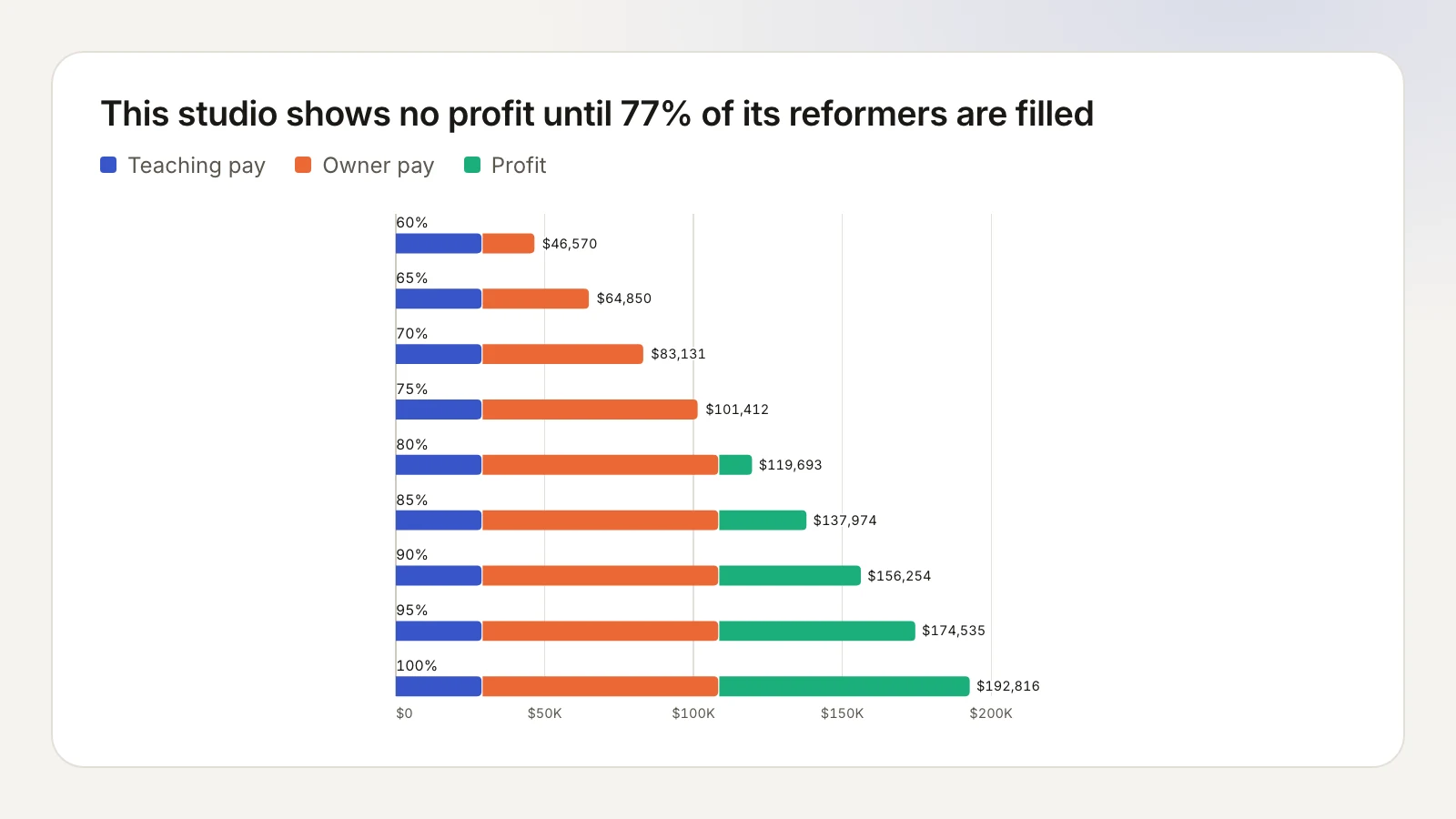
The chart splits that income into three kinds of money: pay for teaching, pay for running the studio, and what is left. It assumes the owner teaches 40 of the 120 classes. An owner who teaches none has the same chart without the bottom layer.
This studio shows no profit until 77% of its reformers are filled
What the illustrative eight-reformer studio leaves an owner who teaches 40 classes a month, each year, before income tax and loan payments.
- Teaching pay
- Owner pay
- Profit
Owner income a year
Illustrative: 120 classes a month, $31.74 from each client, $16,800 a month before the owner, teaching at $60 a class, owner pay capped at $79,520.
Show the numbers
| Share of reformers filled, on average | Teaching pay | Owner pay | Profit | Total |
|---|---|---|---|---|
| 60% | $28,800 | $17,770 | $0 | $46,570 |
| 65% | $28,800 | $36,050 | $0 | $64,850 |
| 70% | $28,800 | $54,331 | $0 | $83,131 |
| 75% | $28,800 | $72,612 | $0 | $101,412 |
| 80% | $28,800 | $79,520 | $11,373 | $119,693 |
| 85% | $28,800 | $79,520 | $29,654 | $137,974 |
| 90% | $28,800 | $79,520 | $47,934 | $156,254 |
| 95% | $28,800 | $79,520 | $66,215 | $174,535 |
| 100% | $28,800 | $79,520 | $84,496 | $192,816 |
Across the timetable, one more client a class is worth $45,702 a year, which is why fill matters more than any other line in this example. The studio covers its costs at 4.4 clients, 55% of the reformers, and the 100% bar is a ceiling, since it needs every class on the timetable full.
Two franchise disclosures give real reference points, and they measure different things. JETSET reports class utilization, booked spots over available spots, by studio and month. Its ten studios averaged 82% to 100% in 2025, 89% across the network, with 11 to 19 reformers and an average of 77 classes a week.1 Studio Pilates reports clients attending: an average class of 8.5 across 12 US studios, from 5.8 to 11.2, and its disclosure calls for 12 to 14 reformers.7 If those rooms hold that many, the average runs at 61% to 71%. Our division assumes they do, since the document does not give each studio's count.
JETSET's 89% may run high as a guide to your room. It counts bookings, not clients who came, and some months top 100%, which a count of people on reformers could not do. Third-party booking platforms supplied 57.4% of its service transactions, at an average of $22, and 21.3% of its revenue, so part of that fill is sold cheaply. Its sample is ten of the 12 franchised studios open at the start of 2025, the ones that gave JETSET full statements, and it does not show the rest.
Those rooms are also far busier than the example, at 77 classes a week against about 28. By our arithmetic, assuming 52 weeks, each studio sold about 50,000 booked spots at about $23 of revenue each, against 8,640 visits at $33.74 in the example at 75%. So JETSET's earnings come from volume at a lower price as much as from fill.
That makes the 77% in our chart this studio's line, at its price, its costs and its timetable, and not a target for every room. At Studio Pilates's fill, the example leaves an owner who teaches nothing $20,381 to $57,378. At JETSET's 89% it would leave $123,798, if a room this size could hold that fill at $33.74 a visit. Plan on your own first-year fill being lower than a brand's until your bookings show otherwise.
Separate your pay from the profit
Owner pay is what the studio would have to pay someone else to do your job. Profit is what remains after that. For the job, we use the $79,520 US median for entertainment and recreation managers, in May 2025, which excludes the self-employed.8 It covers all kinds of recreation business, so replace it with a local quote. The test it sets is plain: can the studio run without you?
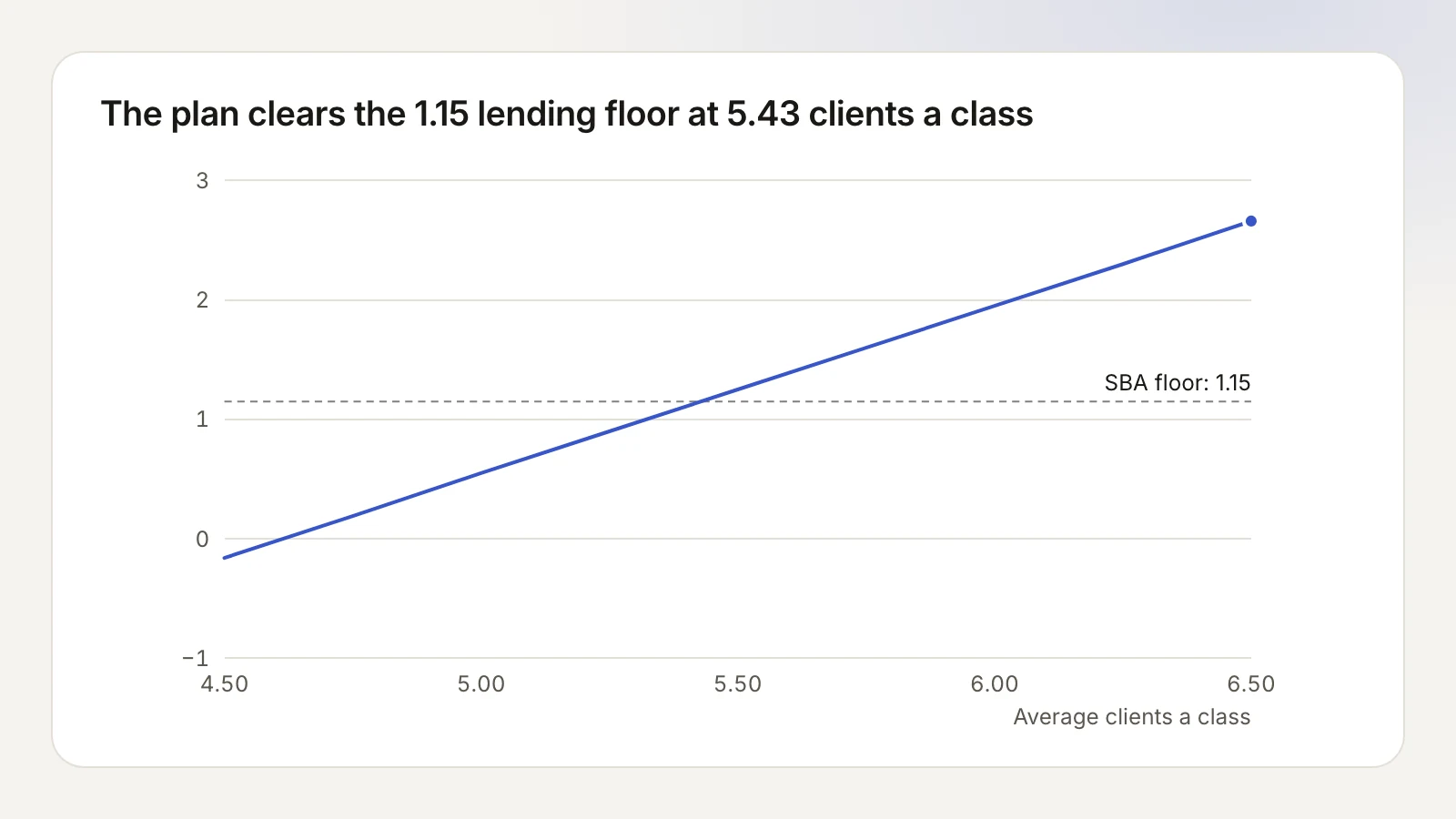
- At 75% fill, no. The $72,612 is $6,908 short of a manager's wage, so a hired manager would leave a loss and the owner nothing. A hands-off owner of this studio needs about 77%, 6.2 clients a class, to break even on the arrangement.
- At 68% fill, you match an instructor. That leaves $47,160, the US median for exercise trainers and group fitness instructors (Pilates instructor pay). Below it, an owner who teaches nothing earns less than the median employee teaching in someone else's room.
- At 65% fill, the calculator's default pay is covered. The calculator pays the owner $3,000 a month by default. A studio can read as break-even there while paying its owner well under a manager's wage.
Count the classes you teach as a wage
If you teach 40 classes a month, about nine a week, the studio saves $2,400 a month, $28,800 a year. At 75% fill you take home $101,412 rather than $72,612. At 55% fill, where the studio itself leaves nothing, you still take home about $28,300.
That money is a wage for hours you worked, at the $60 you would have paid someone else. It disappears on the day you hire a replacement, and on any week you cannot teach, the studio pays cover. Teaching can carry an owner through thin months. It does not make the studio more profitable, and a buyer who does not teach will pay the instructor out of the same earnings.
See what changes the answer
Each row changes one input from the 75% fill case, for an owner who teaches nothing, before income tax.
| Change | Owner income a year |
|---|---|
| The example as it stands | $72,612 |
| One client fewer a class, 62.5% fill | $26,910 |
| Members come 10 times a month, not 8 | $44,640 |
| Instructor pay of $75 a class, not $60 | $51,012 |
| $1,000 a month more in costs | $60,612 |
| A $192,000 ten-year loan at an assumed 11% | $40,872 |
In the members row, an unlimited plan earns less per visit the more a member uses it, so the same room brings in $30.50 a visit and not $33.74. The loan row is the payment from our Pilates studio business plan, $2,645 a month. Principal is not an expense, so profit on paper can exceed the cash you can take out. That loan pays for the reformers, so if you take it, drop any reformer finance from the $9,600 so you do not count it twice.
The calculator starts from the same studio. At its defaults it shows $3,051 of profit a month after your $3,000, so "what the month leaves you" is $6,051, or $72,612 a year. Enter your own timetable, mix and costs, and set your pay to what the job would cost to hire.
One month's profit at a Pilates studio
Multiplies your timetable by the clients you expect, prices each visit from your mix of memberships, packs and drop-ins, and takes off every cost, your own pay included. The defaults are the opening guide's hypothetical eight-reformer studio; enter amounts in your own currency.
At 6 clients a class, the month leaves $3,051 after your own pay. It takes 5.2 clients a class to cover the month.
| Profit a month, after your own pay | $3,051 |
|---|---|
| Average clients per class to break even | 5.2 |
| Average fill at break-even | 65% |
| Profit margin | 12.6% |
| What the month leaves you, your pay included | $6,051 |
| Profit with every place full | $10,668 |
| Revenue a month | $24,291 |
| Revenue per visit, across the mix | $33.74 |
| Visits a month | 720 |
| Members the mix implies | 45 |
| Instructor pay | $7,200 |
| Visit costs | $1,440 |
| Months of this profit to repay the opening cost | 98.3 |
- A pack's price per visit assumes every credit is used, and prices stay the same however full the classes get. Intro offers and retail are left out.
- The result is before income tax and before loan payments, unless you add those to the monthly costs. Sales tax is not counted as income.
- Average clients is one number for the whole timetable. A month of full evenings and empty middays can have the same average as a steady one.
Weigh the income against what you put in
The calculator's placeholder cost to open is $300,000. At 75% fill that is 4.1 years of all the owner's income with nothing taken out to live on, and at 85% it is 2.7. The calculator's payback row counts only the profit left after your $3,000 a month, so at its defaults it shows about 98 months. Six reformer franchises estimate $328,620 to $1,029,811 to open, so a franchise starts further back, on more revenue (how to open a Pilates studio).
A sale may not get that money back. To return the $300,000 at 75% fill, a sale would have to fetch 4.1 years of everything the studio leaves its owner, and a buyer who hires a manager to run it would start $6,908 a year short. We found no Pilates studio sale prices we could read at the source, so before counting on a sale, ask a broker what studios with earnings like yours have actually sold for. Plan to recover what you put in from income over the years.
What these sources do not establish
- What Pilates owners earn as a group. JETSET's filing measures one brand's ten studios open for all of 2025, at about $1.1 million of revenue each, before debt and depreciation, and apparently before owner pay. Franchisees reported it, JETSET did not verify it, and the sample leaves out newer studios. Statistics Canada groups Pilates with gyms and recreation centres. StudioGrowth's Pilates-only table gives no sample count.
- How closed studios did. JETSET's sample covers studios open all year. Statistics Canada counts the centres that lost money in 2024, but not those that had already closed. Studios that shut before each period are missing from every figure here, and a chart of survivors overstates what a new owner should expect.
- Whether a franchise would pay you. JETSET's filing shows what ten studios earned, apparently before owner pay, not what their owners kept, and it speaks for no other brand. The two other franchise figures in the table above are a salary-site number and a vendor's model, so we rely on neither. If you are buying a franchise, read Item 19, the financial section of the current disclosure document, and ask existing owners what they take home.
- Anything audited. JETSET says it has not verified its franchisees' data. The broker's ranges come from a firm that sells studios.
- Income per hour or after tax. None of these figures accounts for the hours an owner works or for income tax. Our example excludes both, and it holds every class at one average when real timetables mix full and quiet rooms.
Watch the number that moves owner income
The input that matters most here is fill, and Elara for Pilates studios reports it by time slot, not as one average for the studio. In reports, Sessions by Time Slot shows seats sold, capacity and fill rate for each session at each weekday and start time, so you can see which classes to move, resize or drop.9 Fill rate there is seats sold divided by seats offered, and a no-show still counts as a seat sold. To get the single average the calculator needs, export the report as a CSV and total it. Elara has no profit report and holds no rent or loan figures, so profit still comes from your accounts. Elara is sold by quote: ask for a quote and tell us your reformer count, timetable and class mix.