Gym insurance cost: 2026 rates, policies and add-ons
GuideBy Elara team · Published · 13 min read
A small US gym or class studio pays about $1,000 to $1,700 a year for a business owner's policy, and about $1,000 to $1,200 more for workers' compensation if it has employees, going by the figures Insureon and The Hartford publish. Those are medians and averages for gyms you know nothing about. On K&K Insurance's 2026 rate sheets, the one full set of published prices we found, an illustrative $420,000 studio pays about $3,100 for liability and contents if it runs only supervised classes, and about $5,400 if it also runs staffed open gym hours. Add a sauna or a cold plunge and neither of those two programs will take it at all.
This is for owners of gyms and studios that run scheduled classes in the US or Canada, opening or renewing. Figures are in US dollars unless marked. Quotes will differ, because each one depends on your state or province, your claims and the underwriter.
Which policies a class gym needs
- Workers' compensation, if the law requires it of you. This is the policy most likely to be compulsory, so settle it first. Most US states require it for businesses with employees,1 and Texas lets private employers choose,2 so ask your state's workers' compensation agency. In Canada it runs through a public board in each province, and coverage is compulsory or optional by industry, so ask yours. The section below covers both and gives you a rate to work from.
- General liability that names participants. This is the policy that answers a member's injury claim, and landlords often require it.1 Check that injury to people taking part in a class is covered: K&K lists "Bodily Injury to Participants Liability" as its own line, which tells you it should not be assumed.3
- Professional liability. It answers a claim that instruction itself caused harm. Fitness programs often bundle it with general liability, as K&K's and Philadelphia Insurance's do, so check before buying it twice.4
- Property or equipment and contents. Buy it if you own reformers, racks, flooring or fit-out. A business owner's policy bundles it with general liability.5 K&K sells it separately and requires you to insure full replacement cost or face a co-insurance penalty at the time of a loss.3
- Cover for contract instructors. K&K's small-studio cover does not extend to independent contractors unless you buy the option. Without it, K&K says, you need each contractor to carry their own policy, name your business as an additional insured and give you proof.3 Philadelphia's program extends to contractors as standard.
- Abuse and molestation cover, if you teach minors or run private sessions. K&K excludes it unless it is reported, approved and paid for.
Two more depend on how you operate. Cyber matters if you hold customer data or take card payments online, since K&K's programs exclude it. A commercial auto policy matters only if the business owns a vehicle; K&K's liability programs include hired and non-owned auto in most states.
What insurers publish for each policy
Insureon's figures are the median of quotes for gyms and fitness studios that applied through it, from a page updated June 11, 2025. The Hartford's are its customers' averages, on an undated page. MoneyGeek's are the Fitness Services row of its all-industry small business report, modeled from insurer quote data for businesses with one to four employees, so the row is not gyms alone. The report was updated September 18, 2026.6
| Policy, per year | Insureon median | The Hartford average | MoneyGeek, Fitness Services |
|---|---|---|---|
| Business owner's policy | $1,031 | $1,687 | Not given |
| General liability ($1M/$2M) | $825 | $810 | $1,244 |
| Professional liability | $503 | Not given | $365 |
| Workers' compensation | $1,221 | $1,032 | $892 an employee |
| Commercial property | Not given | Not given | $374 |
| Cyber | $1,552, all small businesses | Not given | $914 |
| Commercial auto | $2,942, all small businesses | Not given | $1,240 a vehicle |
Don't add the business owner's policy to the general liability line, since it includes it. Our guide to starting a gym budgets Insureon's business owner's policy plus workers' compensation, $188 a month, which is $2,256 a year.
Some of the cheaper numbers in search results are for a different buyer. Insureon's $29 a month for general liability is for individual fitness instructors, not premises.7 A studio should not plan on it.
Read a real rate sheet: floor area or sales
K&K publishes the prices the averages hide. It is named here because it prints them, not as a recommendation. Its US programs for 2026 charge either by floor area or by sales, and which one you qualify for matters more than any discount.
Fitness Studio program: for studios of up to 3,000 sq ft a location, priced by area, with general, professional and participant liability included. It takes scheduled, supervised programs only: "Open access to members to utilize facility on a self directed basis" is ineligible.3
| Yearly premium a location | $1M each occurrence | $2M | $5M |
|---|---|---|---|
| Up to 1,000 sq ft | $500 | $750 | $1,500 |
| 1,001 to 2,000 sq ft | $1,000 | $1,500 | $2,250 |
| 2,001 to 3,000 sq ft | $1,500 | $2,250 | $3,125 |
Limited Service Health Club program: for clubs with annual sales of $500,000 or less, priced at $9.10 per $1,000 of sales for a $1M limit, with a $1,100 minimum, or $13.65 with a $1,650 minimum for $2M.8
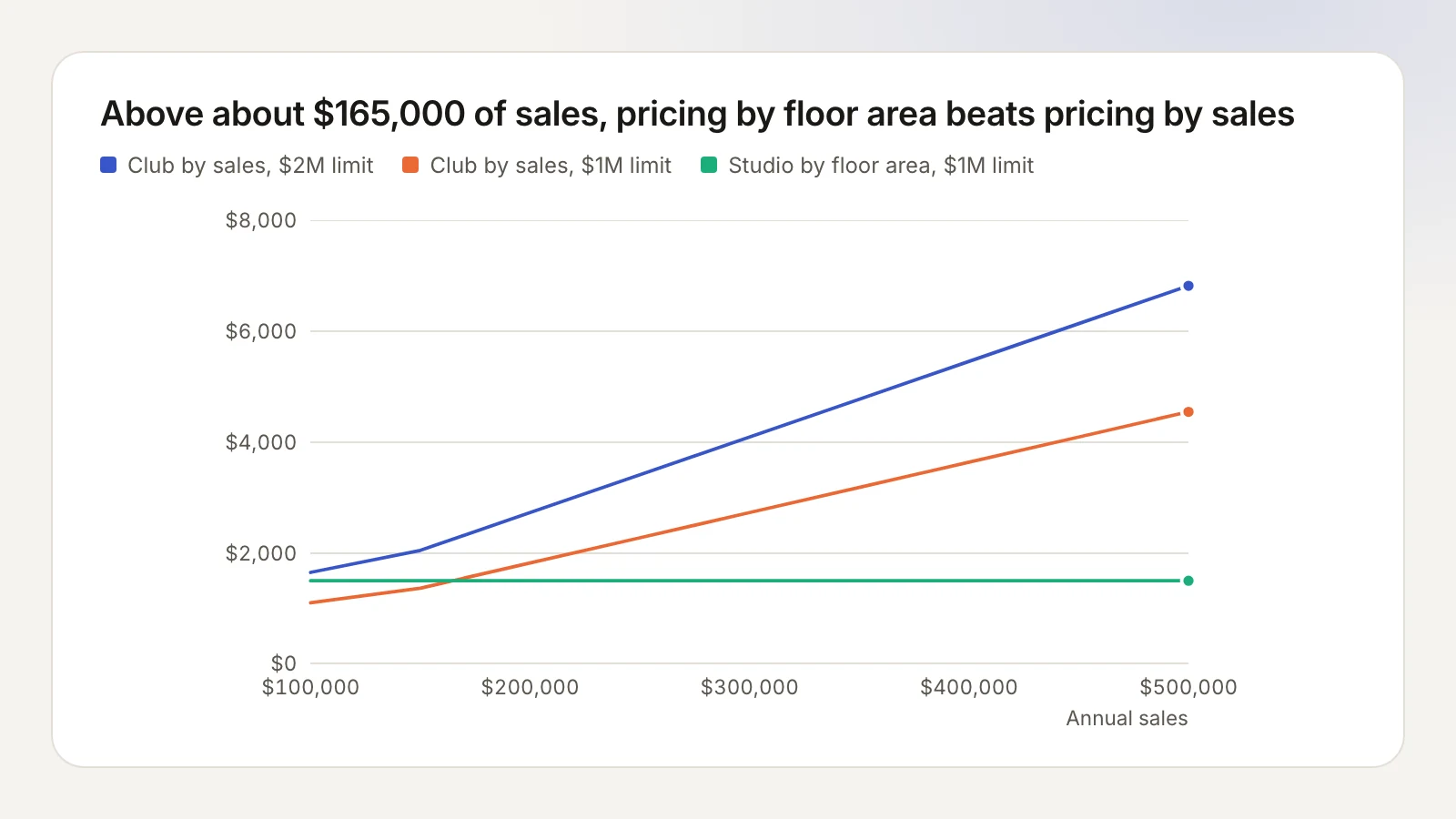
Above about $165,000 of sales, pricing by floor area beats pricing by sales
Yearly liability premium on K&K's 2026 sheets. Studio line is the 2,001 to 3,000 sq ft band, which does not move with sales.
- Club by sales, $2M limit
- Club by sales, $1M limit
- Studio by floor area, $1M limit
Yearly premium
Before the $20 purchasing group fee and any optional cover. Hawaii rates are lower. Both programs are US only and subject to underwriting.
Show the numbers
| Annual sales | Club by sales, $2M limit | Club by sales, $1M limit | Studio by floor area, $1M limit |
|---|---|---|---|
| $100,000 | $1,650.00 | $1,100.00 | $1,500.00 |
| $150,000 | $2,047.50 | $1,365.00 | $1,500.00 |
| $200,000 | $2,730.00 | $1,820.00 | $1,500.00 |
| $250,000 | $3,412.50 | $2,275.00 | $1,500.00 |
| $300,000 | $4,095.00 | $2,730.00 | $1,500.00 |
| $350,000 | $4,777.50 | $3,185.00 | $1,500.00 |
| $400,000 | $5,460.00 | $3,640.00 | $1,500.00 |
| $450,000 | $6,142.50 | $4,095.00 | $1,500.00 |
| $500,000 | $6,825.00 | $4,550.00 | $1,500.00 |
The two prices cross at $1,500 / $9.10 × $1,000, or about $164,800 of sales. A busy small studio pays far less by area, so a studio doing $400,000 should not accept a sales-rated quote without asking whether a supervised-class program fits. The catch is the open-gym exclusion: staffed hours without a class can move you onto the sales basis, and unstaffed hours are out of both programs.
What moves the premium
- What members are allowed to do. Open access rules out K&K's studio program, and any unattended or unstaffed operation, 24-hour or not, climbing walls, childcare and contact sparring are out of both small programs. This is the biggest lever because it decides which price list you are on. For sparring, see how to start a boxing gym.
- Size, by whichever measure the program uses. That is floor area or sales on the two sheets above.
- Limits. Going from $1M to $2M adds 50% on both K&K sheets. A landlord's lease may decide this for you, so read it first.
- Equipment value. K&K's equipment and contents rate is $0.0286 per dollar of replacement value once the total passes $10,000, so $45,000 of equipment costs $1,287 a year. That can approach the liability premium.
- Contract instructors. K&K charges $300 a year at the $1M limit, and more than 10 contractors may bring further underwriting and premium.
- Location, years in business and claims history. The Hartford lists all three.5 Insureon names location and, for professional liability, claims history.9 Neither publishes how much each one moves the price.
Check the numbers on one studio
This example is illustrative, not a customer or a quote. Take a 2,400 sq ft leased studio with $420,000 of sales, five contract instructors and $45,000 of equipment and fit-out at replacement value, buying a $1M limit in a state other than Hawaii. Prices are from K&K's two 2026 sheets.
| Per year | Supervised classes only | Same studio, with staffed open gym hours | Same studio, with a sauna or plunge |
|---|---|---|---|
| Program | Fitness Studio | Limited Service | Neither is eligible |
| Liability | $1,500 | 420 × $9.10 = $3,822 | Quote needed |
| Contract instructors | $300 | $300 | Quote needed |
| Equipment and contents | $1,287 | $1,287 | Quote needed |
| Purchasing group fee | $20 | $20 | Quote needed |
| Total | $3,107 | $5,429 | Not published |
Don't read the first two columns as the same cover at two prices. K&K's sheet defines Bodily Injury to Participants as claims by people "participating in fitness/exercise activities under the direction of the insured",8 and a member training alone in open gym may not fit those words. That is our reading of a brochure, so ask which liability line answers that injury.
Opening the floor adds $2,322 a year, or $193.50 a month, so those hours need to bring in more than that after fees to cover their insurance alone. The sauna column has no total because K&K's Basic Service program prints no price, and its Full Service program prints only a $3,000 account minimum, which is not a sauna price. Workers' compensation, if you carry it, comes on top of every column.
Saunas and cold plunges change the program, not just the price
We found no insurer that publishes a sauna or plunge surcharge. Insureon says a wellness studio offering "infrared saunas, cold plunges, yoga, and IV drips will cost more to insure than a smaller business", and that services such as steam rooms and infrared saunas affect the premium, but it gives no amount. Its figures are general personal care averages of $38 a month for general liability and $79 for a business owner's policy.1 What the programs do publish is who will take the risk at all:
| Program | Saunas and steam rooms | Cold plunge | Published price |
|---|---|---|---|
| K&K Fitness Studio, 2026 | Ineligible | Ineligible | $500 to $3,125 |
| K&K Limited Service, 2026 | Ineligible | Ineligible | $9.10 per $1,000 of sales |
| K&K Basic Service | Named as covered | Not mentioned | Not published |
| K&K Full Service | Whirlpools, saunas and steam rooms named | Not mentioned; swimming and aquatic centers ineligible | $3,000 account minimum |
| Philadelphia Fitness Studios | Sauna named | Not mentioned | Not published |
"Not mentioned" means the page is silent, not that the plunge is covered or refused. K&K's Basic Service page gives two revenue limits for a location, $1,000,000 in its highlights and $2 million in its FAQ, so ask which applies. K&K's two small programs also list "All operations listed as ineligible" among their exclusions, so a plunge you add without telling anyone is not simply a surcharge you skipped: the policy excludes the operation the injury came from. The same sheets exclude cryogenic chambers and therapy and treat red light therapy and salt rooms as ineligible or as a call to K&K, so check any recovery room the same way.
The heater, chiller and pump need their own question. Ask whether contents cover includes them at replacement cost and whether equipment breakdown is included, since K&K's Full Service program lists it as a property coverage and its small programs' contents form does not name it. The contrast therapy guide covers running these sessions. Ask your health department what it requires for a plunge before you take the question to a broker.
Price workers' compensation from your payroll
First check whether you have to buy it, which depends on where you are and, in Canada, on your industry.
- US. Most states require it for businesses with employees. In Texas, the first row below, private employers can choose to carry it and it "is not required in most cases".2 Your state's workers' compensation agency has the rule for your state.
- Ontario. WSIB says its coverage "isn’t mandatory for every business in Ontario", and that a business that isn't required to have it can apply.10 We could not confirm where a gym falls, so ask WSIB.
- Alberta. WCB-Alberta's rate manual marks Private Clubs as an exempt industry, one that isn't required to have coverage but can apply for it.11 It places fitness facilities there, including one that "caters to walk-in clientele", and says they may include saunas and steam baths. Adding other spa, aesthetics or beauty salon services, beyond massage or tanning, moves the entire operation to Industry 87200.12 That is Beauty/Barber Shops and Schools, marked Compulsory/Exempt and compulsory for services such as facials and waxing.13 So ask the board before you add them.
- British Columbia. WorkSafeBC says all employers must have coverage unless the employer is exempt.14
Where you carry it, this is the one line you can estimate yourself: multiply payroll by the rate per $100. Class code 9063 is titled Health or Exercise Institute in many states,15 and New York's table calls it "YMCA YWCA etc.", so confirm the code your insurer assigns. A loss cost is the part of a rate for expected claims and claim handling, before an insurer's other expenses, so a real US quote comes in above it. The Canadian figures are mostly board averages, and yours is set by your classification.
| Where, 2026 | Per $100 of payroll | What it is | On $100,000 of payroll |
|---|---|---|---|
| Texas | $0.18 | Advisory loss cost, class 9063 | $180 |
| Alaska | $0.545 | Advisory loss cost, class 9063 | $545 |
| New York | $0.60 | Loss cost, class 9063 | $600 |
| Ontario | C$1.23 | Average across all classes; Leisure and Hospitality class is C$0.90 | C$1,230 |
| Alberta | C$1.46 | Average across all industries; Private Clubs industry, marked exempt, is C$1.34 | C$1,460 |
| British Columbia | C$1.55 | Average base rate across all industries | C$1,550 |
WSIB's page does not say which class a gym falls in. A new studio has no premium rate statement to read it from, so ask the board for your class before you budget; if you are already registered, your statement shows it. Contract instructors may sit outside this payroll, but whether they are really contractors is a legal test in your state or province, not a choice you make on an application. Check your case with your state labor or workers' compensation agency, your provincial board or an employment lawyer. Per-class or per-head instructor pay covers how they are paid, not how they are classified.
Budget differently in Canada
K&K's small US programs list "Facilities outside of the U.S." as ineligible, and we found no Canadian insurer that prints a gym rate sheet. The public Canadian numbers are for smaller risks, in Canadian dollars:
- Montreal broker KBD says most personal trainer and fitness instructor liability policies cost $500 to $1,500 a year.16
- Zensurance says a fitness instructor can expect about $200 a year for $2M of general liability.17
- HelloSafe shows one quote for a B.C. trainer who owns a gym with two employees: $1,295.11 with taxes for $2M of general and professional liability and $50,000 of contents. It says gym owners with employees should expect more than $1,000 a year.18
Treat those as a floor for a room with a timetable, members and equipment, and get a Canadian broker's quote early, before you commit to a lease.
Get these answers from a broker, in writing
Use a licensed broker or agent in your state or province who already places fitness accounts, and ask at the point you can still change the lease or the fit-out. Send them your timetable, floor plan, sales or forecast, payroll, contractor list and equipment list, then ask:
- Is injury to a participant in a class covered, and under which limit?
- Are contract instructors covered, or must each carry their own policy naming us?
- Are open gym hours, unstaffed hours and members under 18 covered, and which liability line answers an injury to a member training on their own?
- Are the sauna, steam room, cold plunge and any other recovery room covered by name, including when used without an instructor?
- Are the heater, chiller and pump covered for breakdown as well as fire and theft, at replacement cost?
- What does the policy exclude? Ask for the exclusions page, since K&K's own brochure warns it shows only some of them.
- What does our lease require for limits and additional insureds, and does this policy meet it?
- What changes at renewal if sales rise, and do we have to tell you when we add equipment or a service?
- Is workers' compensation compulsory for a business like ours here, and if it is optional, what answers an employee's injury if we don't carry it?
A waiver doesn't replace any of this. In most places it can stop an ordinary negligence claim, but the rules vary, and it is void in some states: see gym liability waivers by state and province.
Keep the records in Elara
- Waivers. Members accept every active waiver before they book online, and check-in is refused until it is signed. Every customer owes every active waiver, so a waiver can't be limited to the sauna or plunge. Online, the acceptance is one ticked box with no typed name or drawing, and no IP address or device is recorded. Staff open signatures on screen one record at a time, and there is no bulk export, so tell your broker how waivers are captured if they ask. Each customer signs only for themselves, so a parent cannot sign for a child in Elara. Changing a waiver's text creates a new version, earlier signatures stay on record as outdated, and customers accept the new one. Guests on a private booking are recorded by name only and are not asked to sign, so collect a form for a buyout of your sauna.
- Attendance. The session roster shows who staff checked in to a booked session, which is what you will want to look up if a claim names a class. It holds only what staff marked: a confirmed booking left unmarked when the day ends becomes a no-show, even if the member came. Elara keeps no record of open-floor or unstaffed entry, so for those hours look to your access system.
- Figures for the application. Reports give Total Revenue by date range and location with a CSV export. It counts only money recorded in Elara, and gift card sales are shown separately, since a card counts as revenue when it is redeemed. It is not an insurance form, so check it against the sales definition on the application.
Elara does not insure anything or advise on cover. The waivers page shows how signing works at booking and check-in. Elara is sold by quote: ask for a quote and tell us your timetable and which waivers you collect.