Bathhouse booking software has to sell timed entry to a building where guests spread across hot rooms, pools and rest space and stay for hours. In Elara, each entry time is a scheduled time of one session, with its own places and roster. The price comes from the session, so a place costs the same at every entry time in it. Guests book a place online, the booker accepts your waiver at checkout, and reception checks guests in from the attendance list. Anyone who still owes a waiver cannot be checked in until they sign.
Elara keeps one capacity per entry. It has no record of your rooms, pools or zones, and it does not add overlapping entries against a limit for the building. How many people are inside at once is a number you work out and build into each entry's capacity. This page gives you that arithmetic: the limit your busiest zone sets, the places per entry that keep you under it, and what each visit length does to a sold-out day.
If guests buy a place on one bench for a set session, sauna studio software fits better. If you sell a circuit around a cold plunge, read contrast therapy studio software.
Find the limit your busiest zone sets
Adding up your zones overstates the building. A guest uses each zone for part of the visit, so a zone supports more bathers than it holds, and the tightest zone sets the limit.
Building limit from one zone = people the zone holds ÷ share of the visit spent there. The smallest result is your limit, unless your fire or occupancy limit is lower.
The figures in this table are hypothetical.
| Zone | Holds | Share of a visit | Building limit it sets |
|---|---|---|---|
| Hot pool, 100 sq ft of water | 10 | 25% | 40 |
| Cold plunge, 30 sq ft of water | 3 | 5% | 60 |
| Sauna | 14 | 20% | 70 |
| Steam room | 8 | 10% | 80 |
| Rest area | 20 | 40% | 50 |
The zones hold 55 between them, but this building's limit is 40. At 55 inside, about 14 people want a hot pool that holds 10.
Water usually comes with a number already. Utah requires ten square feet of water per bather in a spa pool and makes the manager responsible for not exceeding the peak load. Massachusetts uses the same ten square feet for special purpose pools. Washington takes the most restrictive of three limits, one of them that same area. These rules vary, so ask your health department what applies to each pool.
For the shares, count heads in each zone every 30 minutes through a busy day. A zone's share is its average count ÷ the average number inside. These are averages, and guests bunch. If your count shows the hot pool full with 34 people in the building, 34 is your working limit.
Turn the limit into places per entry
Places per entry = building limit ÷ entries inside at once, rounded down. Entries inside at once = visit length ÷ minutes between entries, rounded up.
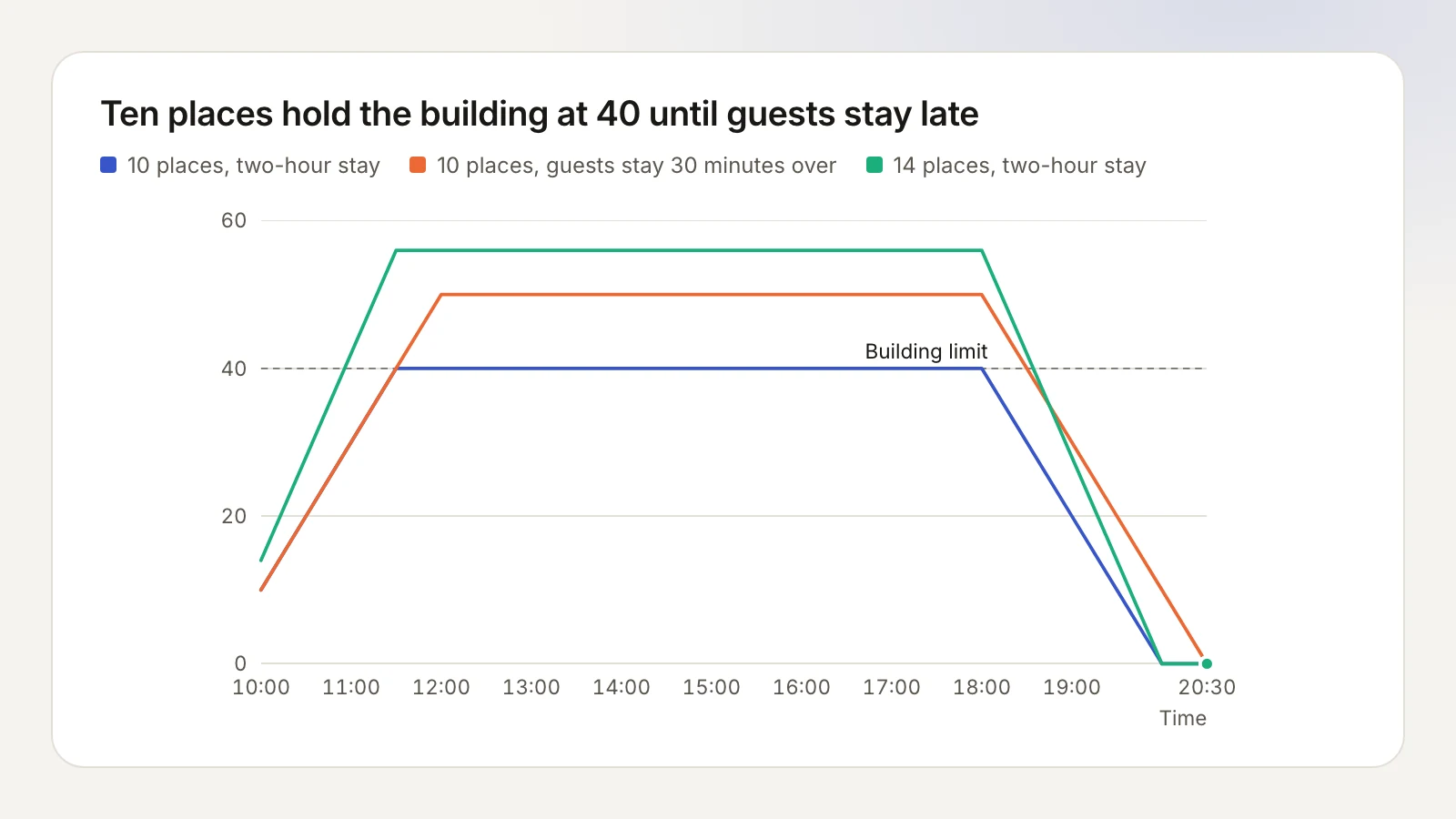
This worked example is hypothetical. The building holds 40, sells two-hour visits and opens an entry every 30 minutes from 10:00 to 18:00. Four entries overlap from 11:30, so each gets 10 places. At 14 places, which looks only slightly greedier, a sold-out afternoon puts 56 people in a 40-person building.
Ten places hold the building at 40 until guests stay late
People inside a building with a 40-person limit through a sold-out day, with an entry every 30 minutes from 10:00 to 18:00.
- 10 places, two-hour stay
- 10 places, guests stay 30 minutes over
- 14 places, two-hour stay
People inside
Hypothetical: every entry sells out and everyone stays the time shown. Each point counts the entries inside at that moment.
Show the numbers
| Time | 10 places, two-hour stay | 10 places, guests stay 30 minutes over | 14 places, two-hour stay |
|---|---|---|---|
| 10:00 | 10 | 10 | 14 |
| 10:30 | 20 | 20 | 28 |
| 11:00 | 30 | 30 | 42 |
| 11:30 | 40 | 40 | 56 |
| 12:00 | 40 | 50 | 56 |
| 12:30 | 40 | 50 | 56 |
| 13:00 | 40 | 50 | 56 |
| 13:30 | 40 | 50 | 56 |
| 14:00 | 40 | 50 | 56 |
| 14:30 | 40 | 50 | 56 |
| 15:00 | 40 | 50 | 56 |
| 15:30 | 40 | 50 | 56 |
| 16:00 | 40 | 50 | 56 |
| 16:30 | 40 | 50 | 56 |
| 17:00 | 40 | 50 | 56 |
| 17:30 | 40 | 50 | 56 |
| 18:00 | 40 | 50 | 56 |
| 18:30 | 30 | 40 | 42 |
| 19:00 | 20 | 30 | 28 |
| 19:30 | 10 | 20 | 14 |
| 20:00 | 0 | 10 | 0 |
| 20:30 | 0 | 0 | 0 |
Plan for the visit guests actually take. Elara does not move anyone out, so if your two-hour guests shower and linger for another 30 minutes, the building holds 50. Use the length you observe at the changing rooms: 2.5 hours ÷ 30 minutes = 5 entries inside, so 8 places an entry. Guests who leave early free space the schedule cannot see, and selling it is a decision for the desk.
A longer visit or a tighter spacing cuts the places per entry
Places per entry that keep a 40-person building at or under its limit, by visit length and minutes between entries.
- Entry every 15 minutes
- Entry every 30 minutes
- Entry every 60 minutes
Places per entry
Hypothetical building limit of 40. Entries inside are rounded up and places rounded down.
Show the numbers
| Visit length | Entry every 15 minutes | Entry every 30 minutes | Entry every 60 minutes |
|---|---|---|---|
| 90 min | 6 | 13 | 20 |
| 120 min | 5 | 10 | 20 |
| 150 min | 4 | 8 | 13 |
| 180 min | 3 | 6 | 13 |
| 240 min | 2 | 5 | 10 |
Rounding aside, spacing does not change how many guests you can serve. The two-hour building takes 20 people an hour at any spacing: 5 every 15 minutes, 10 every 30 or 20 on the hour. It changes how many reach your desk and changing rooms together, so choose the spacing those can absorb.
In Elara, each entry is a scheduled time of one session, and a scheduled time holds one start time, so 17 entries a day are 17 times you add, each set to repeat. They share the session's capacity, price and credit cost. Because they overlap at one location, a conflict warning appears as you add them. You can save past it, and it is the only check that compares one entry with another.
Test each visit length against a sold-out day
A longer visit sells far fewer places. This table is hypothetical: the same 40-person building, open 10:00 to 20:00, with an entry every 30 minutes and everyone gone by close. The last column is the price that matches the two-hour day's $9,350.
| Visit length | Places per entry | Entries a day | Visits a day | Price to match |
|---|---|---|---|---|
| 90 minutes | 13 | 18 | 234 | $40 |
| 2 hours | 10 | 17 | 170 | $55 |
| 2.5 hours | 8 | 16 | 128 | $73 |
| 3 hours | 6 | 15 | 90 | $104 |
| 4 hours | 5 | 13 | 65 | $144 |
Of the 11 bathhouses we read that post a visit length, two sell three hours, at $69 and $72, well under the $104 here. Their buildings differ from this one and neither publishes how often it sells out, so this does not show they priced it wrong. It shows what a three-hour visit has to earn: on a sold-out day it needs nearly double the two-hour price. Length costs you little on days your entries do not fill, so test a longer visit there first.
Decide whether to time entry at all
In October 2026 we read the posted prices and policies of 67 heat-led studios in 12 US and Canadian metros, 22 of them bathhouses: several thermal amenities, typically hot and cold pools, sold by day or timed pass, including Korean and Russian-style baths. It is a sample we chose for convenience, not a market average.
| What we observed | Studios | Figure |
|---|---|---|
| Single visit or day pass, median advertised price | 21 | $55 (middle half $42 to $72) |
| Visit with a stated length, median price | 11 | $63 |
| Visit with a stated length, median price per hour | 11 | $25 |
| Stated visit length | 11 | 90 minutes to 4 hours, median 2 hours |
| Largest pack, median price per visit | 9 | $38, a median 16% below a single visit |
| Walk-in admission only, no online booking | 22 | 7 bathhouses |
Prices are in USD before tax, with Canadian prices converted at the October 1, 2026 Bank of Canada rate. Half of these bathhouses state no fixed visit length, and about a third take no online bookings. The 12 that book through a named platform use ten of them, and none appears more than twice.
Timed entry moves the queue from your door to your website and lets you hold the building at its limit, at the cost of guests who decide on the day. Elara has no untimed admission and no anonymous door ticket: a guest at the door needs a customer record with their own email address, so a couple sharing one address cannot be two records. A day pass can be one long session, for example 10:00 to 20:00 with a capacity of 120, but that capacity then counts entries for the day and nothing stops all 120 arriving at noon. If your building fills at peak, timed entries give you the control a day pass does not.
Groups, guests and buyouts
- A guest bringing friends. A signed-in customer can add up to three friends to a booking unless you set your own limit from 1 to 30. Each friend takes a place. A friend new to your bathhouse gets a customer record and an email link to your waiver; one who is already a customer is matched by email. A friend who has not signed is flagged on the roster and cannot be checked in until they do.
- Member guest passes. A membership plan can include guest passes each month, which pay for a friend's place. The friend still takes a place.
- A group taking one entry. Turn on private booking for your studio and for an entry time, and set a flat price or credit cost. An unlimited membership does not cover a private booking. A customer can then book the whole entry, but only while no one else has booked it. Elara never moves guests to make room. The party is capped at the lower of the entry's capacity and the location's capacity. The private entry gives the group that entry's places, not the building: guests from earlier entries are still inside.
- The whole building. Create a session for the event with private booking on, with the session and location capacities set high enough for the party. Then call off the public entries that overlap it, moving or cancelling their bookings first, because Elara does not close them for you. Pricing a private booking works through the places you give up.
One Saturday at the desk
A fictional bathhouse, not a customer: the building in the zone table, two-hour entries every 30 minutes at ten places each, a $55 entry, a 10-visit pack and a membership with two guest passes a month. One Saturday:
- 9:40. The first guests arrive for 10:00. Each accepted the current waiver when they booked online. Reception checks them in from the attendance list for the 10:00 entry.
- 11:00 entry. A member books themselves and two friends, using both guest passes. Three of the ten places go. Both friends are new, so each gets an email link to the waiver. One signed on Friday. The other did not, so the roster flags them and check-in is refused until reception opens Sign Waiver in Person and they sign on the staff device.
- 13:30 entry. It sold out on Thursday and four people joined the waitlist, each paying the entry price up front. At 8:00 a guest cancels online, which is allowed because it is outside the bathhouse's 2-hour cancellation window. With auto-confirm and booking notifications on, the first person waiting takes the place and receives a confirmation email.
- 14:00 entry. A couple walks in and the entry has two places left. Staff create a customer record for each, using each guest's own email address, and add them from the attendance list. Adding a booking never takes a card payment. Reception either sells each a one-visit pack at the point of sale first and books them with it, or takes payment its own way and marks the seat paid at the desk. Neither guest has signed, so both sign with Sign Waiver in Person before check-in.
- 15:10. The steam room goes down for the afternoon. Its 10% of the visit spreads across the other zones in proportion, so every other share is divided by 0.9. The hot pool's 25% becomes about 27.8%, and its limit falls from 40 to 10 ÷ (0.25 ÷ 0.9) = 36. With four entries inside at once, that is nine places an entry, so the floor manager sets the capacity for this date to nine on the later entries with places left. Entries already holding ten stay sold unless staff move or cancel bookings. Elara has no record of the steam room, so the decision, and telling the guests inside, are the manager's.
- 17:00 entry. A birthday party of eight asked on Wednesday. No one had booked 17:00 yet, so they booked it privately at the flat price, and 17:00 left the group schedule. The booker accepted the waiver online. The roster shows the booker plus seven guests, not their names, so reception works from the booker's list and collects the other seven waivers on paper.
The waitlist runs in joining order. A group waits until all of it fits, so a place can sit empty. Someone on credits who cannot cover the entry stays waitlisted while the next person is considered. Nothing is promoted once the entry has started or inside your booking cutoff. With auto-confirm off, promotion creates a request for staff to approve, and staff can edit or turn off the email.
Questions owners ask
Can Elara cap the whole building?
Use the capacity on each entry, sized with the formula above. Location capacity limits only the size of a private party. The schedule's overlap warning is your prompt to add up the places.
Can I cap a pool or a sauna on its own?
Build each zone's limit into the entry capacity, as in the zone table. Elara has no record of rooms, pools or equipment, so it cannot close a zone or stop one filling. A room you sell privately can be its own session at the same location, but its places do not count against your entries.
Can reception see how many people are inside?
The roster shows who has checked in for each entry. Elara records arrivals and not departures, so add up the entries still inside or keep a floor count.
Can I charge less on weekday mornings?
Make those entries a separate session with its own price. A scheduled time takes its session's price, and no plan has a time-of-day rule. An unlimited membership covers every shared session unless you limit a session to selected plans. It does not cover private bookings.
Can I run men's and women's days or sides?
Make each side or day its own session with its own capacity. Elara holds no gender field, so the session's name and your house rules do the sorting.
Can I book massages and scrubs?
Run a fixed treatment timetable as one-place sessions. Elara has no appointment menu or therapist calendars, so a treatment-led spa should look elsewhere.
How do towels and robes work?
Sell them as products at the point of sale at the desk. Online booking has no add-ons.
Do guests on a private booking sign a waiver?
The booker does. Guests are names the booker enters, not customer records, and the roster shows only how many there are. Ask the booker for the list and collect their waivers on your own form at the door.
Do lockers, wristbands or doors connect?
Reception checks guests in from the attendance list. Lockers, wristbands and door controls stay on your existing systems.
How do reminders work?
Confirmations and waitlist promotions go by email. Send any reminder before a visit through your own channel, since Elara has no pre-visit reminder or text messaging.
Does Elara keep water tests?
Elara has no water test records. Keep water tests and inspection records where your inspector expects them. Ask your health department how your pools and tubs are classified before you design the timetable around them.
Moving from another system
Elara imports from Kenko and Mindbody only, with no importer for any other system. Switch from Kenko and switch from Mindbody list what comes across. If you are comparing, read Elara vs Mindbody and Elara vs Zettlor.
Get a quote for your building
Ask for a quote, or email admin@goelara.app, and tell us your building limit, your visit length and how often you open an entry.